"Throwing Down"
With The SAA
Eating crow but relishing the taste

The first cartridge developed for the Colt Single Action Army used a Benét primer
(left) then a folded-head case (center) and the balloon-head case (right). It was
eventually replaced by the modern solid-head case.

Original Colt SAA mainsprings (bottom) were quite strong. By the end of the
First Generation run, the thickness had diminished. Third Generation Colt SAAs
sport a much thinner and narrower mainspring. Photo: Peacemaker Specialists
My wife refuses to watch westerns with me. Why? I pick apart details in the show. If John Wayne is shooting a Winchester ’92 and the story is set in 1866, it bugs me. When Roy Rogers is packing a Colt Single Action Army revolver during the Civil War, I cuss out loud. It’s the curse of being a western history buff.
The same is true for the character’s actions. When an actor pulls a lever-action down from his shoulder to cock it, I know they are not familiar with the gun. The same was true in old westerns in which the actors sling the bullets at the bad guys! I used to mock them without mercy!
Unfortunately, I have to eat crow because now I know better.
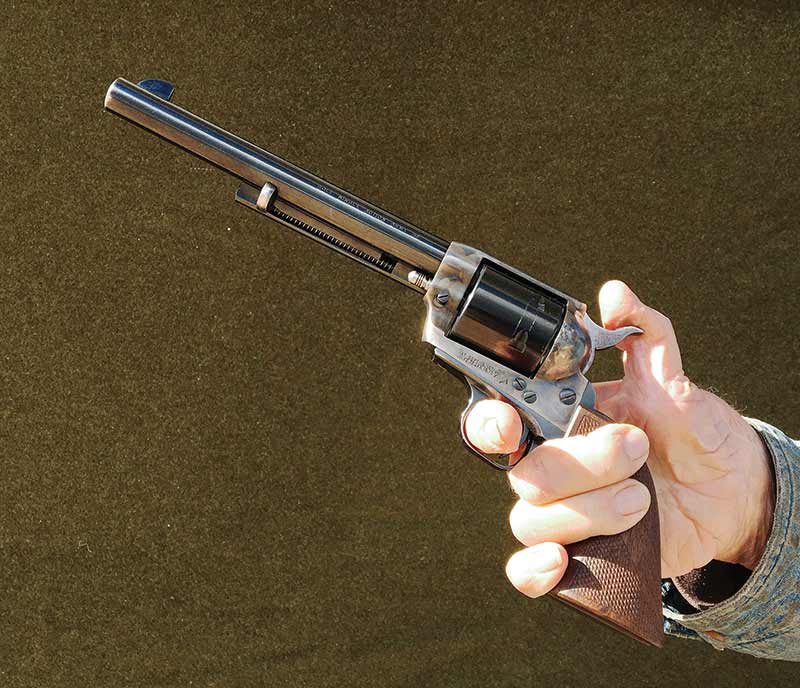
To throw down, raise the muzzle and hook the thumb over the hammer spur.
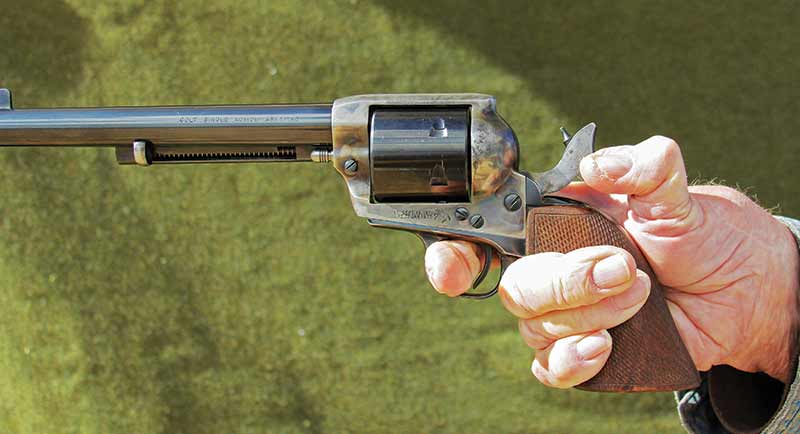
Fling the muzzle down as if popping a whip.
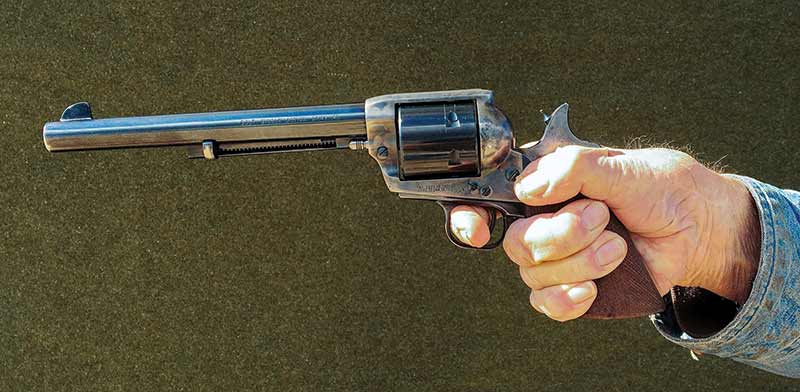
Complete the motion by sliding the thumb down onto the grip. When firing,
allow the recoil to drive the muzzle upward for easier re-cocking.
Why?
The original mainspring of the early 1st Generation Colt SAA was a whopping 0.127″ thick at the base! By the end of the 1st Generation production, Colt reduced the thickness to 0.080″. Over the last 148 years, the mainsprings have been reduced to less than half of the original — typical mainsprings on modern Colt SAA revolvers run 0.053″ thick.
So why was the mainspring so stout at first? Most likely it was due to the type of ignition used by the original .45 Colt cartridges.
For roughly the first 10 years, the cartridge used a Benet primer. The Benét primer looked like a rimfire cartridge but was a center-fire with the priming compound and anvil crimped inside the cartridge base. The firing pin had to hit with enough force to ignite the primer through the copper case. The Benét primer wasn’t replaced until the case design changed in 1882 to an external primer. We can assume the military had stockpiles of Benét primer ammunition to use up for much longer. Mystery partially solved.
John Kopec, a well-known authority on all things Colt SAA and co-author of A Study of the Colt Single Action Army Revolver, shed further light.
In the Colt records, regular and extra-strong mainsprings were sent as spare parts to the U.S. Army. Under what circumstances a mainspring would be replaced with an extra-strong version is not known but the strong mainsprings caused many of the soldiers to develop their own throwing down technique, which in turn causes problems.
The act of throwing down is violent and creates a great deal of energy in moving the cylinder. The original Colts had almost no bolt approaches and shallow bolt-lock slots. With the accelerated speed of the cylinder, it was common for the bolt to not lock in place and the cylinder to stop out of alignment. At best, this caused lead shaving as the bullet jumped the barrel gap. At worst, the revolver blew up. This happened enough the U.S. Army sent letters to Colt asking the design be changed. In the correspondence, this phenomenon was called “throwing past.” This can still happen today when gunsmiths lighten the bolt spring too much.
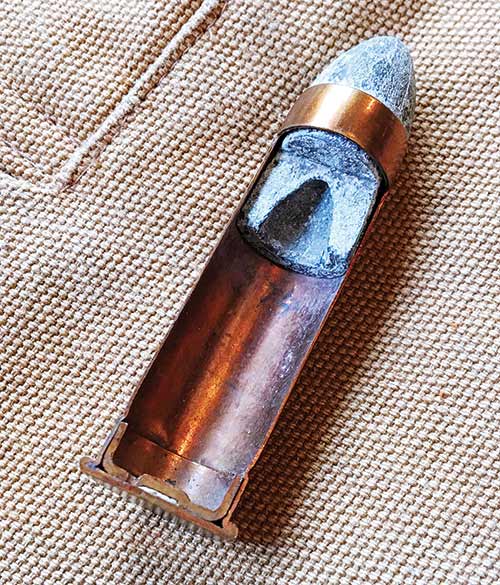
The Benét primer (left) was inside the case. The anvil was held in place by a crimp in the case sidewall.
Silver Screen Antics
Mystery solved, almost. In old silent movies, many of the actors were ex-cowboys, lawmen, even former outlaws who found a market for their unique skills. What we see on the screen — minus the melodrama — is them being themselves and acting out events using methods they used to survive. Those techniques were passed on for a while until Hollywood and Colt watered it down or washed it away altogether. As odd as it looks now, throwing down was real in the Old West.
While I don’t like eating crow, the quest Jim set me on opened my eyes to things I never knew about in a period of history I love. So, it’s like adding mashed potatoes, buttered rolls, and a slab of pecan pie to the crow I’ll gladly eat!