Keeping Ruger Single-Action Dates & Lingo Straight
What Sixgunners Needs to Know

An original Ruger Blackhawk and magazine ad. John Taffin photo credit.
Bill Ruger and the advent of his Ruger Blackhawk have probably done more to promote single-action sixgunners than any event in the world of thumb-cockers. After the release of the Ruger Single Six in 1953, the mid-frame Blackhawk quickly followed in 1955. Everyone thought Bill Ruger was crazy bringing out a “cowboy” style gun after Colt stopped making their SAA in 1941, but he proved naysayers just how wrong they were.
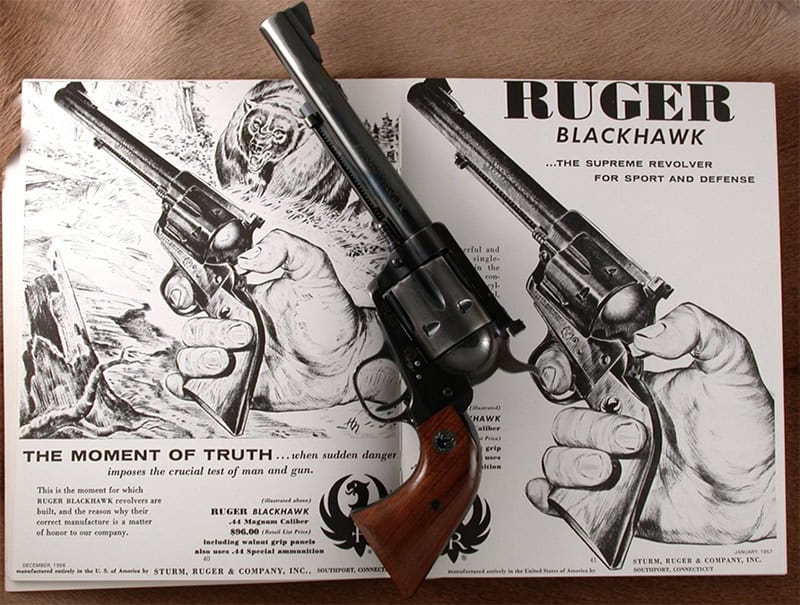
Ruger flat top .44 Blackhawk and magazine ad. John Taffin photo credit.
Success!
Both the Ruger Single Six and the Blackhawk were released with actions similar to those of the Colt SAA. That is, the hammer had to be cocked to fire and four distinct clicks could be heard while thumbing back the hammer. Too, the grip-frames were reminiscent of Colt’s, also. However, Ruger used stronger, more reliable coiled springs and frame-mounted firing pins for his guns, unlike Colt’s flat springs and hammer-mounted firing pins.
To prevent negligent discharges, Rugers had to be carried with the hammer over an empty cylinder chamber just like the Colt SAA. If the hammer was struck with a live round under the hammer, the gun would discharge. Greenhorns failing to heed the age-old advice were at risk of shooting themselves or others. Of course, a few negligent discharge incidents occurred, followed by lawsuits.
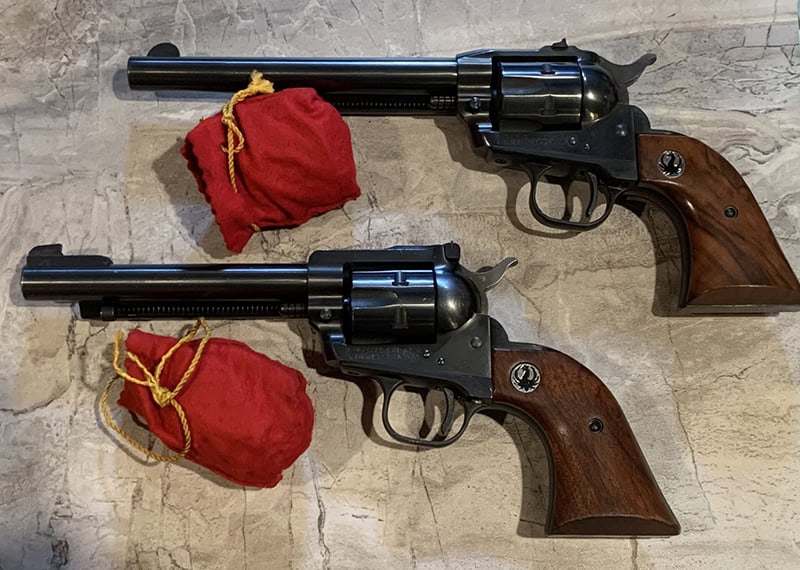
Old model single six and Super single six, below.
Super Blackhawk
The .44 Magnum followed in 1956 with a larger-framed Blackhawk, maintaining the flat-top profile and Colt-like aluminum grip frame. In 1959, Ruger released the Super Blackhawk, using a non-fluted cylinder, a steel dragoon grip-frame and adding ears to the top of the cylinder frame to protect the rear sight. The added weight answered requests for a heavier gun to help absorb recoil. The Super Blackhawk’s also had a high polish finish.
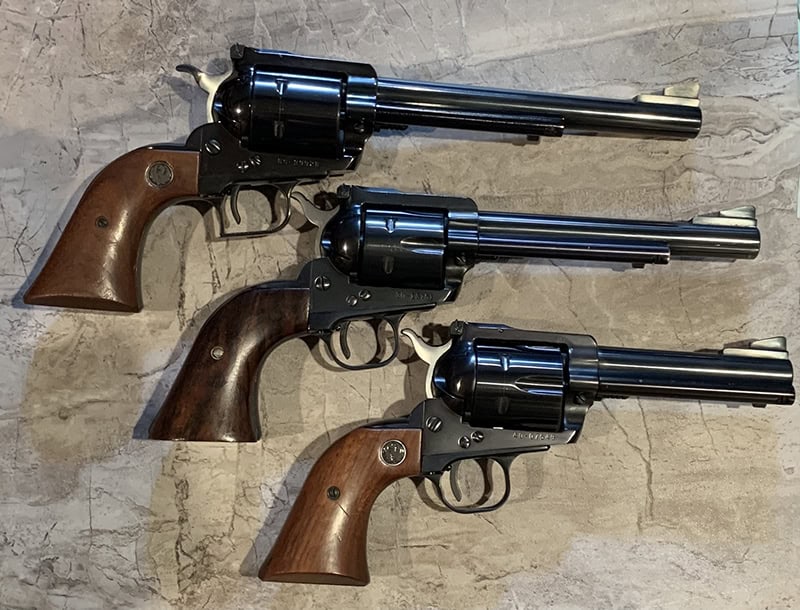
Super Blackhawk (top), flat top .44 Magnum Blackhawk (center), three-screw old model .41 Magnum (bottom).
Safety First
After several lawsuits, Bill Ruger did what had to be done. In 1975, he offered free conversions to “old model” three-screw guns and returned the original factory parts with the converted guns to encourage people to send their guns in. Conversions to old 3-screw guns were done at no charge, and guns built from 1973 were equipped with transfer bar safeties and referred to as “New Models.”
Now, single-action sixguns having transfer bars couldn’t be fired unless the trigger was pressed. Advantages included being able to carry your Ruger sixgun safely with six rounds loaded. Disadvantages included insulting sixgunners knowing how to safely carry their sixguns and taking away the classic rule of loading one cartridge, skip one, load four, so the hammer rested on an empty chamber, just as it’s been done for a hundred years.

New model flat top mid-frame .44 Specials.
New & Old Model
Now we have the distinction between “old model” or “three-screw” Rugers and “new model” guns having transfer bar safeties. The old model 3-screws, with a transfer-bar safety installed, were called conversion guns and made the guns safe to carry with six cartridges.
Lastly, some converted “old models” had a classification called “converted, with factory original parts included” for die-hard sixgunners wanting to reinstall the original parts to make their guns “correct” by converting them back to original condition with their bag of original parts when buying secondhand guns. It was kind of confusing for some shooters.
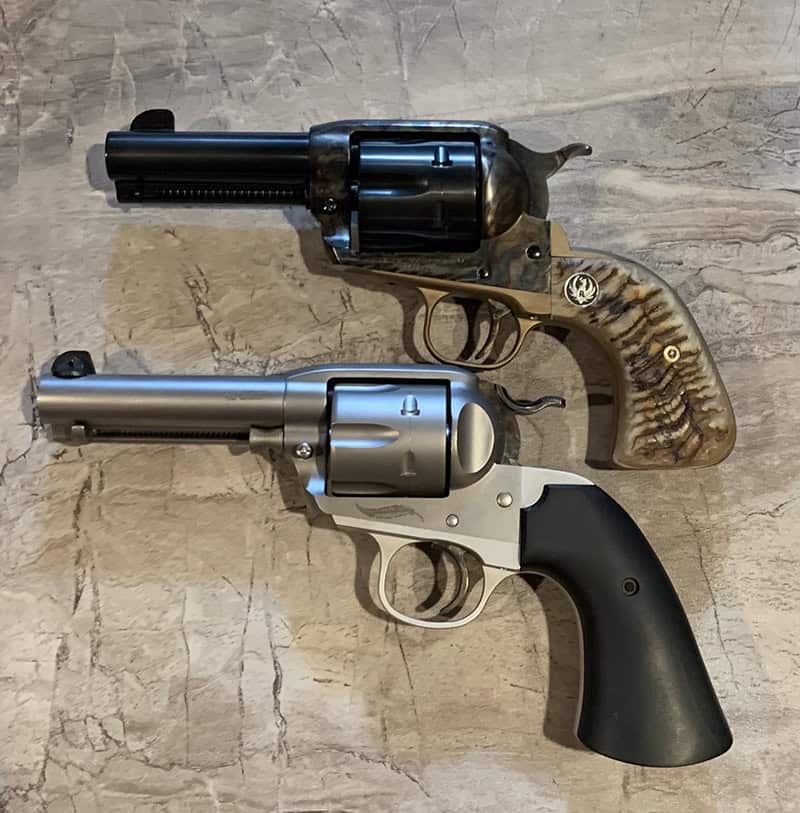
Large-frame (top) and mid-frame New Model Vaquero’s that have been customized by Tyler Gun Works.
Old & New Vaquero’s
Ruger released the “original” large-framed Vaquero in 1993, satisfying the demand of cowboy action shooters. These guns were built using the large Blackhawk frame, but with fixed sights, reminiscent of Colt SAA. The large-frame, or “original” model Vaqueros were made until 2005, when once again, cowboy action shooters wanted a gun more closely resembling the Colt SAA in size.
This was all well and good for the cowboy action shooters. They had it all, now. A gun having the relative size, fixed sights, and grip-frame as the original Colt SAA. The only problem now was that people referred to the original Vaquero as the Old Model Vaquero. This confused many people as the term “Old Model” was already delegated to the three-screw Blackhawk. All Vaqueros are New Model Vaqueros. They never had a three-screw model Vaquero. The New Vaquero is slightly smaller and features a mid-frame.
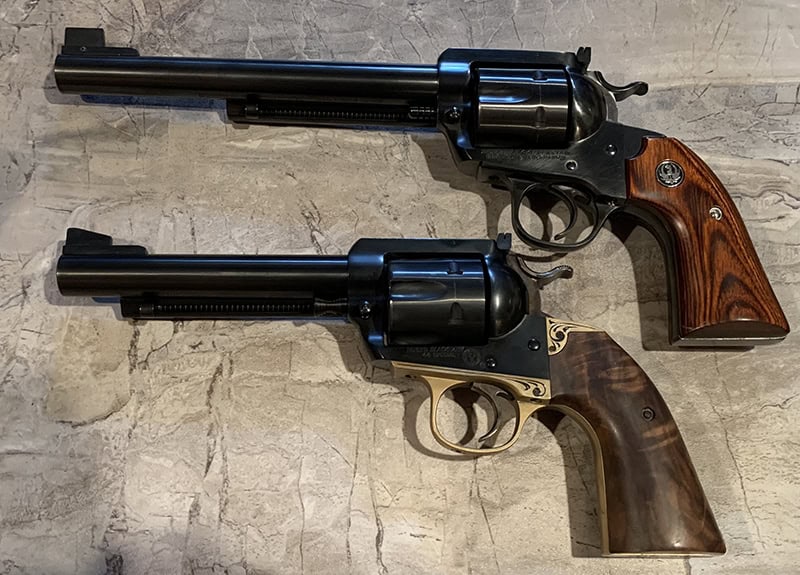
Mid-frame flat top .44 Special Bisley’s.
Handload Confusion
This also led to problems when handloaders started using “Ruger Only” .45 Colt handloads intended for large frame guns in the smaller mid-frame New Vaquero guns. Original large-frame Vaqueros are rated for 30,000 psi +P+ loads, while the mid-frame New Vaqueros are limited to standard .45 Colt loads of +P, up to 23,000 psi.
Using the Heavy “Ruger Only” 30,000 psi loads puts both the shooter and gun at risk.
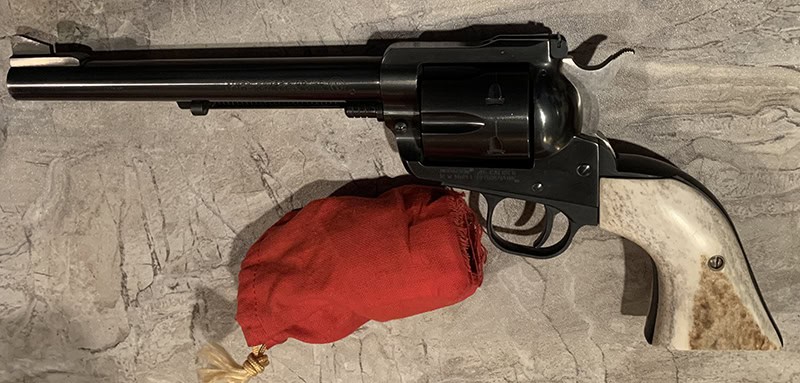
Pre-Warning New Model Blackhawk .45 Colt.
American Graffiti
As if taking away the 3-screw single-action sixgun wasn’t bad enough, in late 1977 to early 1978, Ruger added their Warning Label, “Please read instruction manual,” to the barrels of their guns because of product liability lawsuits. Now, a whole new classification of guns was established called “Pre-Warning” guns.
This really insulted sixgunners! To Ruger’s credit, they started printing the warning label on the underside of the barrel in 2005, making it less obvious.
Dated Material
There are some important dates as they apply to single-action sixgunners. I’m sure there’s more, but these are the ones I find important. Remember, keep your lead hot, your powder dry, and load one, skip one, load four if you have an original “old model three-screw” shooter. Above all else, have fun while doing it!
Get more Guncrank content every week!
By submitting this form, you are consenting to receive marketing emails from: . You can revoke your consent to receive emails at any time by using the SafeUnsubscribe® link, found at the bottom of every email. Emails are serviced by Constant Contact