Hammer & Knife Basics at its Best
Classic Tool Steel
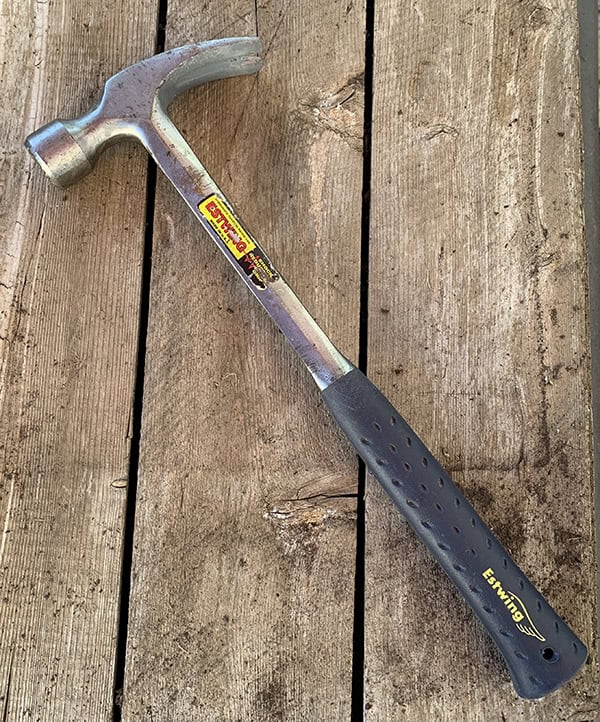
Tank’s well-used Estwing hammer is over 40 years old. Tank wonders, “how can that be?”
When breaking down the basic chores performed day in and day out, they can be simplified as hitting and cutting. Going back to prehistoric Cro-Magnon man, a rock was the most basic of tools. With it, he could pound things into the ground, use it as an impact weapon, and even make other tools. By striking obsidian rock with it, he discovered it chipped away into a glass-sharp edge. Using sinew, handles could be added for greater comfort and control.
Evolution of Tools
Over time, tools evolved with man. Stones were replaced with steel, and hickory shafts were attached to hammers and axes. Knife handles can be made from many materials, such as wood, horn, bone and synthetics. While the tools evolved and improved over time, the basic needs of pounding and cutting remained the same. With a hammer and a knife, you can conquer the world.
Hammer Time!
The basic claw hammer is used every day by millions of carpenters and homeowners. It basically remained unchanged until 1923. Every year, millions of hammers are rendered useless when their handles snap at the base of the hammer head. Sure, you can re-handle your hammer, but for professional carpenters, this means time away from the job — plus, it’s a nuisance.
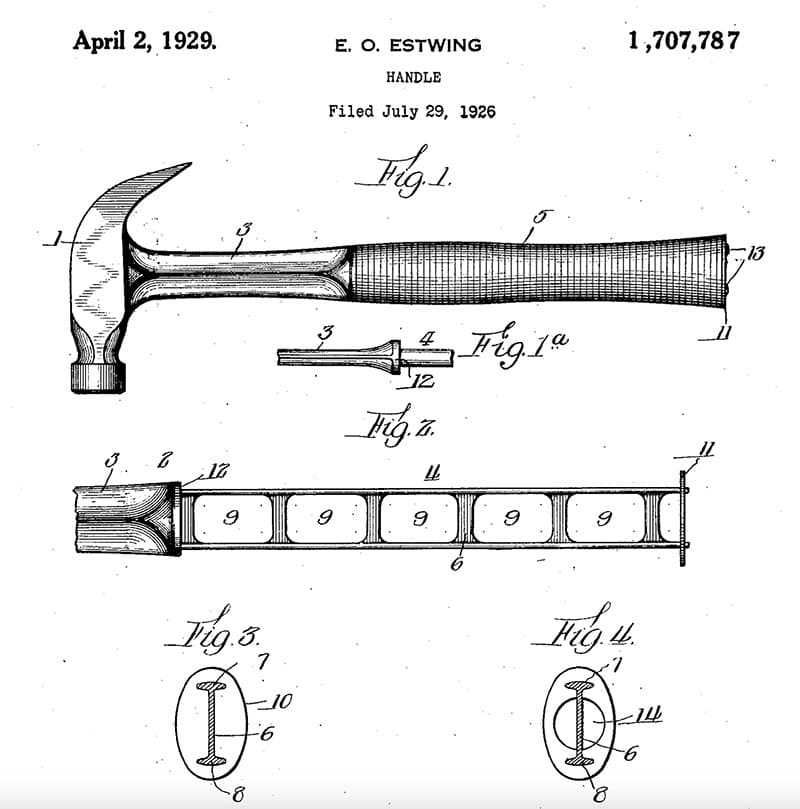
Patent for Estwing hammer.
Estwing Hammers
Ernest Otto Estwing invented the break-proof hammer! Born in Öland, Sweden, in 1885, he immigrated to the United States at the age of 16. An industrious young man, he settled in Rockford, Illinois, where he enrolled in night school to learn English and master the machinist’s trade while working in a machine shop.
He married Hulda Svenson in 1906 and moved to the East Coast, where he worked for Remington, repairing typewriters and for Bridgeport Manufacturing Company as an industrial engineer. By 1918, Hulda grew homesick for her family, and Estaing’s moved back to Rockford.
New Developments
Ernest continually came up with new inventions as a self-taught engineer, including a patented self-loading shotgun and several legendary hand tools, such as hammers, hatchets and hacksaws. He was aware of the limitations of wood-handled hammers and hatchets and came up with a solution. This was the basis for establishing the Estwing Manufacturing Company in 1923.
Ernest wanted to build the finest hand tools the world had ever seen — and he did, forging a single piece of steel for the hammer head and handle, creating a nearly indestructible tool. At the time, a regular hammer sold for $1 a piece; Ernest’s Estwing hammer sold for $2 but lasted a lifetime. This struck a chord with professional tradesmen. Gone were the days of spending hours re-handling your hammer during work hours.
Before passing away at the age of 97, Ernest saw his beloved Estwing Company grow and expand exponentially. The company he started in his basement now has product lines sold in leading hardware stores, home centers and retailers around the world.
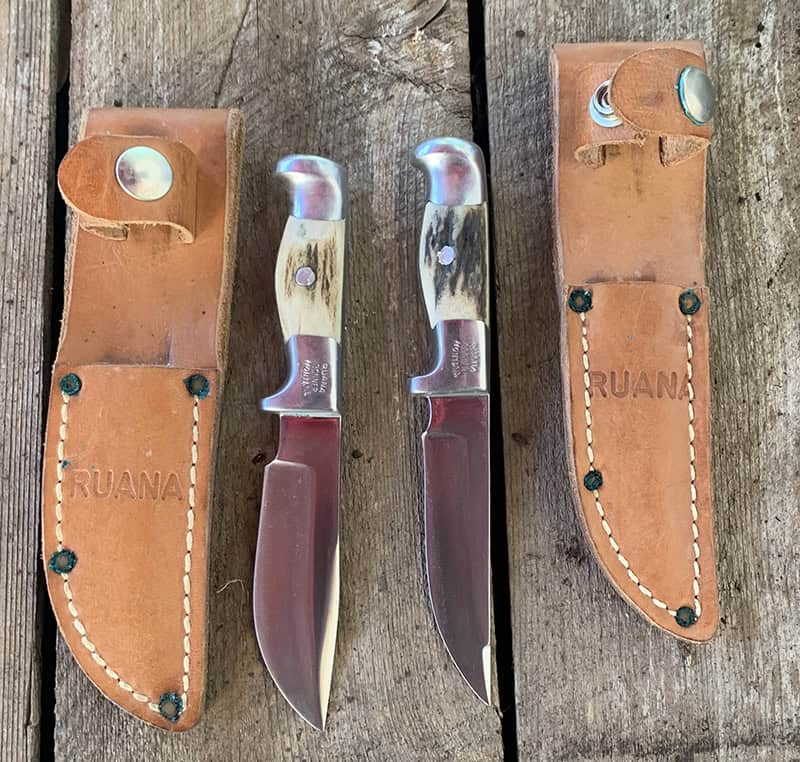
Two smaller belt knives favored by smoke jumpers and paratroopers.
Home Store
Estwing was founded – and is still located – in the northern Illinois city of Rockford, a city with a rich manufacturing history and home to many Swedish immigrants in the early 1900s, including its founder, Ernest Estwing. The blue and yellow of Estwing’s logo, the same colors of the Swedish flag, highlight the influence and importance of Ernest’s (and Rockford’s) Swedish roots.
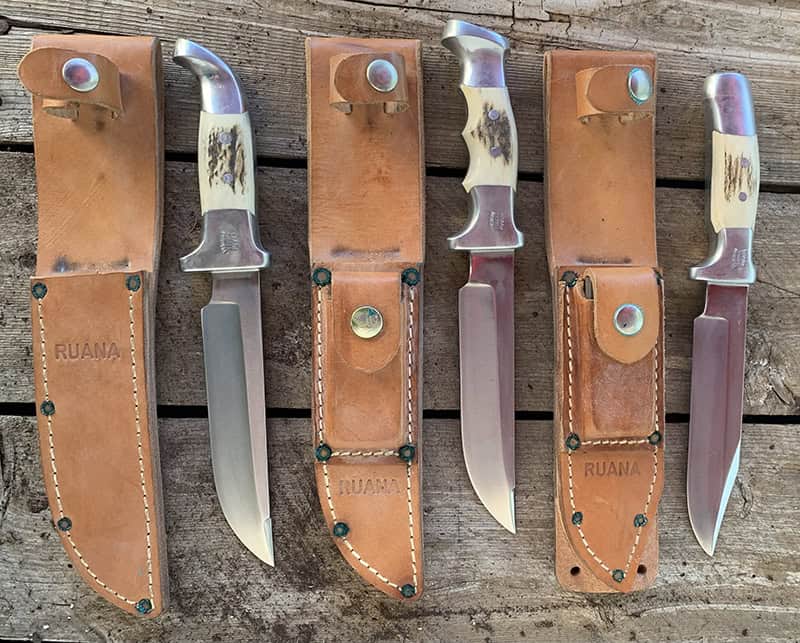
Three stickers suitable for camp and military duties.
My Experiences
During the early ’80s, I always worked construction between college semesters. Always appreciating nice hand tools, I noticed the more professional carpenters swung Eastwing hammers — and I wanted one! The longer one-piece steel handle provided more leverage, whether pounding nails or prying something. My hammer is now over 40 years old and going strong. When my daughter graduated from college, one of her presents was an Estwing camping hatchet she carries in her Jeep for off-road adventures.
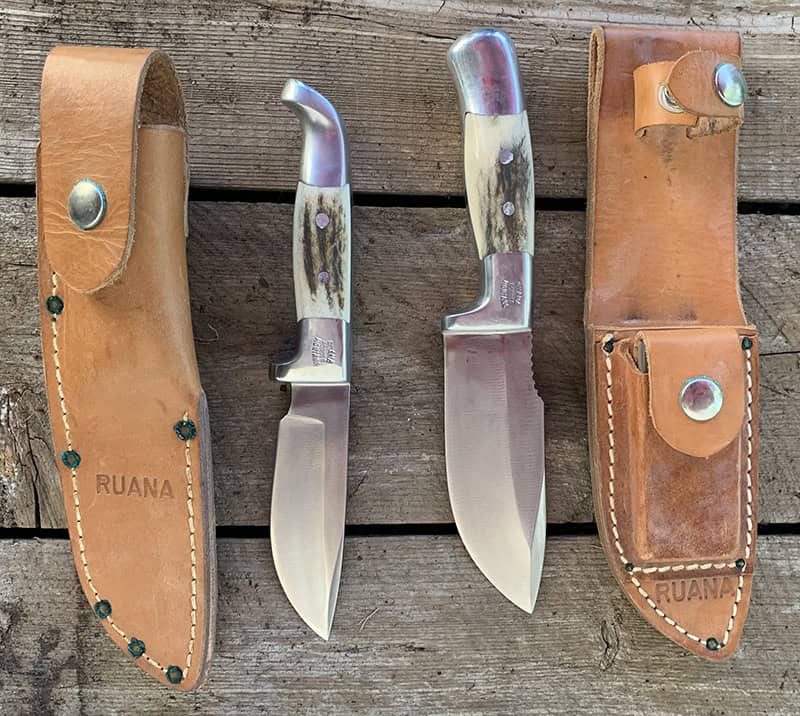
All purpose Outdoorsman blades. The style on above blade was favored by Elmer Keith.
Knives
I first became aware of Ruana Knives in the late 1980s. They were known for being robust, rugged knives used by guys who hunted elk and mule deer in Montana’s mountains. They also served a dual purpose, as many young men brought a piece of home with them, using the blades during wartime as utility knives and backup weapons.
The blade is made from a hand-forged leaf spring, while the handle is cast to the blade tang from molten aluminum. The handles are then fit with beveled elk antler. These knives caught my attention with a huge case of wanderlust eyes. The first blade I ordered was their small utility blade, described as “being used by paratroopers and smoke jumpers.” This really grabbed my imagination.
After receiving the blade, with its rugged leather sheath, I ordered another model. This ritual continued over the years until I had seven different blades, all having legitimate reasons for owning them, for any possible different scenario. Hey, you need to be prepared, right?
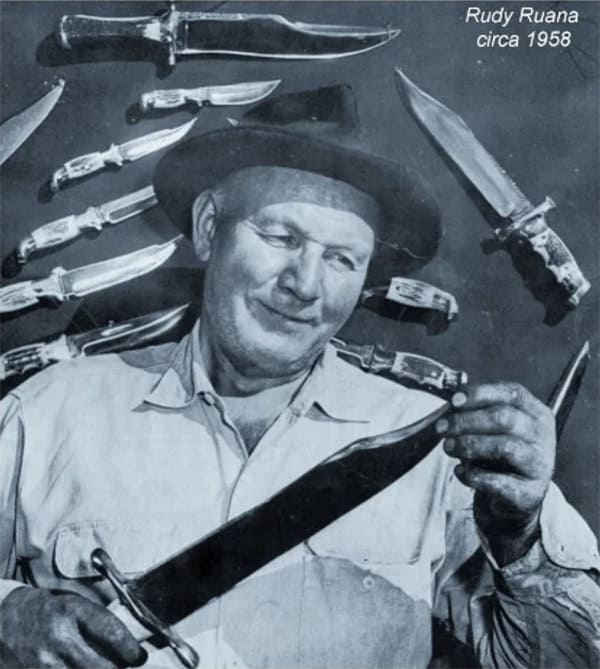
Here’s a picture of Rudy Ruana, the founder of the Ruana Knives!
Ruana History
In 1938, Rudy Ruana began making knives in a small Montana shop. Today, his family members continue to handcraft Ruana Knives in the same shop, in the same way Rudy did.
Rudy left North Dakota in 1938, before settling in a small community of Bonner, Montana and worked as a welder and mechanic. During the hard post-depression era, he started making knives to help the family survive, a skill he learned as a farrier when in the cavalry. He made his first knives for a couple of Native Americans in need of a better tool for skinning horses.
As time passed, and the reputation of Ruana’s knives grew, demand became so great that Rudy began making knives full-time in 1952, calling his business Ruana Knife Works.
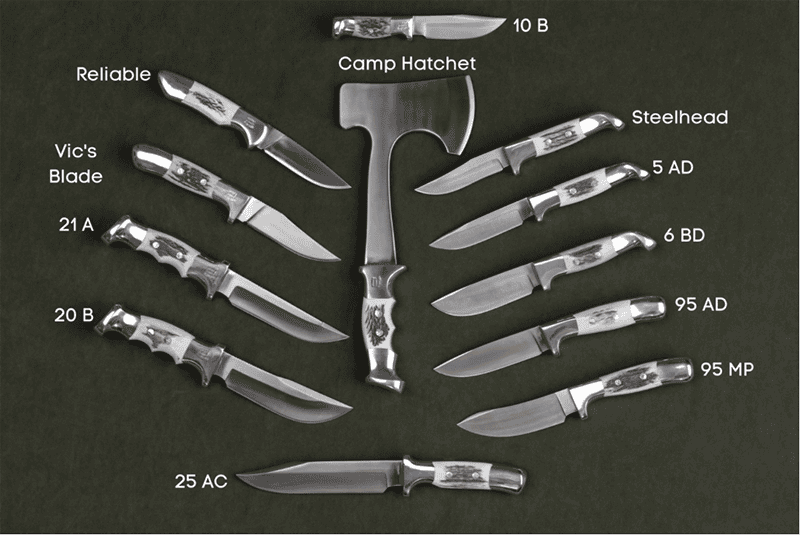
Sampling of Ruana knives made back in the day.
Testimonial
I can tell you first-hand, Ruana Knives are a testament to good, hand-forged blades. They hold an edge while being easy to re-sharpen. Skinning deer with a good knife is one of the finer joys in life. The cast aluminum/beveled elk-horn handles with an aluminum rivet are a dead giveaway for the knife’s identity you’re carrying. I take pride in having a truly legendary Montana knife made the Ruana way.
I feel the same about my Estwing hammer. Like quality guns, quality tools have a knack to rekindle memories from long ago. Besides framing hammers, Estwing makes hammers/hatchets for geologists, astronauts, farriers, heavy metal workers, and a host of others. The stacked leather washer handle hammers may have inspired the famed KA-BAR knife used in World War II. With a Ruana knife, an Estwing one-piece hammer, and some common sense, there’s nothing you can’t conquer in this world.
Get More Guncranks Every Week!
By submitting this form, you are consenting to receive marketing emails from: . You can revoke your consent to receive emails at any time by using the SafeUnsubscribe® link, found at the bottom of every email. Emails are serviced by Constant Contact