The Rise and Fall of the
Cutts Compensator
Taming the Kick 100 Years Ago

The Cutts Compensator is considered the first commercially successful muzzle device and a vital part
of the iconography of the late-model Thompson submachine gun. Photo: Will Dabbs, MD
If you’ve ever stared at the snout of a classic Thompson submachine gun or an old skeet gun from the 1930s, you’ve probably noticed a fat, slotted muzzle device that looks like it belongs more on a plumbing fixture than a firearm. This is the Cutts Compensator, a clever contraption once hailed as the future of recoil control and now remembered as both a quirky footnote and a collectible relic of American gun history.

The Lyman Cutts Compensator was often seen on shotguns. Aside from reducing recoil, the later models added
in adjustable choke tubes — a shotgun feature that didn’t become widely popular until the 1970s.
Origins
The story begins with Colonel Richard Malcolm Cutts of the U.S. Marine Corps. In the years after World War I, he wanted to reduce the way rifles and machine guns kicked when fired. Muzzle “brakes” had been around for at least 20 years — though the principles had been understood nearly as long as gunpowder firearms had been in use — but had mainly been on field artillery. Cutts took the concept and scaled it down for rifles, resulting in the first commercially successful muzzle device.
The device worked by venting some of the burning powder gases upward and sideways through a carefully slotted device on the muzzle. By Newton’s laws, the escaping gas pushed the barrel down and back, reducing muzzle climb and helping the shooter keep the sights on target.
Cutts and his son, Richard Jr., refined the idea throughout the 1920s, eventually patenting the design. But they didn’t just stop at the military market. Colonel Cutts believed the invention could revolutionize sporting shotguns, especially for trap and skeet shooters. In an era when most shooters considered recoil an unavoidable fact of life, the thought of taming it with a simple screw-on device was revolutionary.
Popularity
The Cutts Compensator hit the big time when paired with the Thompson submachine gun. The “Tommy Gun” was already famous (or infamous) thanks to gangsters and G-men, but shooters knew controlling a .45 ACP buzzsaw at 800 rounds per minute isn’t easy. The Cutts helped reduce muzzle rise and gave shooters a fighting chance at keeping bursts on target.
By 1930, Lyman had purchased the rights from Cutts and began marketing the Cutts Compensator to hunters and clay shooters. They offered not only the compensator body but also a system of screw-in choke tubes, decades before screw-in chokes became popular. Trap and skeet shooters embraced the system in the 1930s through the 1950s. A long, ported Cutts sticking off the muzzle of a Browning Auto-5 or Winchester Model 12 became a familiar sight on American trap fields.
Advantages and Disadvantages
On paper, the Cutts delivered real benefits. It could reduce felt recoil and muzzle climb by a noticeable margin — reports from the time claimed 30 to 45 percent less recoil on some loads. The added muzzle weight also helped shotguns swing more smoothly, a real bonus on crossing birds, though the added mass is an issue on doubles. Obviously for the Thompson, every little bit of controllability helped.
But there were impossible-to-ignore drawbacks. The device added bulk and weight to the front of the gun, making it ungainly. Gas venting made the blast louder and more concussive, particularly to shooters standing nearby. Shotgun purists complained that the Cutts ruined the clean lines of their fine doubles and pumps. On the Thompson, the compensator was effective but also finicky — soldiers in the field sometimes found the device dented, clogged or otherwise a liability. It also tended to deafen and blind those standing nearby in a close fight. It was also expensive, so most issued Thompsons never came with a Cutts.
Factory Thompsons of the 1920s and ’30s are considered the O.G. of the Cutts Compensator, but on the sporting side, Browning Auto-5s, Winchester Model 12s, and Remington Model 11s were commonly fitted at the factory or by Lyman. If you find a 1930s skeet gun with a stubby barrel and a fat compensator, chances are good it came that way from new.

Nowadays, recoil reducers come in a limitless palette of designs — and effectiveness. Photo: Jeremy Clough
Decline: Technology Moves On
By the late 1950s, the Cutts Compensator’s star was fading. On the military side, new flash hiders such as on the M14 rendered it irrelevant. Civilian shotgun shooters gradually abandoned the bulky system as manufacturers introduced lighter, simpler screw-in choke tubes that offered the same versatility without the blast and weight penalty.
By the 1970s, the Cutts was seen as a relic. Shotguns wearing one were often considered “butchered” compared to original barrels, which hurt resale values. Gunsmiths routinely cut them off and rethreaded barrels for modern chokes.
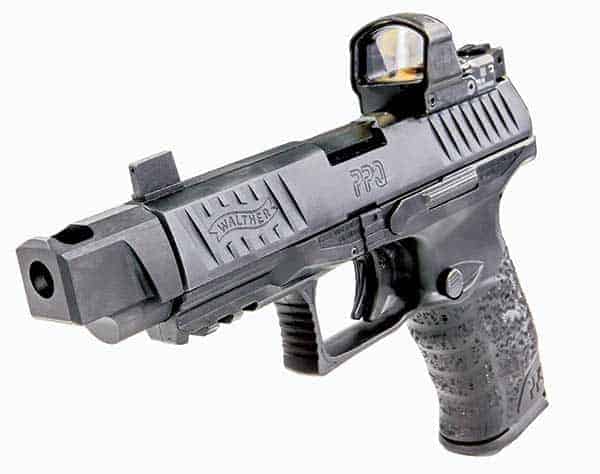
Handgun compensators had been around for decades, but were primarily the province of the competitive shooters until the 2000s.
Now, there are many factory or bolt-on options, such as this Walther PPQ 9mm Compensator from Jarvis Inc.
The Stuff of Shooting Lore
Despite decline and extinction, the Cutts holds a special place in gun lore. It was one of the first widely marketed muzzle devices, a direct ancestor of the countless brakes, comps, and hybrid devices you can buy today. Every time you screw in a variable choke tube to your duck gun or admire the tuned compensator on a competition pistol, you’re looking at the legacy of Colonel Cutts’ idea from a century ago.
It’s also burned into pop culture thanks to Hollywood gangster flicks. To many, without the Cutts, the Tommy Gun just doesn’t look “right.”

Nearly all modern rifles come with either threads for muzzle devices, such as suppressors, or a well-designed factory brake,
like this one on a Springfield Armory Waypoint Rifle. It’s a far cry from the bulky Cutts models of 100 years ago! Photo: Jeff Hoover
Collectability Today
Here’s where it gets interesting. For years, a shotgun with a Cutts was worth less than one with an original barrel, but collectors have started to come around. A pristine Winchester 12 Skeet Grade with a factory-installed Cutts now carries nostalgia value. Among Thompson collectors, the compensator is absolutely essential for authenticity. Different generations of Cutts — marked with varying logos and stamps — are studied, cataloged, and traded with the zeal of coin collectors. Rare early-marked versions can fetch serious money.
As for shooters, some still appreciate the smooth swing and soft recoil on a skeet field, while others install them simply for the retro cool factor. They may no longer be state-of-the-art, but the Cutts remains a conversation piece every time it shows up at the range.
The Cutts Compensator was born from one Marine’s determination to solve the age-old problem of recoil. It rose to fame on the Thompson and on trap fields across America, only to fall out of favor as technology marched on. Today it sits at the intersection of history, nostalgia, and collector obsession — a reminder that even an odd-looking gadget can leave a permanent mark on the shooting world.
Want more online exclusives from GUNS delivered straight to your inbox? Sign up for our FREE weekly email newsletters.