The "Other Guy" at Ruger: Alexander Sturm
The “Baron” of American Gun Companies

The young founders of Sturm, Ruger & Co. – Bill Ruger (left) and Alexander Sturm (right).
If you spend any time around the firearms world, one name dominates the story of Ruger: William Batterman Ruger, or “Bill Senior,” as he was often later known. Ruger was the engineer, the relentless tinkerer, the man with the mechanical instincts who could turn steel and springs into a profitable idea. His personality — and his long life — naturally put him at the center of the company’s mythology.
But Ruger’s name appears second in the company’s title.
The other half belonged to Alexander McCormick Sturm, a man whose personality and background were so unusual that he almost feels like a character from a novel rather than the co-founder of one of America’s most successful firearms companies.
Ruger built the guns, but Sturm made the company possible. He was also one of the most interesting characters ever connected to the American gun business.
Silver Spoon
Sturm was born June 23, 1923, in Westport, Connecticut, into an Ivy League family where creativity and accomplishment were practically expected. His father, Justin Sturm, had been a Yale football player who later became both a sculptor and an author. His mother, Katherine “Kit” McCormick, came from the wealthy McCormick mercantile family. Sturm grew up surrounded by art, culture, and money — unusual for gun-company founders.
He attended Yale University, where his artistic streak showed early. Before even graduating, he had already written and illustrated two children’s books, The Problem Fox and From Ambush to Zig-zag. A New York Times reviewer called The Problem Fox “marvelous” and “a little masterpiece.” This accomplishment alone would have been a respectable career path, but Sturm wasn’t exactly the quiet literary type.
Renaissance Man
The descriptions of Sturm from people who knew him paint a larger-than-life picture. One classmate remembered that while other students were eating in the dining hall, Sturm preferred to dine at the best hotel in town. He wore custom-tailored clothes, traveled frequently to New York on weekends and carried himself like a man who belonged in a gilded carriage.
He was also a collector of guns, swords, canes, and heraldic symbols — all things hinting toward a slightly medieval aesthetic he enjoyed. Despite apparently preferring indoor pursuits, he was also an accomplished polo player and shooter.
In short, Sturm was something of a Renaissance man: artist, writer, sportsman, collector and social butterfly. People described him as sensitive and artistic, yet physically strong and almost imposing.
Bill Ruger later recalled the first time he introduced Sturm to a prominent magazine editor. Sturm showed up wearing an elaborate green suit with decorative cuffs and trimmings, sporting a beard and carrying himself like a pre-war German aristocrat. Ruger said he looked like a “baronial type” but was also “a bull in the woods.”

Alexander and Paulina Sturm on their wedding day.
Roosevelt Connection
Like many men of his generation, Sturm’s life was interrupted by World War II.
He served as an officer in the Office of Strategic Services (OSS), the wartime intelligence organization that eventually evolved into the CIA. While working in Washington, he met Paulina Longworth. Paulina was the daughter of Alice Roosevelt Longworth and the granddaughter of Theodore Roosevelt, from one of the most celebrated families of the era. Alexander and Paulina married in 1944 and later had a daughter, Joanna. The couple settled in Westport, living on family property near Sturm’s parents.
Even here, the story feels slightly improbable. The eventual co-founder of a legendary firearms company marrying into one of the most prominent political families in American history.
The pivotal moment in Sturm’s life came in 1949. He became friends with a young gun enthusiast, tinkerer and visionary named Bill Ruger. Ruger had a promising design for a .22 pistol, but lacked the capital to turn it into a business. Sturm certainly had money, and the improbable pair formed a legendary company.
Sturm invested $50,000 — about $670,000 in 2026 dollars — to start the company that became Sturm, Ruger & Co. Ruger contributed the mechanical expertise and design work, while Sturm handled the finances and branding.
The branding included the company’s famous heraldic eagle. The red eagle design (not a phoenix as commonly believed) reflected Sturm’s fascination with heraldry and medieval symbolism, and it quickly became one of the most recognizable logos in the firearms world.
In the earliest days of the company, Sturm wasn’t just an investor sitting in the background. He answered letters, kept records and helped build the business from the ground up. His wife, Paulina, helped too — stuffing envelopes and assisting the two founders on Sunday afternoons. It was a very small startup, built with equal parts engineering talent and faith. This part of the story is typical of the firearms industry.
Tragedy Strikes
Unfortunately, the company had barely begun to gain traction when disaster struck.
In 1951, Sturm suddenly fell ill with viral hepatitis. After only about 10 days in the hospital, he died at the tender age of 28. According to other published reports, the official cause of death was “cirrhosis of the liver caused by heavy drinking and malnutrition.” It wouldn’t be unusual back in the 1950s to sugar-coat such indelicate matters in the press (not that it ever happens today with celebrities!), so it is quite possible his love of alcohol was substantial.

A photo of Paulina Longworth Sturm and her mother,
Alice Roosevelt Longworth. The tiny smirk on Paulina’s face
may reflect the well-known tempestuous streak of her mother.
Alexander wasn’t the only Sturm to meet with fate early. His wife, Paulina, fell into depression after his death and died from an overdose of sleeping pills on January 27, 1957, after being found by 10-year-old Joanna. There is still speculation as to whether the overdose was accidental or intentional, though her obituary notes, “Coroner A. Magruder MacDonald said he understood Mrs. Sturm had been under the care of a physician.” Talk about a loaded sentence!
While researching this story, I discovered household drama ran deep. It turns out Paulina was biologically the daughter of William Borah, a Republican Senator from Idaho who was 59 years old when Paulina was born. I’m sure this was an uncomfortable topic, considering the legendary hell-on-wheels Alice was married to Nicholas Longworth at the time. One interesting tidbit: Paulina’s parentage from an illicit affair was a well-known “secret,” and she went by the nickname “Aurora Borah Alice” (a play on Aurora Borealis, the northern lights) as a child.
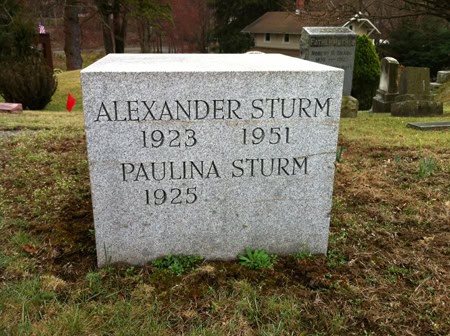
Paulina Sturm was buried next to her mother in Washington D.C.,
not next to her step-father, biological father or husband as is tradition,
apparently due to some long-forgotten grudge of Alice Roosevelt Longworth.
One final familial ruckus — Paulina was buried next to her mother in Section F, Lot 51 of Rock Creek Cemetery in Washington, not with her father, stepfather, or husband, allegedly because Alice Roosevelt Longworth had a well-documented mean streak and held a grudge.
In today’s parlance, Sturm clearly married into a “hot mess” of a famous family, and it’s easy to recognize at least one possible reason why Alexander Sturm allegedly liked to pull a cork.
Regardless of all the Sturm domestic intrigue, Bill Ruger was deeply affected by the loss of his partner and friend. As a tribute, he changed the company’s logo from red to black — a subtle mourning symbol still in use. After Bill passed, the company has been known to use red, black, silver, grey and a few other eagles through the years on different firearms and with subtly different versions of the logo.
Time Passes
Bill Ruger went on to build the company into one of the giants of the American firearms industry, but the name never changed, and Sturm remains first in the company name to this day.
Because Sturm died so young, history mostly remembers Ruger — understandable considering Ruger spent the next 50 years building the company, designing firearms, and shaping the modern American gun industry.
But the more you look into Alexander McCormick Sturm, the more fascinating he becomes:
• A Yale-educated artist who wrote children’s books.
• A polo player who collected swords and heraldry.
• An OSS officer who married into the Roosevelt family.
• A stylish eccentric who dressed — and acted — like an aristocrat.
Yet, beyond all these interesting mannerisms, he’s mostly remembered as the man who put up the money to create one of the most successful firearms companies in American history.
I’ve never met anyone who actually knew Alexander McCormick Sturm, as the circle of people who did has long since disappeared. But after studying his life, he’s definitely on the list of historical characters I’d like to meet someday — provided his mother-in-law wasn’t around!
Want more online exclusives from GUNS delivered straight to your inbox? Sign up for our FREE weekly email newsletters.