The "Shooter" D&L Sports MR-30PG
In The Court Of The Black King

The result of nearly five decades of careful development of both
rifle design and technique, the D&L Marksman’s Rifle-30 Caliber,
Professional Grade — aka The Black King — is a purpose-built
implement for when lives are on the line.
Sometimes you test the gun, sometimes the gun tests you. Thus it is with the D&L Sports’ MR-30PG — also known as the “Black King” — which has been putting me to the test. If the nickname sounds familiar, it should: It was the centerpiece rifle for the USA Network series Shooter, based on the successful Bob Lee Swagger novels by Stephen Hunter. While the book used a Winchester as the Black King, the TV series chose the D&L rifle with its distinctive King of Spades grip.

While many other precision rifles have the level attached to
the scope mount/rings, the MR-30PG has it neatly tucked
into the stock where it is visible but well protected.

The stock contains an inset compass, mandatory for calculating the Coriolis Effect. Tru-Nord provides compasses calculated either for magnetic north or a specific lat/lon.

Slots machined in the chassis make it immediately obvious
whether or not there is a magazine in the rifle. The Black King
uses tuned Accuracy International magazines.
Meet the Man
You should also know D&L’s founder Dave Lauck. Former American Pistolsmith Guild Pistolsmith of the Year, Lauck’s prowess is impressively broad, ranging from single action revolvers, 1911s used by Texas Rangers, an innovative set of sights and dot mounts for DA revolvers and, of course, precision rifles for which Lauck has been a technical consultant for Hunter. Lauck comes naturally to it — descending from gunsmiths who armed the American revolution and helped developed the iconic Kentucky long rifle — and has himself has been quietly behind a number of innovations stretching out over decades.
One is a focus on the accurate AR15 that began years before seemingly everybody had three ARs and a multitool. Lauck’s experience as a rifleman, including both competition and longtime service as SWAT officer filling countersniper, training and other roles, firmly convinced him of the utility of a two-gun system — a very accurate AR which he called the professional perimeter carbine or “PPC” for close-to-intermediate range, and a heavier caliber bolt gun for intermediate to long distances. Together, the pair works from 0-1,000 yards.
Like the PPC, the MR-30PG (Marksman’s Rifle, 30 caliber, Professional Grade) didn’t just pop into being. First, “professional grade” tells you that while successful in competition, it is intended primarily as a static position, one-shot rifle for when human lives are on the line. This drives every feature beginning with the action. Lauck began building custom Remington 700-based rifles in the 1970s and the 700 action was an option on the first MR-PG rifles, largely due to its ubiquity among law enforcement and military shooters.
A longtime competitor, Lauck won the 1990 tactical rifle event at the storied Soldier of Fortune match in Las Vegas and founded the International Tactical Rifleman Championship. Held at several ranges in Wyoming, the ITRC ran from the ’90s to the aughts and was a precursor to PRS competition. Like Col. Jeff Cooper’s storied Leatherslap competitions, it attempted to duplicate real-world conditions to determine what actually works. The demanding stages included handgun, carbine and rifle, multi-mile hikes and firing from moving vehicles including aircraft and boats, an amount of awesome for which I personally am not yet prepared.
As expected, there was equipment failure which turned Lauck from using the 700 action to a modified version of the match-bred Nesika Bay action incorporating his suggested improvements to the extractor and ejector. These have since been incorporated into his own signature action, which has a one-piece bolt body/handle stem, fixed ejector and controlled feed. The fixed ejector is so the shooter can decide whether they want the casing flung clear or dropped back into the action when cycled.
Long favored by those who pursue dangerous game, controlled feed actions keep the ascending cartridge completely under the control of the extractor throughout the feed cycle. Think M1911, where a cartridge slides up the breech face directly under the extractor hook, as opposed to the push-feed AR extractor that snaps over the case rim as the bolt closes on a chambered cartridge. More compact than the traditional full-length Mauser claw extractor, Lauck’s is neatly held in place by a t-slot and though it can be driven home onto a cartridge dropped into the chamber in an emergency, it should not be absent exigent circumstances. A helpful warning to this effect is marked on the barrel.
The enhanced Accuracy International magazines are held in place by a downward pivoting mag release on either side of the trigger guard reminiscent of the HK USP and equipped with a knurled lock screw to avoid intermittently dropping a mag. Slots on either side of the magazine well show at a glance whether there’s one in the gun. The safety on the test gun is located inside the trigger guard but can also be on the top of the stock. The pinned-in Triggertech Diamond trigger assembly breaks at an unbelievably crisp 1 lb., 7.3 oz. on my Lyman digital scale.

THE MR-30PG’s magazine release pivots downwards, reminiscent of the HK USP pistol, with a captured locking screw to make sure it’s not accidentally released.

A well-known brand in the benchrest world, this first-focal-plane MOA
model comes with an illuminated reticle, zero-stop capability and the
option of having turrets custom engraved with your comeups.

The aluminum chassis incorporates an integral carry handle
underneath in front of the magwell to the bottom of the forend
reinforces the stock in flying buttress fashion.
Bedtime
The aluminum chassis uses no added bedding compound and incorporates an additional strap across the front of the action and an integral carry handle stretching from the front of the magwell to the bottom of the forend, reinforcing the stock in flying buttress fashion. Pic rails are bolted in place at the 3 and 9 o’clock positions with larger-than-usual 10/32 screws and the bottom of the forend is equipped with a row of threaded holes for sling, bipod or other mounts. The butt is adjustable for length of pull and cheek height.
Perhaps the most visually distinctive part of the Black King is the scope protector. Not only do the 1/4″ thick aluminum hoops provide substantial protection for the optic, it serves as a carry handle or support for camo netting and Lauck offers a harness purpose built for slinging the rifle with scope protector installed. Like everything else on the rifle, all corners and edges have been carefully chamfered to avoid snags. Even the various screws are either button-head or countersunk.
As a hard-use rifle, Lauck intended the MR-PG be as self-contained as possible. The stock has a knurled elevation knob at the toe to serve as a rear monopod, and a compass and level are built into the top. The March 2.5×25 scope also incorporates this principle with a range-finding reticle Dave designed after watching marksmen struggle to make complicated distance calculations under the stress of competition.
Previously offered by Leupold, the version of Lauck’s reticle used on March scopes includes a duplex vertical crosshair and a fine line horizontal one with dots spaced out to represent 3″ at 100 yards. This provides a quick cross-face ranging capability out to 200 yards, while the bottom of the reticle contains eight inverted “T” brackets sized for 10″ high and 20″ wide (head height and shoulder width) marked for 300-1,000 yards. While those outside the precision orbit may not be as familiar with March, they are highly regarded in the benchrest world. This first focal plane, MOA model comes with an illuminated reticle, zero-stop capability and the option of having turrets custom engraved with your comeups.

Officially christened the MR-30PG, the Black King gets its
nickname from the King of Spades on the 1911-style grip panels.
It appears throughout the USA network Shooter series.
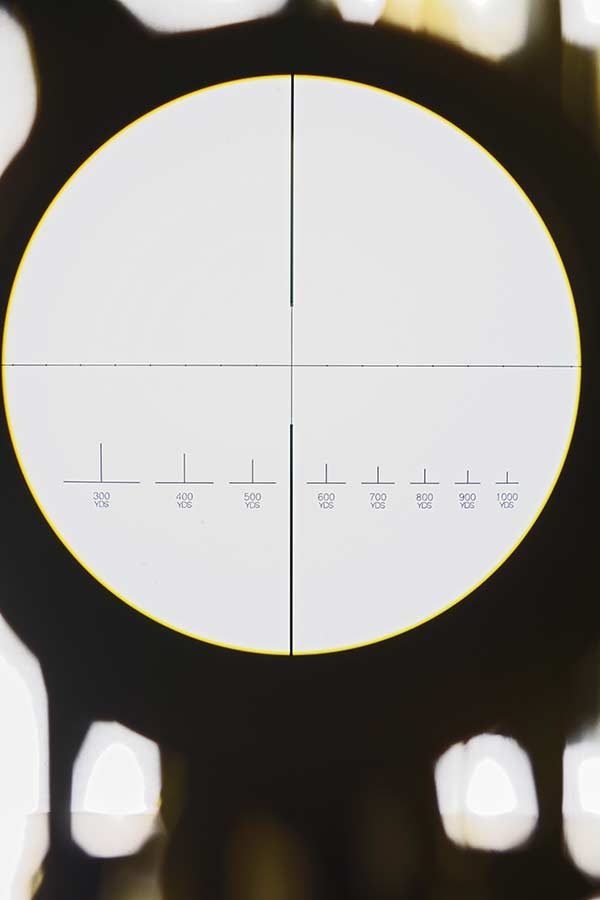
The March 2.5x25 scope incorporates a Lauck-designed
range-finding reticle previously offered by Leupold. The
inverted “T” brackets are sized for 10" high and 20"
wide — head height and shoulder width.

A few of Jeremy’s recent 100-yard targets: 1 round, 3 rounds
and 5. DoubleTap Ammunition provided the ammo for the
excursion to Gunsite and Black Hills provided the rest.

Jeremy’s been shooting a lot of 9mm lately … including this
casing at 100 yards. The Black King and a generous supply of
ammo from Black Hills are making him a rifleman!
Traveling King
When Lauck offered to send me a Black King, I had only one problem: zero prowess with a precision rifle. Sure, I could put bullet holes close, sometimes, but the rifle came with a 200-yard test target that was one hole, a fair bit tighter than my usual capability. I knew it would take time to develop the skill to cover the rifle, since I was learning an entirely new discipline, but Lauck generously agreed to give me the time I needed to do just that. Indeed, for the past couple years, the Black King has not only been the standard by which I have judged other rifles, but primarily by which I have judged myself.
Each MR-PG is custom built for the individual user, with caliber, twist rate, barrel profile and length, etc., selected for the specific application. While .338 Lapua and other longer-range calibers are available, I requested a .308 due to ammo availability and the shorter distances in the Southeast.
So far, the Black King has gone with me to North Carolina, Virginia, Tennessee and Arizona, but most frequently to the 100-yard range at my gun club where, session after session, I go after the work of trying to shoot to its limits. While I often use a Ransom Master Rest for rifle testing, I chose to shoot the Black King as it was intended with its bipod, sometimes adding a rear bag.
I took the Black King to Gunsite for a little hands-on instruction. Zeroing under the watchful eyes of Rangemaster Lew Gosnell and instructor Aimee Grant, my first group strung about 1/4″ wide and a couple inches high. Gosnell and Grant, both former Marines, quickly diagnosed me as continuing to breathe while breaking the shot. Pistol habits die hard: I focused on finding my natural respiratory pause.
When our class lined up prone on a 20º morning, I put three in the same splash on the head of a Pepper Popper at 300 yards. Unfortunately, I used a little Kentucky windage rather than fine-tune my zero, which cost me dearly at 600. With that concrete example of how long-range requires as much operator headspace as rifle accuracy, and a generous supply of 168-grain boat tail hollow point ammo provided by Black Hills, I devoted myself to seeking consistency. The fine crosshair intersection — there’s no dot — allows superb precision. The barrel measures 25 ½” from breech face to the end of the nine-port muzzle brake, tapering from roughly an inch to 0.850″. Together with the soft Limbsaver recoil pad, recoil is simply eliminated. The action is glass smooth and the trigger breaks at the speed of intent. And oh, it stacks bullets. Can I give you an accuracy chart, showing its precise mean group size? No. But it’s better than 1/4″ at 100 yards, because that’s what I manage on good days.
With the Black King, you save money on targets: Once you chew out the X, there are always those little numbers … or the staples holding the targets up. I began taking cold bore shots at 100 yards using a small metal disk the size of a penny. I’ve only missed one. Empty casings became a favorite target of opportunity.
It ain’t the Black Knight. It ain’t even the Black Prince. It’s the Black King.