The 7x57mm Mauser
An Enduring Influence
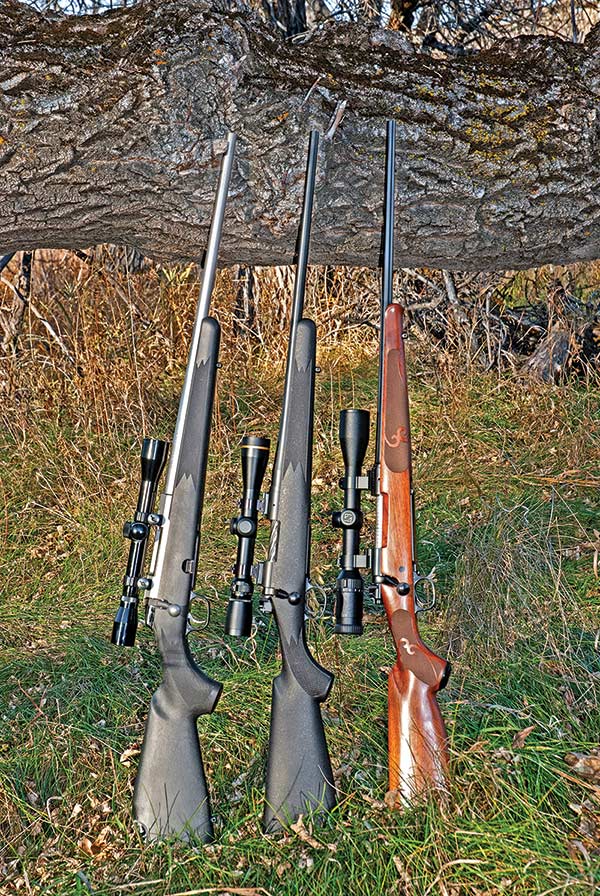
(L-R) Tikka 595 7mm-08 Rem.; Ed Brown Damara 7mm-08 Rem.;
Winchester 70 Featherweight circa 1980, 7x57 Mauser. All-good,
all-around rifles and all, sad to say, discontinued.
In 1892, Mauser introduced the 7mm (7×57) Mauser cartridge. It played a role in two major conflicts circa-1900 — the Boer War and the Spanish-American war. It was used in Mexico during the violent years from 1910–1920. The Mauser rifle and the 7×57 cartridge influenced the development by U.S. ordnance of the Springfield rifle and the .30 Government cartridges, the .30-’03 and .30-’06.

Specs
The 7mm is the bore diameter while the case length is 57mm. 7mm is equivalent in inches to 0.27559. Groove diameter of German-made rifles was generally a bit over 7.2mm, measuring 0.285″. Currently, most 7mm rifles are made with a bore diameter of 0.276″ and groove/bullet diameter of 0.284″.
It was as a sporting cartridge the 7×57 would have its most enduring influence. English hunters and gunmakers liked the cartridge for their “light” rifle, but were not about to recognize the metric system. Instead, they called it the .275, sometimes the .276. Prestigious gunmakers such as Holland & Holland and Rigby turned out handsome light rifles in .275 on imported Mauser actions.
One such hunter was W.D.M. Bell, a Scot who hunted extensively in Africa early in the 20th century. Bell amassed considerable wealth shooting elephants for ivory. Most of his shooting was with a .275 Rigby-Mauser and he used the original military load, an 11.2 gram (173-grain) round-nose solid, saying his barrel had never been “polluted” by a soft-nose bullet.
Bell liked the compact size of the 7×57 cartridge, which allowed more cartridges to be carried. He also liked the short bolt throw for greater reloading speed. His main reason, though, was reliability. He wrote, “I have used almost every kind of rifle; the only one which never let me down was a .276 with German (DWM) ammunition. I never had a single hang-fire even. Nor a stuck case, nor a split one, nor a blowback, nor a misfire. All of these I had with other rifles.”
In the first decade of the 20th century, the 7×57 spurred development of other 7mm cartridges in Europe. Holland & Holland came out with the .275 H&H Magnum. Sir Charles Ross of Scotland designed the Ross rifle and .280 Ross cartridge, made in Canada but popular in Europe. Other examples were the 7×64 Brenneke and the 7mm Von Hoffe Super Express.
In the U.S., the 7×57 had a brief vogue in the 1920s when many Mausers used in the Mexican fighting were sold as surplus in the southern states. The 7mm caliber started catching on after the war, often based on the .300 H&H case. Weatherby introduced the 7mm Weatherby Magnum in the 1940s on the same shortened .300 H&H case as the .257 and .270 Wby.
The 7×61 Sharpe & Hart appeared in the early 1950s. I’ve only known one shooter who had a 7×61. Whenever I met him, he was either praising the cartridge (meaning he had obtained a supply of 7×61 cases) or saying he was going to rechamber to 7mm Rem Magnum (meaning he couldn’t find 7×61 cases). Last I heard it was still a 7×61.
Another U.S. 7mm introduced in the 1950s was the .280 Rem. in a case similar to the .30-’06 and .270 Win. The fireworks came in 1962 when Remington brought out the 7mm Rem. Mag. Many American shooters wanted a magnum but — although they would never admit it — found recoil of .30-cal magnums a bit much.
Remington’s new cartridge had the magic word “Magnum” but with recoil not much more than the familiar .30-’06. The hot setup was a Remington 700 BDL in 7mm Rem Mag with a 3-9x variable Redfield. If you were lucky enough to get one, you kept it constantly in sight lest it be stolen.

Another of Dave’s favorite 7mm rifles is this Remington 700 Mountain Rifle in .280 Rem.
The Family Tree
The success of the Rem. Mag. led to the introduction of many more 7mm caliber cartridges as 7mm became virtually an American standard. Examples are the .284 Win., 7mm-08 Rem., 7mm WSM, .28 Nosler, 7mm STW, 7mm SAUM and RUM, and the 7mm PRC. Even the 7×57 found new life as Ruger and other gunmakers began offering it in limited runs.
In 1980, Winchester introduced the model 70 Featherweight. Those of us who grew up in the ’60s and ’70s had resigned ourselves to thinking today’s rifles weren’t very good and tomorrow’s would probably be worse. “Pre” was the word of the day. We had missed it. The good times were over for good.
The model 70 Featherweights of 1980 gave us hope. Elegantly shaped stocks, real cut checkering, fine polish and blue, exceptional workmanship — many a budding rifleman was saved from a life of despair, dissolution, alcoholism and suicide. I still remember the first time I saw the new models at a gun shop. Did I buy one? No, I bought two, a .270 and a 7×57.
I’ve since added two more 7×57 rifles — a Brno ZG-47 made in the 1950s and another Winchester 70 Featherweight on the redesigned Classic action. If you like 7×57 ballistics but don’t find rifles or ammunition available, the 7mm-08 Rem. is a better choice. It’s a cartridge I like very much. Sometimes, though, nostalgia wins out over practicality. That’s when the 7×57 shines.