Classic Revolver Of The U.S. Border Patrol
Deadly Business Along The Rio Bravo

Legendary Border Patrol tracker and member of the famed USBP
National Pistol Team, Charlie Pirtle, carried his S&W Model 28
Highway Patrolman most of his career. Photo: Carl Pirtle
The year 2024 marked a century of service for the United States Border Patrol and much has changed in the past 100 years. In the beginning, recruits supplied their own horse and saddle while Uncle Sam furnished hay and oats for their mount. Today, agents use state-of-the-art technology to help secure our nation’s borders.
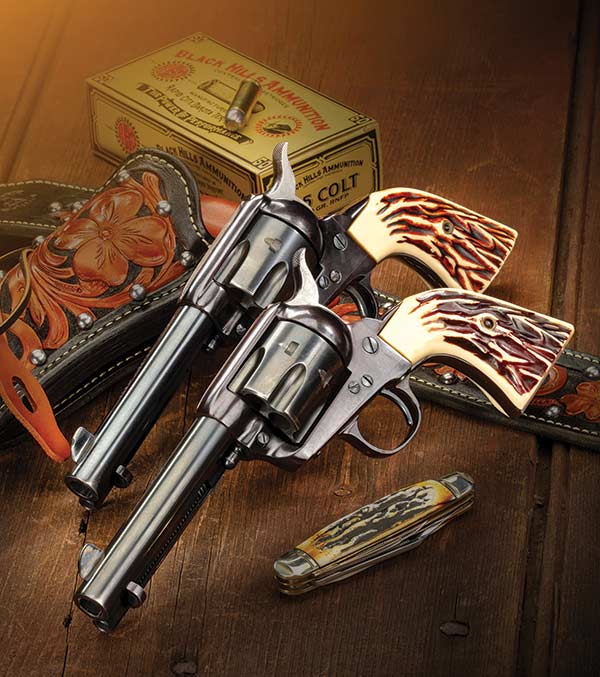
In the early days, many of the first border agents had been working in state and local law enforcement and simply crossed over to work for the Feds, bringing their trusty Colt Single Action Army with them. A few cowboys joined the ranks as well. For those needing a sixgun, the Colt and Smith & Wesson Model 1917s in .45 ACP were provided.

Quite possibly the first Border Patrol Pistol Team with the Unrepentant
Sinner, Charley Askins, in the center. Photos: U.S. Border Patrol Museum
Roll With Your Own
A quick glance shows well over a dozen handguns that have been issued for uniform carry by Border Patrol Agents. Records indicate the various firearms overlapped in issuance and it seems there were some options to choose from based upon availability. However, for a good portion of the agency’s history, agents were allowed to carry personal guns.
Many of the early recruits were prior lawmen who certainly would have had predetermined notions about the guns they were comfortable staking their lives on. Old photos indicate some of the first guns in use were the classic Colt Single Action Army, the Colt New Service and S&W 1917. A few Border Patrolmen also carried 1911s as well.
The early service-issued Colt 1917s were military surplus guns chambered in .45 ACP that required half-moon clips. Many of the lawmen found the three-round clips to be an unwelcome distraction. Officers carrying their own big S&W and Colt double-action revolvers likely chose rimmed cartridges like .38 WCF, .44 Special, .44 WCF and .45 Colt that were popular in those days.
Most relied on a good rifle or shotgun for the frequent gunfights that were prevalent during the early years, and it is noted Winchester’s Model 1897 12-gauge and Model 1907 self-loader in .351 Winchester were popular among the lawmen. “Prevalent” is probably a good word to use when one realizes there were 238 officially recorded gunfights involving Border Patrol in the El Paso District from 1924 to 1933. During that time span, fighting the violent liquor smugglers was a dangerous and bloody time in the U.S., especially along the Mexican Border. Several Border Patrolmen were killed in the line of duty in that era and a huge number of smugglers were sent to the hereafter.

A gun like this Official Police (top) but with a heavier barrel was issued to
Border Patrol Inspectors in the early 1950s. Specially built for the agency
on Colt’s E-Frame, it was marked “COLT BORDER PATROL .38 Special Heavy
Duty” on the barrel. Approximately 400 were made. The Colt Police Positive
Special (bottom) also saw use on the border. Photo: Mark Hargrove
Colt’s New Service In .38 Special
A few years after its beginning, the Border Patrol realized some formal training was necessary. Charles Askins, who had hired on with the outfit in 1930 and was having a literal blast combating liquor smugglers in El Paso, was made the firearms instructor for the entire service. About that time Askins had been moved over to Strauss, New Mexico because his name was appearing in gunfight reports a bit too often for the liking of some higher-ups.
Charley Askins was probably one of the last old-school gunfighters of the 20th century. Many of his actions have drawn controversy. His autobiography, Unrepentant Sinner, is worth reading. He was unapologetically a killer of men, without a doubt.
Once the budget restraints of the depressed economy eased, Askins suggested The Patrol purchase and issue The Colt New Service in .38 Special with a 4″ heavy barrel to the lawmen as a whole. The .38 Special of those days was nowhere near the reliable fight-stopper it is today. It’s a little surprising that Askins, with his personal experience in shoot-outs picked the cartridge, especially when larger, more powerful cartridges were available in the New Service at the time. His personal Colt New Service was chambered in .44-40 Winchester. Nonetheless, 642 of the guns were received and Askins personally sighted in each of the fixed-sight guns. Built on Colt’s large frame, the New Service was reliable and the guns held up so well some were still in use 30 years later!

Some of the first Border Patrol Inspectors carried the tried-and-true Colt.
Times a’ Changing
When alcohol was made illegal in the U.S. during the Prohibition Era from 1920 to 1933, the law of supply and demand was quickly seized upon by many in the form of bootlegging. Some of these bootleggers were violent and had the money to arm themselves with automatic weapons and stout .45s, while many in law enforcement were carrying .38 Special revolvers loaded with the somewhat inept 158-grain round nose bullets trotting along around 800 fps.
This was also the same time of the notorious bank robbers of the Great Depression who tormented financial institutions and shot it out with lawmen across the country. Many of these felons were especially well-armed. Down on the border, as is always the case, goods wanted in one country will be supplied by another in the form of smuggling. Contrabandists in Old Mexico were more than happy to supply liquor to thirsty Americans. Many of these smugglers had spent their earlier careers fighting in the Mexican Revolution. They were not strangers to gunplay and a lot of hot lead filled the air along the Rio Bravo.

The S&W .38/44 Heavy Duty was designed to spice up the old
.38 Special loads of the day. Winchester’s 1897 12-gauge was a
favorite of lawmen for close quarters gunfighting.
Smith & Wesson .38/44 Heavy Duty
A more powerful round was needed to combat the crooks, so the .38 Special was boosted in the velocity department to over 1,100 fps. The case was topped-off with a flat-nosed semi-wadcutter bullet and chambered in S&W’s big N-Frame revolver. These meaningful improvements to the cartridge and the gun it was chambered in were given the name “S&W .38/44 Heavy Duty.” These strong revolvers are made for the outdoorsman. Surprisingly, even though the Heavy Duty had already arrived in 1930, the Border Patrol didn’t officially catch up to it until the late 1940s to early ’50s when it was issued to the field.
Smith & Wesson Model 19 Combat Magnum
Smith & Wesson has shown the good business sense to listen to the experts in the field. The Combat Magnum, or Model 19, as it later came to be known, is a prime example. It was once touted as “the answer to the peace officer’s dream” and none other than the legendary Border Patrolman Bill Jordan was largely responsible for its inception.
Jordan envisioned the powerful .357 Magnum being chambered in a K-Frame with adjustable sights and a heavy barrel with a shroud to cover the ejector rod. This wheelgun became the darling of the Border Patrol and was worn on River Belts along the border for many years thereafter. It’s the epitome of balance in a double-action revolver, especially in the 4″ barrel model. Not only that, but it also just looks right to the educated eye.
One hundred years of patrolling the borders and still going strong, this country needs the U.S. Border Patrol now more than ever. While civilization, policies and technology have changed enormously over the past century, some aspects of the job have not. The age-old skill of sign-cutting and tracking is still practiced by agents along our borders. So too has changed the trends in sidearms. Thirty years ago, The Patrol transitioned away from the revolver. Maybe I’m nostalgic, but I don’t recall a time when one of these good sixguns would not have suited me just fine down on the Rio Grande.