Thermal Scopes:
What They Are, How They Work, and How to Choose One
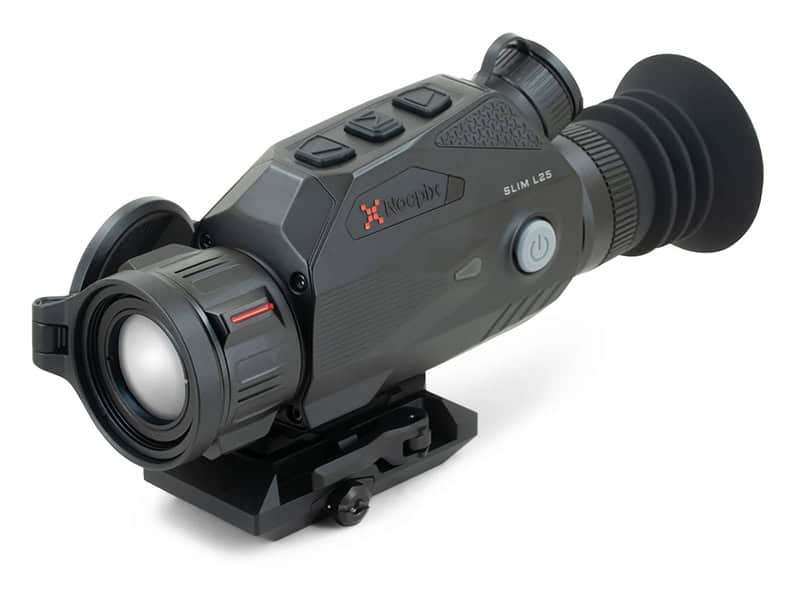
A model like this SLIM L25 performs double duty. The quick-detach mount and hand-friendly
shape allow you to use it as a monocular for scouting.
If you’ve read the first three parts of this series: Seeing The Unseeable, See The Heat Not The Light and The LUMI P13 Compact Thermal Monocular … For Urban Dwellers, you’ve probably seen how thermal imaging starts as a curiosity. Once you learn how it works, you start doing things like spotting glowing raccoons in the backyard and finding energy sucking appliances around the home.
I’ve got news. It doesn’t take much until experiencing the value of being able to spot “invisible” stuff moves you to the next level of thermal technology application. You go from finding things with a handheld thermal monocular to identifying them, tracking them, and aiming at them with precision.
That’s where thermal scopes come in. And since we’ve spent the first three parts of this series talking about the “seeing” side of thermal vision, this final discussion gets into the aiming side with thermal weapon-mounted sights. Specifically, the lineup from NocPix offers an interesting mix of entry-level, mid-range, and high-performance scopes for everything from hog control to professional use.

Remember, using weapon-mounted optics for “looking around” isn’t a good idea,
so the ideal field setup will include either something like the SLIM
quick-detach solution or a riflescope paired with thermal binoculars like these.
What Exactly Is a Thermal Scope?
A thermal monocular helps you see stuff, whether or not it’s normally visible to the naked eye. A thermal scope has a much more serious job: it has to help you aim. That means all the magic that happens inside a handheld thermal device, like detecting invisible heat, rendering it as an image, and enhancing it with a processor, must remain perfectly aligned with a digital reticle that stays zeroed on a rifle. As if things weren’t complicated enough with the monocular device …
A scope doesn’t get the luxury of being slightly off. It has to survive recoil, weather, temperature swings, rough handling, and the chaos of field use without losing alignment. In other words, a thermal scope is equal parts camera, computer, and shockproof targeting tool.
Like all thermal gear, a scope doesn’t need any light. It turns mid- to long-wave infrared energy (heat) into a detailed picture. If a coyote steps out in complete darkness, or a hog hides behind brush, or a moving target crosses a shadow line, the thermal scope doesn’t care. Heat is heat, and the scope will “see” it.

The technology advances in thermal are breathtaking. Note how “normal” this thermal scope
is when mounted to a rifle. This model even contains an integrated laser-rangefinder.
Where Thermal Scopes Shine
1. Predator and Hog Control
This is the classic use case for a thermal rifle scope. Coyotes are wily and cautious creatures by nature and rarely step out into the light. Hogs, well, they do hog things, but they often root about and move at night, where thermal vision shines. Thermal scopes let you track and identify animals at night or in thick cover. That’s why farmers, ranchers, and night hunters rely on them.
2. Search and Safety Roles
Mounted on a patrol rifle, UTV, or agricultural vehicle, a thermal scope can reveal warm bodies far beyond the range of headlights or flashlights. That can be especially useful for spotting human movement or distant heat signatures during emergencies. This is an application where a combination of a searching device (like a monocular) and a weapon-mounted device can complement each other.
4. Conditions Where Night Vision Fails
Smoke, fog, brush, camouflage, shadows, and moonless nights can present challenges to traditional night vision technology. However, thermal slices through those types of obstacles. When clear “vision” is critical and lighting is unpredictable, thermal scopes are the most reliable tool available.
Just remember: legality varies by state. Some areas regulate night hunting tools, and you must always have positive identification before shooting. The golden rule applies: use responsibly in ways the technology was designed to be used. If you’re “looking,” don’t use a scope; use a thermal monocular or thermal binoculars.

A perfect hunting pairing. A LUMI monocular for “looking” and a BOLT thermal scope for shooting.
Key Features to Understand When Choosing a Thermal Scope
Thermal specs can add new layers of complexity to scope specifications. So here’s the plain-language version.
Sensor Resolution: The Heart of the Scope
Think of resolution as the “texture” of heat you can see. The more sensors, the higher the potential image quality. Models with 256 sensors will be more affordable and great for shorter-range predator hunting. For reference, the NocPix LUMI P13 we looked at in parts one through three has 256 sensors. As you move up, you’ll pay more, but get more in return, just as with traditional optical scopes. For example, models with 640 sensors will offer premium clarity, especially when zooming. If you need to tell the difference between a coyote and a domestic dog at serious distances, this is the class to choose.
Higher resolution means more tiny temperature detectors, which means more detail, especially when digital zoom kicks in.
Lens Size and Magnification
Larger lenses gather more infrared energy, which gives you improved clarity and better “vision” at longer distances. As with optics, you’re letting more “light” (heat in this case) into the sensors with a larger lens. Smaller lens units can provide a wider field of view, which can be desirable at shorter ranges.
A compact 19mm or 25mm lens is terrific for woods and brush. A 35mm or 50mm lens is for longer ranges and open fields. Choosing one is really about matching the scope to your environment and desired use case.
Refresh Rate: Why 50 Hz Matters
A 50-Hz refresh rate means the image updates 50 times per second. Why care?
Because animals move. So do you and your rifle. A low-refresh-rate scope will smear or stutter when panning. A 50-Hz unit stays smooth and natural when viewing moving targets.
Holding Zero and Reticle Options
A thermal scope needs a rock-solid zero. That means strong internal construction, shock-resistant electronics, and a design built for recoil.
Digital reticles offer huge benefits over traditional ones etched into glass. You can switch between different patterns for different calibers or uses. Lighting doesn’t matter to a digital reticle. And there’s no parallax shift.
Some NocPix scopes offer multiple color reticles that contrast differently against heat signatures. This feature is more important than it sounds, as a “warm” background can wash out your reticle.
Image Processing: The Secret Sauce
Thermal images start as raw temperature data. Image processing algorithms turn raw data into crisp, usable results. This is especially noticeable when zooming digitally.
Choosing the Right NocPix Scope for Your Mission
Start with these simple questions:
What distance do you realistically shoot?
If your typical distances are less than 150 yards, consider 256 or 384 sensor models like the Bolt P25R or the SLIM L25. One nifty benefit of the SLIM series is the dual-use design. It’s kind of like a quick-detachable monocular, so you can take it off the rifle for “looking” so you’re not pointing at objects yet to be identified.
For distances over 200 yards, consider a 384 or 640 sensor solution like the SLIM H35 or ACE H50.
Do you need detection, recognition, or identification?
The technology supports three functions, and the right hardware depends on your usage scenario. Detection is figuring out if something is there. Recognition might tell you it’s an animal. Identification allows you to determine what type of animal it is.
If more of your requirements lean toward the detection side of the spectrum, consider something like the SLIM models that can be detached for scouting and finding applications. For recognition-intensive use, go with a higher-resolution device for improved detail and clarity.
For more information visit: NocpixUSA