Triggers: How Light is Too Light?

The H&R 999 Sportsman had a hellacious DA trigger pull.
Good luck keeping the sights aligned!
I was at a local gun store recently and entered into conversation with a gentleman (or as the kids say, “some rando”) on the topic of triggers. Quite vociferously, he told me his revolver had been modified by his gunsmith to deliver an action superior to anything on the market. His specifications? A double-action trigger pull of 6 lbs. … and a single action pull of only 1 lb.
To him, this was proof of his exquisite connoisseurship. To me, and assuming he wasn’t pulling my leg, it was proof of what some shooters think they need in order to shoot well — and the possible dangers they’ll face when their triggers are tinkered on by questionable parties.
Before we go any further, let’s build a working definition of what a “good” trigger is, exactly. I think most of us will imagine one that can be taken up until it hits a definitive “wall,” which can then be overcome with a moderate amount of pressure. To use a common analogy (at this point, a trope), we seek a creep-free trigger that “breaks like a glass rod.”
Normally, the force to overcome this resistance seems to be somewhere within the range of about 3 to 5 lbs. At the same time, we gunwriters will often make some concessions to those triggers that “feel lighter” or are significantly heavier than this ideal range, but are nevertheless “crisp.”
In aggregate, these qualities minimize the disruption occurring when the trigger is manipulated. If you’ve pulled the trigger perfectly, it often feels like “carefully pulling the front sight back through the rear sight,” as the saying goes. The result is usually a bullseye.
It’s certainly possible a trigger outside of the 3- to 5-lb.range can make this goal possible. However, things get hairy when you go too far in either direction.

The Beretta 92 (left) has garnered praise for its DA pull, which is
even and predictable. The trigger starts the entire firing sequence
but opinions vary about what is “too much” or “not enough.”

Too heavy
A trigger’s “surprise break” is certainly conducive to good accuracy. It’s another thing altogether to steadily increase pressure and ask yourself, “When in the hell is this thing going to go off?!?”
As a case in point, let me tell you about my Spanish “Alfa” revolver. With its 14-lb. single-action pull, it offers a level of resistance taking people out of the mindset of shooting and straight into “troubleshooting.” You’re not going to be focused on accuracy when you’re wondering if something got stuck behind the trigger guard or worried the lock work is seized.
The heaviest DA triggers I’ve encountered have been so stiff I thought I was going to give myself nerve damage. An old Harrington & Richardson Model 999 “Sportsman” had an utterly hellacious double-action pull somewhere in the neighborhood of 20 lbs. Shooting it quickly tired my index finger and I sold it without much regret.
In either case — for both the too-heavy DA trigger and the too-heavy SA trigger — you’re applying a substantial amount of muscle to a small piece of the gun. When the sear finally trips, it’s like shoving on a door that suddenly gives way. Before you can course correct, all the extra force is suddenly imparted to the gun in the form of movement, which typically means pushing the barrel off target.

S&W’s Model 52 features perhaps the best factory trigger at 2.5# exactly.

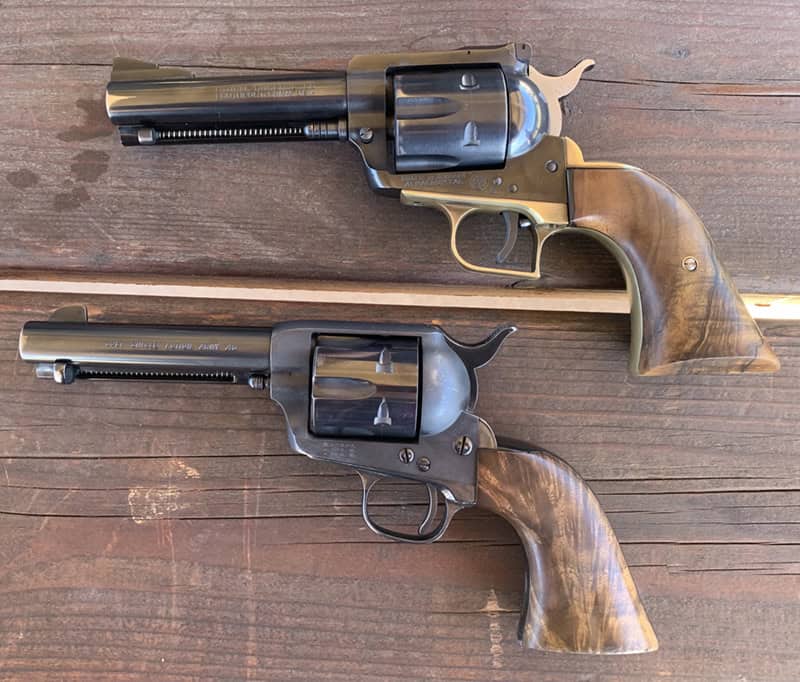
I wouldn’t want to go lighter. This old “Alfa” clone of a K-Frame
S&W boasts an SA trigger pull of 14 lbs. That’s bad!
Too Light
Just about nobody sends out their guns to make their triggers heavier than the factory weight. However, in the pursuit of giving themselves every advantage in making an accurate shot, some shooters go too far.
Learning to shoot involves developing a kinesthetic understanding of how to manipulate a trigger. The beginner will usually just put their finger on it and yank, with results being typically poor. After not too much time, however, shooters will instead move the trigger through a few distinct operations: taking up the slack until it hits a “wall” of resistance, and then increasing pressure until the resistance is overcome.
The problem lies when a trigger is made so light there’s no longer any “wall.” The shooter will take up the trigger and BLAM! The bullet is out of the gun before it is intended. At best, this will scare the shit out of you. However, spare a minute to consider the worst that can occur when a bullet leaves the barrel without your full control over its path of travel.
This issue can also surface when even a well-tuned target trigger is placed in the hands of a green shooter. Assume any novice you hand a gun to is not going to “speak” the language of how to operate a trigger, even if you explain it to them beforehand. While they’re building competency at this fundamental task, it’d be prudent to provide them a trigger with some degree of engagement resistance.
Elsewhere, a too-light trigger is the result of mechanical problems. Take a gander at any parts schematic and you’ll see most triggers barely rest on their sears. A lighter trigger pull is most readily achieved by reducing the amount of friction and surface area between these two parts. If reduced by too much, however, you’ll have a gun that can fire not only if dropped, but bumped or jostled even through normal handling.
One well-meaning gunsmith tried to give a rifle of mine a “sweet target trigger” some years ago. I was not particularly happy when the gun fired as soon as the bolt was pushed home. Suffice it to say I no longer enlisted his services afterward.
Even among very good gunsmiths, it’s a difficult task to engineer a safe trigger both extremely light and repeatable. I’ve fired rifles with triggers billed as being a pound and a half “on the dot.” Sometimes they had a sweet break. Other times, it felt like they’d go off if you sneezed on them.
Consider the shape of most triggers and you’ll understand why this phenomenon occurs. Depending on where the trigger comes to rest, one can apply more or less leverage even given an equivalent amount of pulling effort. But if a gun goes off because your finger comes to rest in one place rather than another, it’s certainly not ideal.
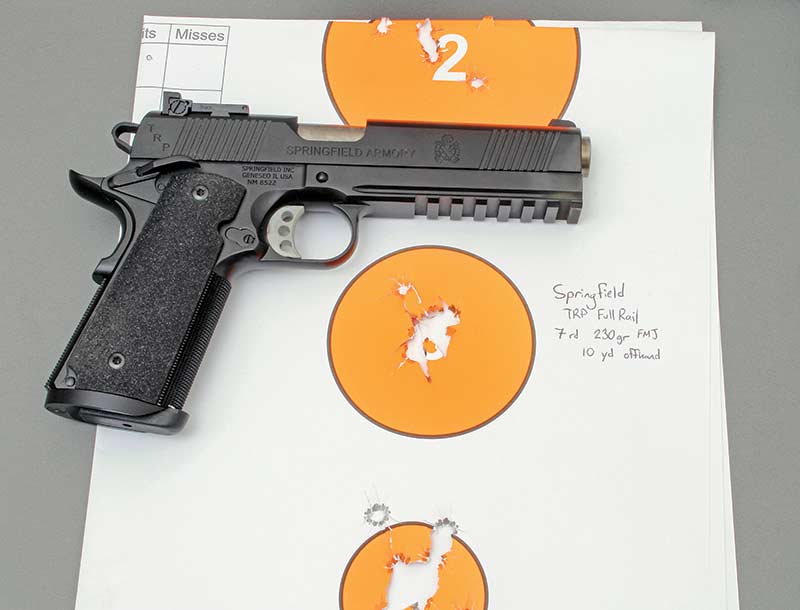
The tuned 3.5# trigger on Clayton’s TRP certainly does help
produce offhand groups like this, but it’s icing on an already ,br>
tasty cake.

If your handgun groups exhibit the telltale low-left mash,
a slightly better trigger could result in substantial improvement.
Gun & Role Dependent
Some shooters might have a different philosophy than I but the lower limit of my own comfort zone — as a guy who’s shot for quite some time — is about 2 ½ lbs. on my dedicated target handguns. There’s not much wall on my S&W Model 52, for example, but the wall exists. I’m also more comfortable with going slightly lower on my bolt-action rifles where a deliberate action is required to get a round from the magazine into the barrel.
For guns designed for defensive use, smart money suggests going heavier. A survey of the highest-quality duty pistols made by Les Baer, Springfield Armory, Kimber and Staccato all point to a trigger pull in the range of about 4 to 4.5 lbs. You can certainly get a 1911 or 2011 trigger to be lighter and still have it pass a safe functioning test, but no maker will sell you a handgun intended for serious business that’s significantly below the 4-lb. standard.
Why not? Well, stress makes people do weird things, and fine motor control generally goes out the window after an adrenaline dump. A finely controlled press to take up trigger slack may be hunky-dory during peacetime; when your heart is pounding at 150 bpm, the press might turn into a jerk. An extra measure of intentionality is a good thing.

Stock guns tend to shoot pretty well these days. Until you know the gun,
resist the temptation to modify it.
An Appeal To Common Sense
While one might have expected me to become more snobbish over the course of a decades-long shooting career, the truth is I’ll pull a lot of triggers and think, “I can work with this.” Instantly trying to modify the trigger into something crisper or lighter might allow an experienced shooter to make better hits.
In truth, an equivalent amount of time, money, and effort is almost always better spent learning the platform. Indeed, most off-the-shelf firearms have benefited from a near-century of engineering to provide shooters with a trigger light enough to manage, but heavy enough to avoid safety issues.
As the saying goes, “Moderation is the key to happiness.” It might certainly be possible a gun’s trigger is just too heavy and clunky for a shooter to work with. In such a case, it might benefit the owner to send it off. A half-pound trigger, however, will create far more problems than it was intended to solve.