Elmer Keith:
The Original Influencer
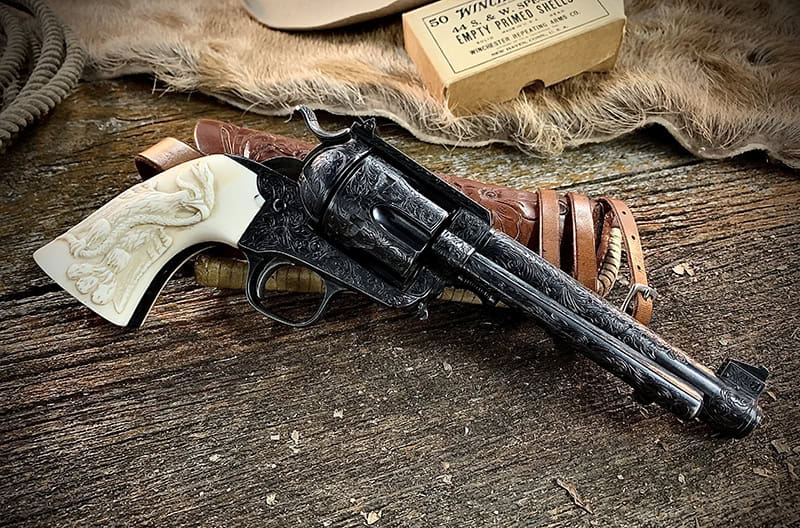
In all its full glory, the Keith #5. Photo by Matthew Peake.
When Elmer Keith had his famous #5 built, he started a tradition among sixgunners like no other. Much like today, the most frugal of men happily send money for a custom sixgun to be made to their specifications. Many simply imitate Keith’s famous #5 sixgun with a grip-frame swap, like those manufactured by grip guru Ronnie Wells. While never on social media, Elmer was the original influencer for sixgunners, and all before the days of cell phones, iPads, and computers!
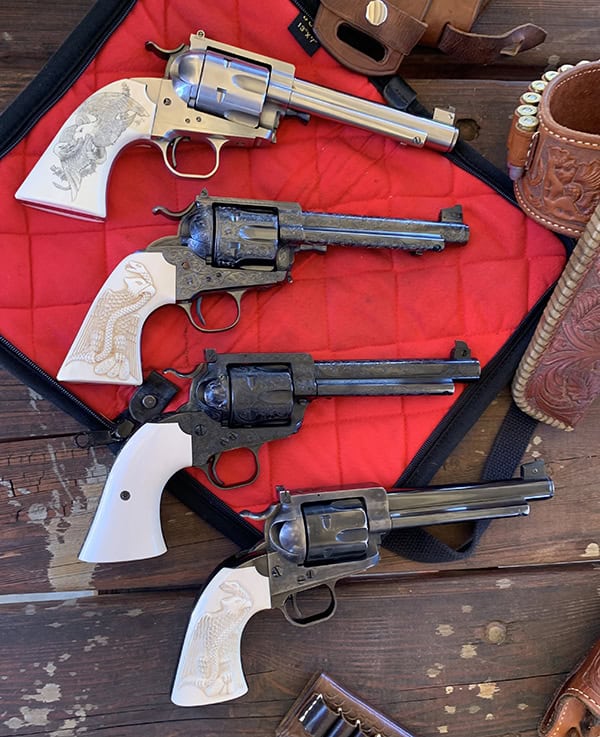
A few “counterfeits” #5’s by top, Alan Harton, Hamilton Bowen, and Bobby Tyler, for a group picture.
All having roots directly related to Elmer.
The Beginning
To understand the full story, we must start with Elmer inviting Harold Croft to Durkee, Oregon, for a month’s visit back in 1927. Intrigued, Croft accepts, wanting to witness Elmer shoot the long-range distances he wrote about in American Rifleman magazine.
Croft brought a “suitcase full of guns,” as Elmer described. Upon arrival, Elmer nailed some boards together, making a 4’x4′ target and set it out a measured 700 yards away. Using his sitting “Keith” position, hands locked between his knees, head resting on his saddle, Elmer starts shooting, hitting the target with every gun Croft brought. Keith even hit the board with a 2″ slip-gun. Croft became a true believer. Elmer was the real deal!
Croft invested much time and money improving standard Colt SAAs, looking to develop lightweight weapons for self-defense. He designed four different featherweight models from SA Army and Bisley Colts, calling them #1 through #4.
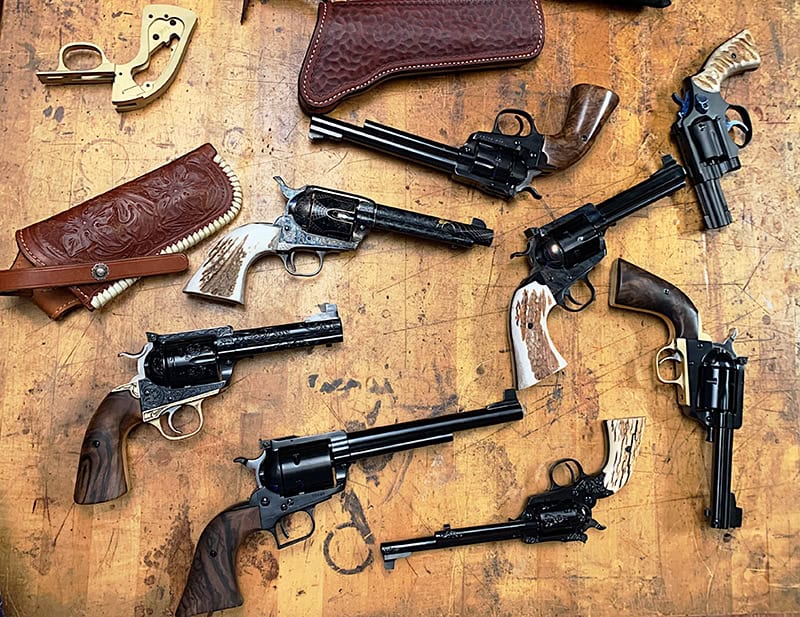
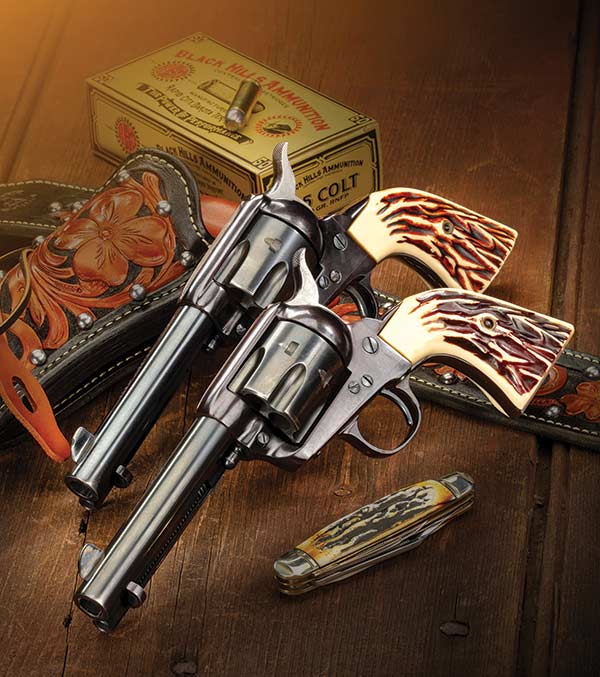
Some customs from the Tyler Gun Works shop all showing some Elmer influence.
#3 is #5?
Elmer regarded Croft’s #3 grip as perfect, considering it “the finest ever put on a sixgun.” It consisted of a Bisley backstrap mated with an SAA guard and front strap, the Bisley back strap was bent to the same angle as the SAA front strap and guard.
Excited, Elmer sent a Colt back with Croft, “to be worked over,” explaining the features he wanted from Croft’s guns, along with a few of his own ideas. Elmer wanted the #3 grip frame, along with target front and rear sights. He also wants the gun to be left full weight, not reduced, for better balance.
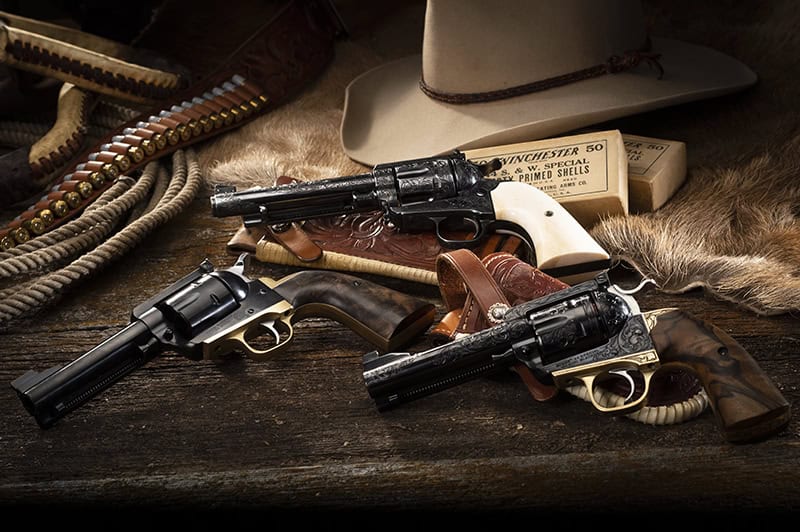
Custom sixguns can be basic, or fancy. It all depends on choice and how much you want to spend.
These are more of Tyler Gun Works samples. Photo by Matthew Peake.
Fantastic Features
The most distinguishing characteristic of Keith’s #5 is the grip frame itself, which blends a Colt Bisley backstrap with the front strap/trigger guard of a Colt SAA. Sedgley, a master gunsmith from Philadelphia, welds up the frame into a flat top, extending it over the hammer top, to maximize sight radius. Sedgley then welds the #3 grip design for Elmer’s gun and makes a new “V” mainspring, designed by him and Croft, fitting it perfectly.
This spring is less prone to breakage and faster and more sensitive than standard flat springs. The hammer was previously made by J.D. O’Meara, who fitted a Bisley hammer top/spur to the lower of an SAA hammer, then dovetailing and brazing them together.
Besides the grip frame from Croft’s #3 gun, the Base Pin Locking Latch is the second most recognizable feature on the #5. Gunsmith R.F. Sedgley designs the mechanism, which positively locks the base pin in place, making it impossible to “jump” from recoil. A swinging latch mounted on the frame fits into a square groove of the base pin.
Elmer also wanted an oversized base pin head for easy removal in the field, the third most recognizable part of the #5, the large hourglass-shaped base pin head. He also demanded adjustable target sights for this sixgun, allowing him to dial in handloads for distant targets. His specifications made the gun more user-friendly for daily tasks while working as a cowpuncher.
In a nutshell, Elmer desired an accurate, reliable sixgun capable of shooting heavy handloads accurately — the #5 fitting the bill perfectly. Keith talks of the finished product in his article “The Last Word” describing the gun and its merits in the April 1929 issue of American Rifleman. Elmer set the stage for sixgunners to build custom guns to their own specifications.
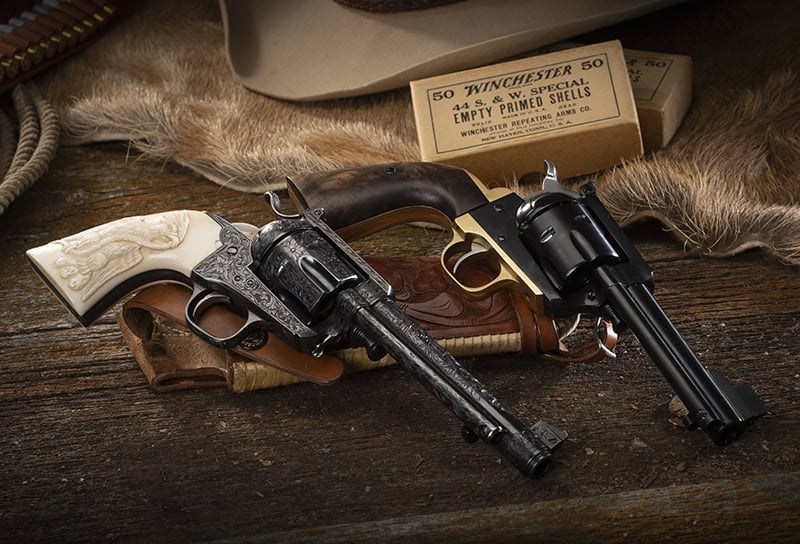
The real McCoy next to a recent custom. Photo by Matthew Peake.
Friendly Advice
Get your hands on a #5 grip-frame before committing to one. Things I noticed from examining Elmer’s #5 is that having a gun with a comfortable grip frame is very relevant. For my hand, it should have been a tad longer so my pinky could also grip the frame, providing more comfort and control.
Having adjustable, sturdy sights is also a must if you demand top-notch accuracy. Also, being well-balanced makes its weight appear lighter. Elmer’s #5 was deceptively light when first picking it up. It was a natural pointer, too, with sights automatically lining up when aiming. These are the traits to strive for with a custom build. As has been said, Elmer’s influence was merely getting the conversation started for custom builds.
We can see the #5’s influence in several factory-made sixguns, too. Luckily, we have more resources than ever before to have our dream guns built today, thanks to the influence of Elmer’s #5. He had his gun engraved, not to be fancy, but rather to cover up, or conceal, the numerous scuffs and scrapes it endured from daily use.
Elmer stated, “I killed 59 magpies, around two dozen crows and hawks, six horned owls, and a bobcat, to say nothing of over a hundred blacktail jack rabbits and a few woodchucks. It does excellent work at long range.”
Speaking of accuracy, Elmer states, “using a charge of five grains of Bullseye and a 250-grain cast bullet, sized to 0.431″, I put five shots under a silver dollar at 15 yards. Such accuracy is good for me and will get meat when I need it.”
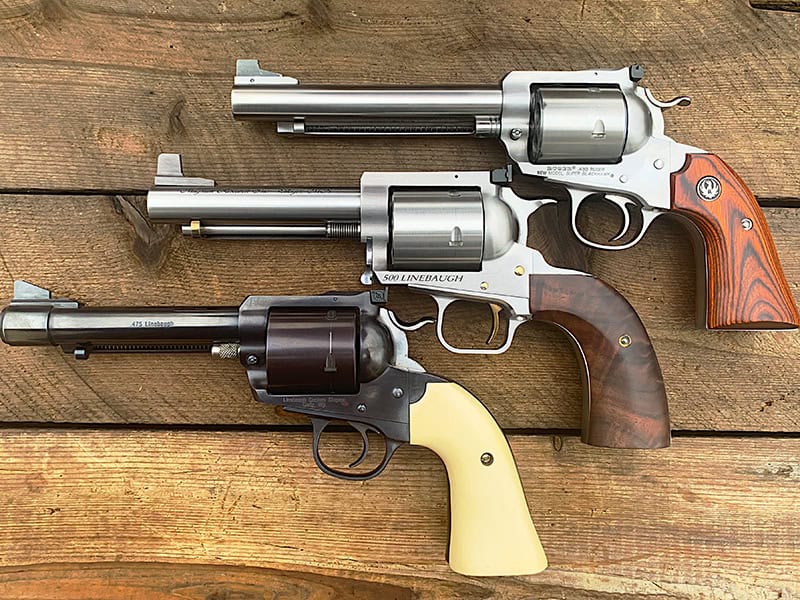
From top, a factory Ruger Bisley, Magnum Research BFR custom shop Bisley, and a Linebaugh custom,
all with Bisley grip frames.
Bisley Background
The famous Bisley Matches date back to the 19th century and are associated with the Victorian-era clubhouse first built in 1865, then moving to its current location, Bisley, England in 1895. The matches challenged shooters to wring the most out of their guns and shooting skills. Colt released its Target Model in 1894. It had a flat top, complete with drift-adjustable rear sights and a removable blade front sight. The Target Model also had a funny-shaped grip …
The Target Colt proved itself at the Bisley Matches and later became commonly known as the Colt Bisley after further refinements were made to the grip-frame and hammer.
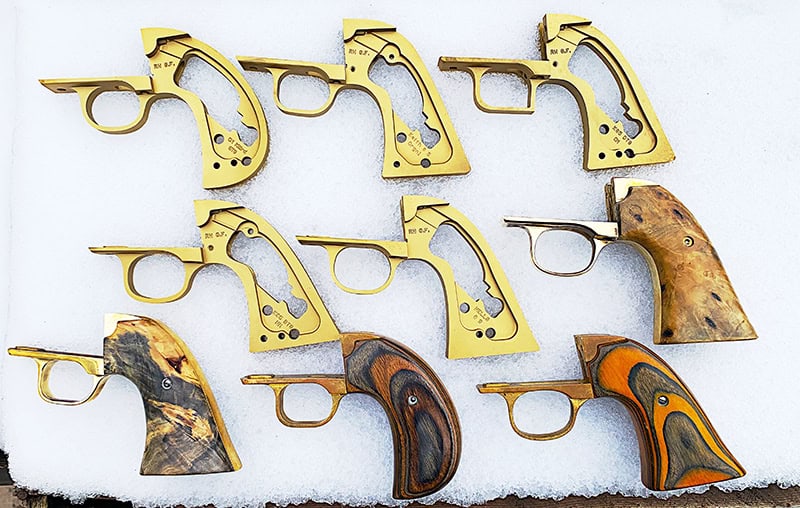
A few samples of Ronnie Wells grip-frames.
Magnum Research
Magnum Research added their rendition of the Bisley grip frame as an option to their BFR line around 2015. A few years ago, I tested their version of Elmer Keith’s #5 in .500 Linebaugh. Their version of the Bisley grip makes shooting the heavy big bores much more comfortable and manageable. It’s nice seeing other manufacturers follow suit with this style of grip frame.
Magnum Research also offers a locking base-pin latch from their custom shop, just like Elmer’s on his original #5. It is a very snazzy offering not seen or even offered by many builders.
Tyler Gun Works
Bobby Tyler of Tyler Gun Works utilizes brass grip frames from Ronnie Wells on his #5 builds. The brass grip frames accent the blued frames beautifully on the guns. Adding engraving really makes things “pop” on his custom builds. While not copying true #5’s per se, you can see the influence on Bobby’s guns. His use of engraving, metal finishes and the blending of brass to blued steel adds style and grace to his custom builds.
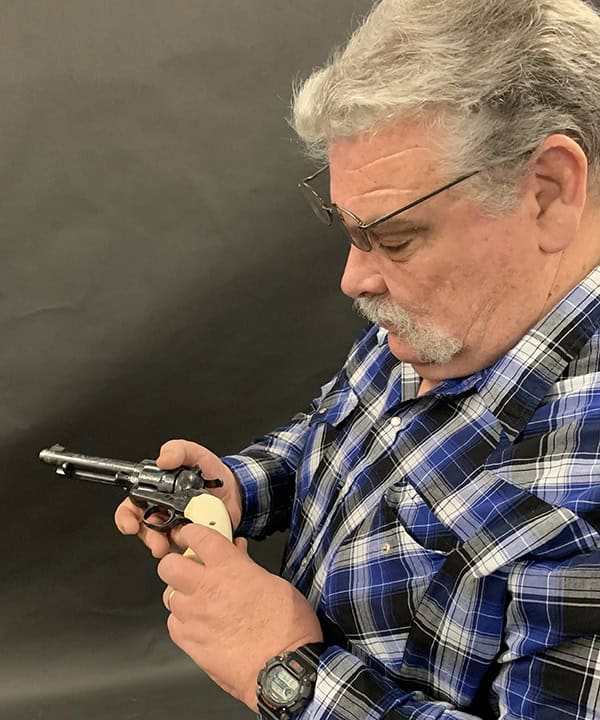
Tank examining Elmer’s #5.
The Ruger Bisley
Bill Ruger brought out his rendition of the Bisley in 1984. Although not a true copy, it has a fuller grip than Colt’s, having less radius on the inner strap. I got my first Ruger Bisley after years of shooting “Ruger Only” .45 Colt handloads and never looked back. Traditional plow-handle Ruger revolvers are small in my hand, and their shape is not conducive to managing heavy recoil.
More importantly, the grip angle is different. Now, recoil comes straight back into the meaty part of my palm, saving my knuckle in the process. Additionally, the Bisley hammer’s stylish drooping curve accommodates one-handed cocking during target shooting while also adding a stylish look!
The Bisley is my favorite factory grip design among Ruger’s big-bore calibers. It’s no surprise that custom builders like John Linebaugh used the Ruger Bisley model as their platform for their custom builds.
Grip-frame Guru
Ronnie Wells is the grip-frame guru of the sixgunner world. I guarantee he has the perfect grip-frame for you. It will fit your hand while taming recoil when shooting big boomers. Ronnie has over 300 current and future model grip-frames in the making. He can size up most people’s grip-frame needs with a two-minute phone conversation. He uses CNC machines and offers brass and aluminum grip-frames. He told me each grip frame goes through a total of 147+ different cuts while being machined.
#5 Samples
For the #5 grip frame alone, Ronnie has 64 different variants to choose from. First, there’s the old model or the new model style Blackhawk. Next is the thickness of the frame, .500″ or .440″. Then there are Bisley, Dragoon, OM, or NM-shaped trigger guards? Other considerations are the amount of space from the rear of the trigger guard to your knuckle.
Last Word
Elmer Keith’s #5 was certainly not the end-all to custom sixguns. Rather, it was just the beginning. Many choose the #5 pattern for their first custom, and I understand that. Emulating our heroes that way makes us feel more connected to them, but I think Elmer’s influence was simply stating to have your shooter, either sixgun, or rifle, made the way you want for your needs.
Get More Guncranks Every Week!
By submitting this form, you are consenting to receive marketing emails from: . You can revoke your consent to receive emails at any time by using the SafeUnsubscribe® link, found at the bottom of every email. Emails are serviced by Constant Contact