Why Is A Rifle Hollow-point
Better Than FMJ?
A Discussion About Putting In The Tip

Why is the nose of this bullet open? Doesn’t that hurt accuracy? Countless experiments and experience has shown
hollow-point rifle bullets are indeed more accurate than FMJ in most cases.
One of the most misunderstood concepts in rifle bullet design is the choice of a hollow-point versus full metal jacket (FMJ). Speaking as an editor who gets reader questions every day, many folks have deeply-held beliefs on this subject, which often turn out to be wrong. Thus, we’ll dive into the deep end and try to clear up the misconceptions.
Hands Down
First off, hollow-point rifle bullets are more accurate than a full metal jacket. Full stop. End of discussion. This has been conclusively decided by countless tests and the billions of rounds fired by people who spend their entire lives designing, testing, loading and competing with rifle cartridges.
There are certainly situations where you might find a certain rifle with a certain type or lot of ammo that is more accurate with an FMJ than the comparable rifle with hollow-point ammo, but those are unicorns. This is why nearly all match-grade ammo — with exceptions I’ll discuss a bit later — uses a hollow-point bullet.
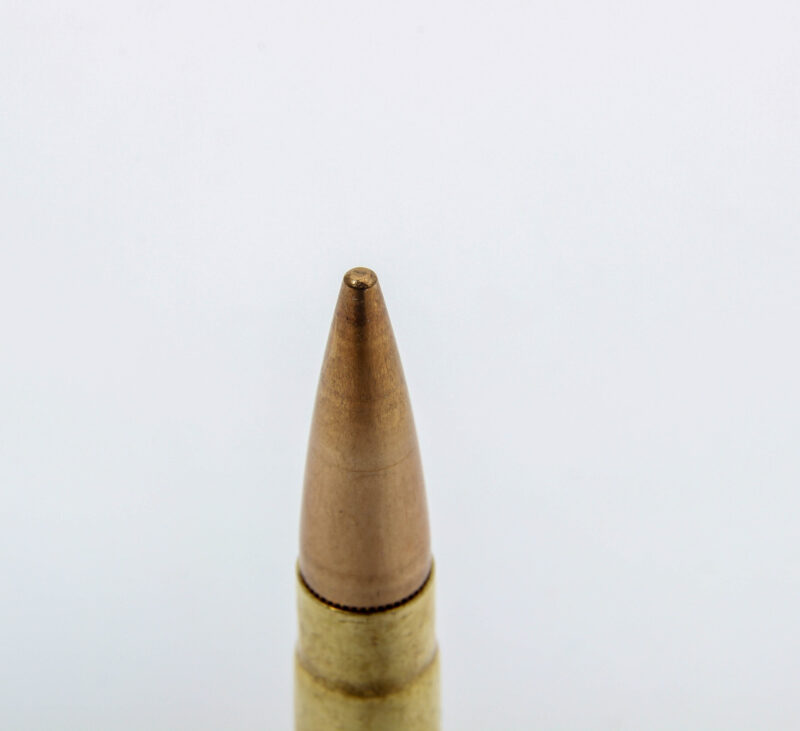
A solid tip bullet would intuitively seem like a more efficient and accurate solution to bullet flight. Surprisingly, it aint!

The hollow point bullet in handgun ammo operates under an entirely different rules and must be engineered to expand at lower velocity.
It seems a nicely-pointed full jacketed bullet would be more accurate, faster and have a better ballistic coefficient than a comparable hollow-point. In a perfect world, this would be true. This is why hand-turned or precision-machined full jacketed ultra-accurate match bullets exist. For tight groups in target shooting scenarios, these are the ultimate bullet. There’s only one problem: they’re stupid expensive and scarce. And, they’re no better than a cheap FMJ if the machining is slightly off.
If you’re willing to spend a small fortune, and commit to all the other nearly-countless aspects of maximizing rifle accuracy, full-jacket machined bullets are a good way to go. Then again, it doesn’t always work because there are so many other factors which contribute to accuracy. Ultimately, there truly is no ‘magic bullet.’
For the rest of us, the world is imperfect, starting with rifle bullets. It turns out the manufacturing process is why hollow-points outperform full metal jacket bullets in term of accuracy.
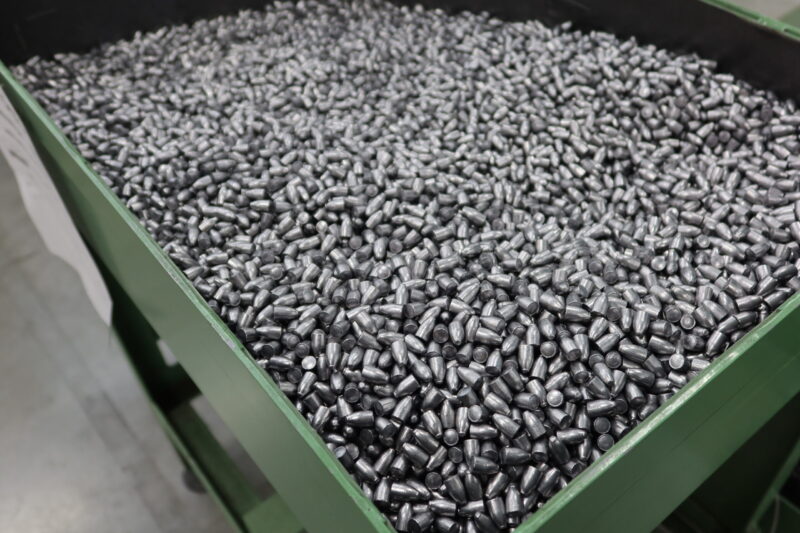
Bullets are made by the truckload and the process of drawing the bullet jacket always creates small imperfections.
The hollow point bullet replaces this imperfect lead in the tip of the bullet with a bit of air.
The reason is simple enough, though a full technical explanation would take a book. When a full metal jacket bullet is formed, the process is fast but full of small errors due to the way the lead core is mashed into the raw bullet. It’s not that these bullets are ‘worse’ in any way, its that they are more variable. And, anyone who earned their rifle merit badge knows that variability is the exact opposite of accuracy.
Meanwhile, hollow-point bullets are formed using an opposite process where the lead core is inserted, then the metal casing is drawn to a point. A long time ago somebody realized if you don’t fully close the metal jacket and leave a tiny airspace up top, the imperfections at the leading edge of the bullet are less because air weighs less than lead. Hollow core bullets aren’t perfect, but they’re less imperfect than full metal jacket bullets.
People also wonder how an open-ended bullet can be more efficient than a sharp-pointed bullet. They’re correct; a closed-end bullet is more efficient, but the numbers are almost insignificant — bullet tip drag is in the low single digits. Thus, hollow-points are indeed a teeny- tiny bit less efficient than an FMG (thereby providing fodder for those argumentative types at the local gun range) but the effect is minimal on overall performance. And, when you are focused primarily on accuracy, the scale tips in favor of hollow-points.
The bottom line is that hollow-point bullets coming off a production line are almost always more accurate than mass-produced full metal jacket bullets. Meanwhile, the FMJ is cheaper because it’s faster to produce, making it a good choice for military or practice ammo.
And, in any given scenario, rifle accuracy is fabulously complicated and tiny changes can have significant knock-on effect downrange. This is why people chase things like cartridge runout, throat depth and all the other stuff. Ultimately, hollow-point rifle bullets offer maximum potential accuracy from the bullet itself, but you still need to do a million other things correctly to win a match!
Meanwhile
Another area of disagreement is using rifle hollow-point match bullets for hunting. Generally speaking, hollow-points aren’t the first choice for hunting because their design isn’t focused on expanding on target (terminal ballistics), but devoted to cutting through the air in a less-variable manner compared to its brothers and sister bullets.
Hollow-points will certainly mushroom or expand on target but generally the degree and repeatability are less than bullets designed specifically to do so.
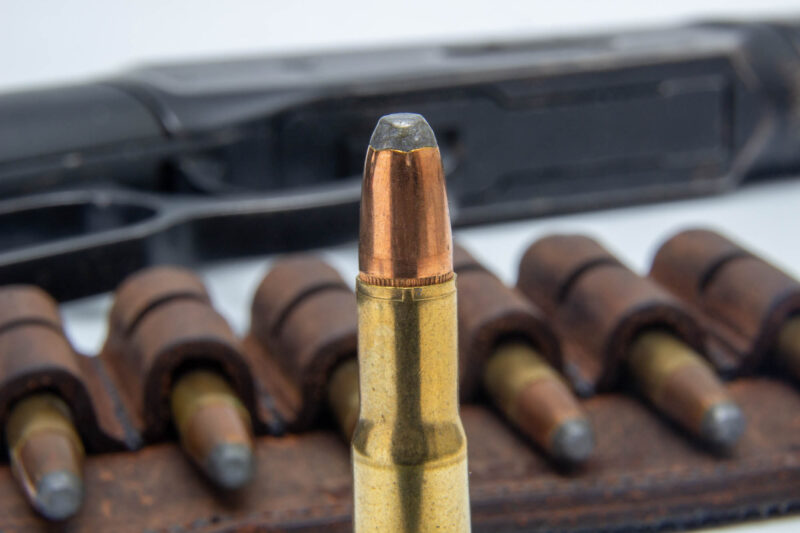
The venerable .30-30 bullet typically has a small flat tip. It helps with mushrooming on impact but more importantly,
keeps your tubular magazine-fed rifle from exploding during recoil!
Yes, hollow-points can kill, as we decrepit old police snipers can attest. I can still mostly recite the ballistic tables of the famed .308 168-grain boat-tail hollow-point, but the rule of thumb is still valid — as the game gets bigger, hollow-point bullets become less generally reliable.
Full metal jacket bullets are even worse in this regard. As millions of people in military conflicts would attest — if they are still alive — FMG bullets are quite effective at killing and, especially, wounding. However, when a hunter is looking to maximize performance in terms of expansion and penetration, they generally choose something else.
This is also a backhanded way of acknowledging the ‘hidden truth’ that when hunting, bullet placement trumps everything else. A .22 LR to the brainstem is 100% more effective than a miss with a .458 Magnum. Everything else is almost an afterthought if you first can’t put a bullet where it goes.
There are hollow-point rifle bullets intended for hunting. However, most of these are in calibers such at the .45-70 which rely on heavy, ‘slow’ bullets for their effects downrange. In these cases, the hollow-point bullet might be gaining some expansion at the relatively slower velocity, but these aren’t generally considered match-grade rounds by any stretch of the imagination.
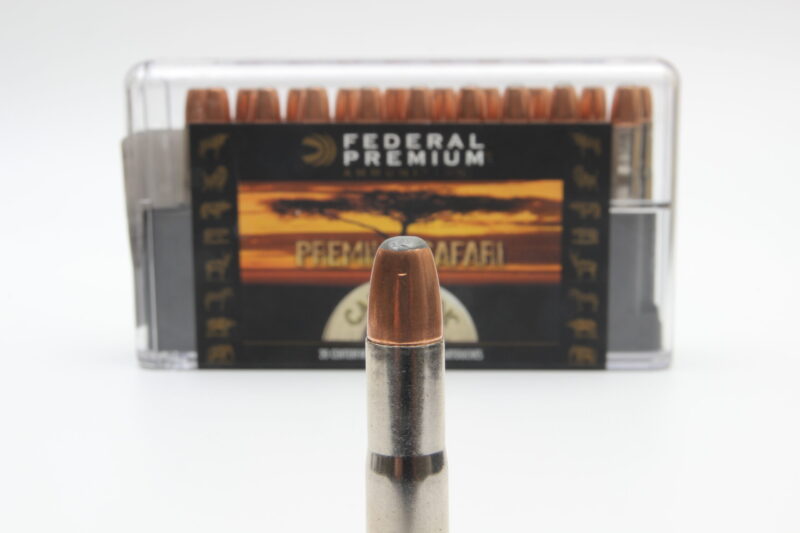
There are plenty of other types of rifle bullets built for special purposes — like this Federal .470 Nitro for dangerous game.
This bullet doesn’t worry about accuracy but focuses on the ability to plow through feet of flesh, brush aside girder-thick bone and keep going.
Plus, there is the possible argument that these huge flying ashtrays might even perform a bit better if they were solid (no hollow point). Having never tested this specific ballistic situation, I don’t know. However, I do know that marketing flash is just as important to ammunition manufacturers as any other business. Just because something appears on the store shelf, it’s not necessarily a better mousetrap in terms of performance — it just might be designed to perform better at getting you to release the credit card from your wallet!
The Others
There are obviously a million other bullet designs. Some are flat-tipped so you don’t detonate a magazine full of rounds in your lever action, and there are round nose ‘solids’ designed to bore through the heavy bone of things like elephant and cape buffalo. General speaking, these other types are designed with a specific purpose in mind aside from maximum accuracy or cheapest price, so the user needs to educate themselves and decide which the bullet is right for their needs.
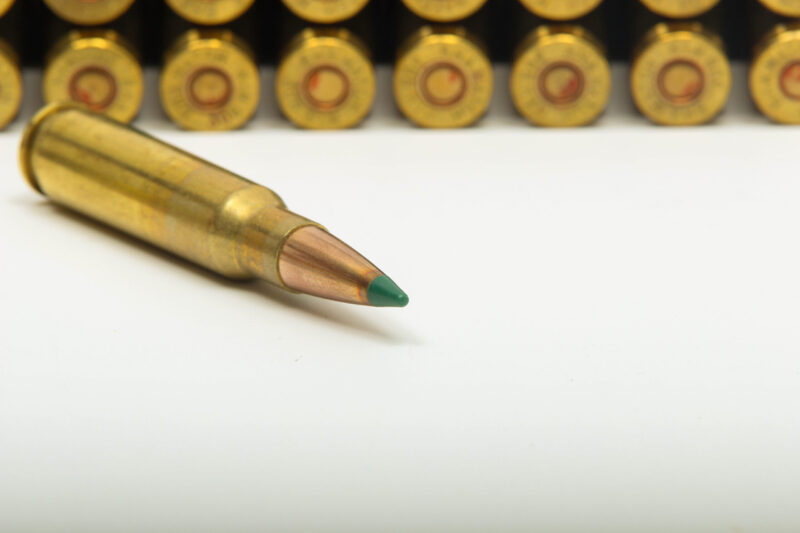
Many modern rifle bullets use a plastic or polymer tip to improve accuracy and also increase or control expansion,
as seen here in a Black Hills Gold .308 cartridge topped with a 168-grain Sierra Matchking bullet.
In the middle of this confusion are the newest polymer-tipped bullets. Some have a hard plastic insert, others have a more-flexible polymer for use in tube magazines and nearly all of them tout superior accuracy coupled with greater killing power. Of the ones I’ve used on game, they’re performed quite satisfactorily. Then again, maybe a more traditional bullet design would have worked just as well.
But that wouldn’t sell many new cartridges, would it?
Want more online exclusives from GUNS Magazine delivered straight to your inbox? Sign up for our FREE weekly email newsletters.