DIY 300 HAM’R Ruger American
Easy — Once You Get Past The Tough Part!
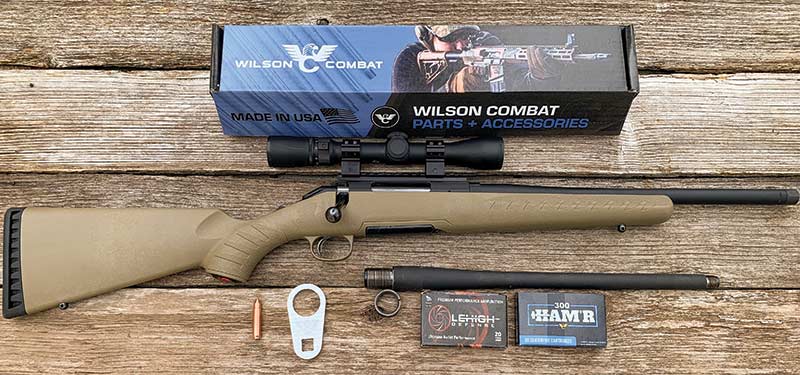
The completed rifle shown with factory barrel and tools
that came with the Wilson Combat 300 HAM’R barrel.
I should have known better — Bill Wilson of Wilson Combat (WC) has his act together. This past fall I received a couple of NULA rifles from WC to review and one of them, their 20S, was chambered for 300 HAM’R.
“What’s a 300 HAM’R?” I asked the WC media representative. I reluctantly agree and receive the scoped rifle, along with a nice sample of Lehigh Defense ammunition (which WC also owns) in a few days.
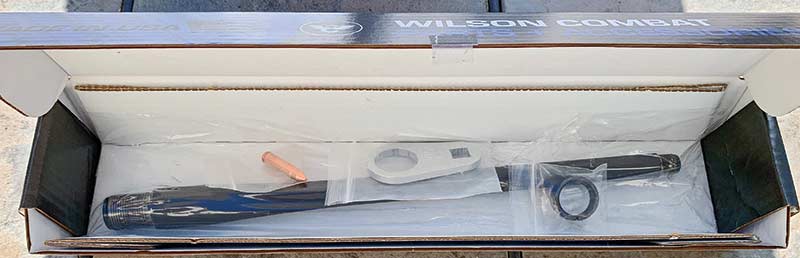
Here’s the Wilson Combat kit for 300 HAM’R. Mission accomplished!
Love Story
After digging around on the Internet and watching several YouTube videos, my curiosity is piqued and the gears start turning. This cartridge has everything I love, mainly because I’m a fiddler. I like fiddling around with brass, handloads and guns as much as possible. It keeps things real, making them seem more yours. My research showed the 300 HAM’R is a potent cartridge for its diminutive size, while being very efficient, powder-wise. Its parent case is .223 Remington, or 5.56, which you can pick up for free at any shooting range. Another big plus.
Converting the brass for the 300 HAM’R is as simple as using a Harbor Freight hobbyist chop-saw, which I already had for making 300 BLK cartridges. I just needed to order a jig for the chop-saw to make things easier. Lee Precision makes 300 HAM’R dies. All that’s required is running chopped brass through the sizing/de-priming die and your case is made.
My handloads shot well in the NULA rifle, almost as good as Lehigh Defense’s ammo, but I was getting excited. I knew from watching the WC videos they made 300 HAM’R barrels for AR-15s, but I’m more a bolt action kind of guy, despite building a half dozen ARs over the years. I’ve also been a big fan of Ruger American rifles because of their affordability and accuracy. I thought, “how cool would it be if WC made a drop-in barrel for the Ruger American chambered for the 300 HAM’R?” I Googled drop-in barrels for the Ruger American and imagine my surprise when I see WC beat me to the punch — they already made them.
Faster than a speeding bullet, I order one! Then I researched doing barrel swaps for the Ruger American. In theory, it seems simple. All you do is remove the barrel nut, unscrew the factory barrel, which in my case was my 300 BLK. Then screw in the WC barrel, use the “Go Gauge” to set headspace and then tighten with factory wrench. Piece of cake, right?
Let me tell you, whoever tightens the barrel nuts for Ruger must be part gorilla, it was that tight! Plus, it’s smooth so there’s no way to use a barrel wrench to get good purchase. I didn’t want to do it, but I even tried my pipe wrench in true “gun plumber” fashion and it still wouldn’t budge while securely held in a Wheeler Engineering barrel vise.
I’d read some used Dremel tools with small cutting wheels and thought, “Hmmm?” Graduating from “Gun Plumber” to “Dremel Guy” in the same day was an act of frustration. With steady, surgeon-like hands and sparks flying, I did it. The operation was a success! The nut popped off, barrel threads were unscathed and I happily unscrewed the factory 300 BLK barrel. Oh, boy! Now for the fun stuff!
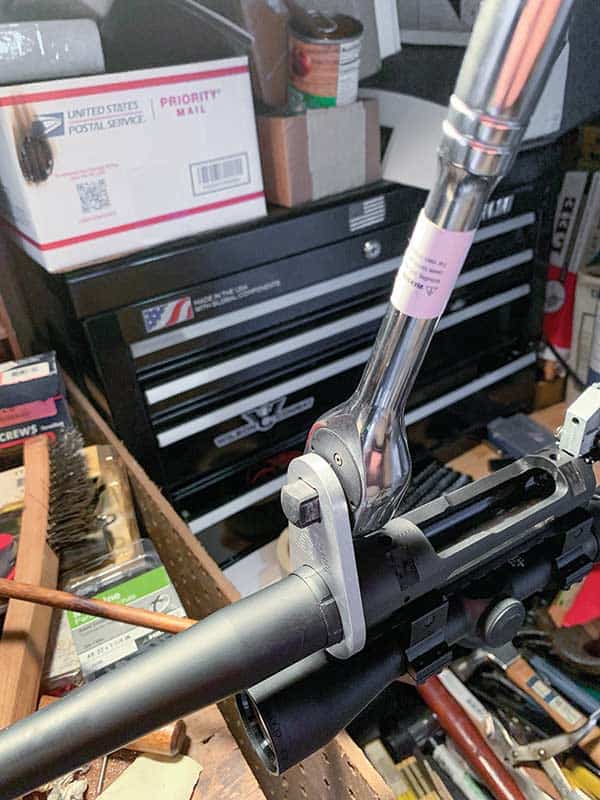
The WC barrel nut wrench (left) is used with a ratchet for leverage. The Ruger factory barrel nut (right) was no match for the Dremel.
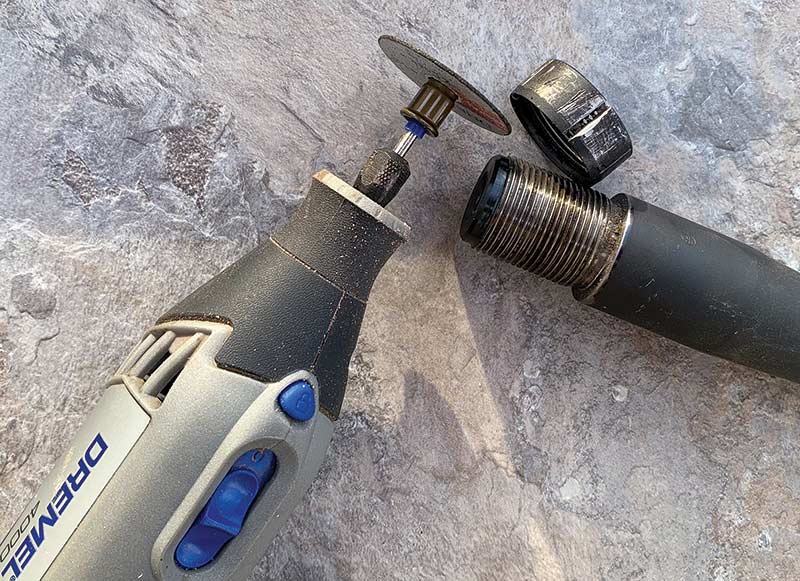
The Ruger factory barrel nut was no match for the Dremel.
The Install
Screwing in the WC 300 HAM’R barrel was easy. After screwing it in all the way, I used the “Go Gauge” for checking headspace. The bolt wouldn’t close. I unscrew the barrel a little at a time until the bolt closed on the “GO Gauge.” Then I hand-tightened the barrel nut and placed the barreled action in the barrel vise, ready to tighten the nut to the recommended 50 lbs. of pressure.
The WC barrel nut wrench has teeth fitting the wide spaced slits cut into it. A ratchet is used for leverage and the nut is tightened. The new barreled action is dropped back in the stock and action screws tightened. I now had a DIY Ruger American chambered in 300 HAM’R. I’ve got to say, I was feeling smug after the swap.

Here’s some homemade 300 HAM’R loads made
with 5.56 range brass. It’s easy and satisfying!
Shooting
Bill Wilson reported the Speer 130-grain hot core .30 caliber bullet is the nuts for hogs and deer. Using this bullet, loaded over Hodgdon CFE Black, using Lake City converted 5.56 brass and CCI 400 small rifle primers, my 3-shot groups at 100 yards averaged 0.750″. Lehigh Defense load with same bullets averaged 0.640 at 100 yards. But I was still happy.
If this sounds like something you may be interested in, it may be worth your while to have a gunsmith remove the factory barrel nut. It may save you a lot of frustration. The install is very easy. Or go for the gusto and grab your Dremel tool. Maybe I need to build one more AR-15? You already know the caliber and where I’m getting the barrel from!