Five Shots Fast
Stoeger’s M3000 Tactical Shotgun
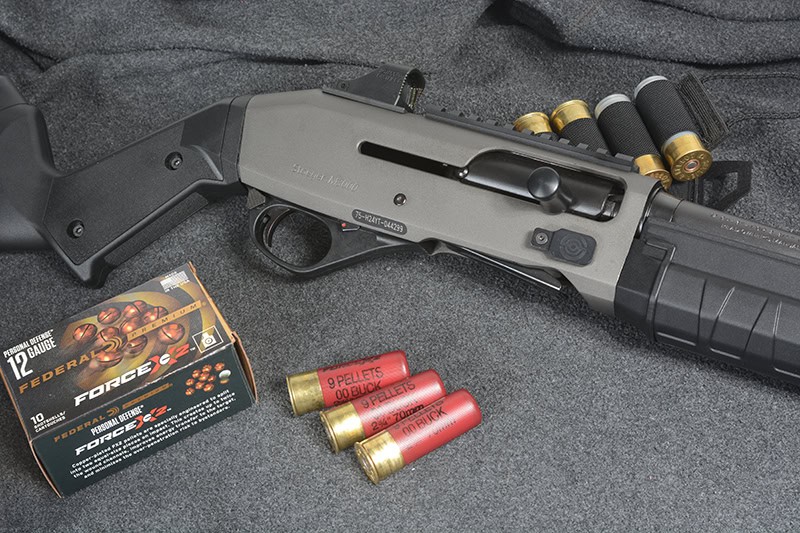
Stoeger’s newly-updated M3000 Tactical combines proven inertia operation with excellent handling qualities.
The breacher-style choke tube makes it clear this gun is intended for self-defense, not field use.
A dozen-plus years ago, I was invited to a skeet benefit. I wasn’t the only one who showed up with a 12-gauge pump, but I was the only one whose shotgun had a heat shield and a SureFire forend. I didn’t own a sporting shotgun at the time, and while I like clay pigeons, that gun wasn’t for that. Neither is Stoeger’s M3000 Tactical.
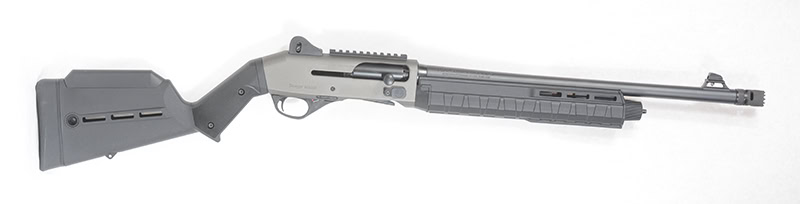
Stoeger’s newly-updated M3000 Tactical combines proven inertia operation with excellent handling qualities.
It holds 4+1, with lively handling characteristics and thoughtfully-designed mag well and furniture.
An update to the M3000 series of semiautos, the recently reconfigured Tactical is an inertia-operated 12-gauge intended primarily for home defense. It has a four-round magazine tube, for a total of five rounds, and an 18.5” barrel crowned by a removable breacher-style choke. It’s cylinder bore, but can be replaced by other Stoeger chokes if desired.
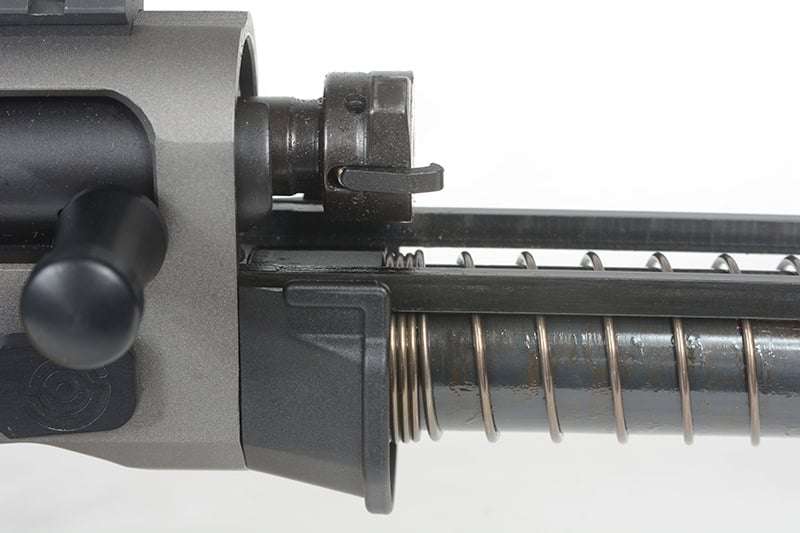
Like many semiauto firearms, the inertia mechanism of the M3000 uses a bolt carrier and a rotating head
that locks into a slot in the rear of the barrel. The difference is that instead of a gas tube or piston, the carrier
is forced backwards by a powerful spring that’s compressed by the gun’s recoil then suddenly extends,
driving the carrier back.
Part of Stoeger’s larger move into the defensive world, the M3000 is obviously a serious effort to incorporate the best of modern defensive shotgun features into an affordable package. Retail is $649, with the similarly-equipped P3000 pump a couple hundred less. While newer shooters may not be as familiar with it, Stoeger is one of the old names in the US gun market and has been around for over a century. I have a 1958 copy of the Stoeger Shooter’s Bible, which was already in its 49th edition by then.
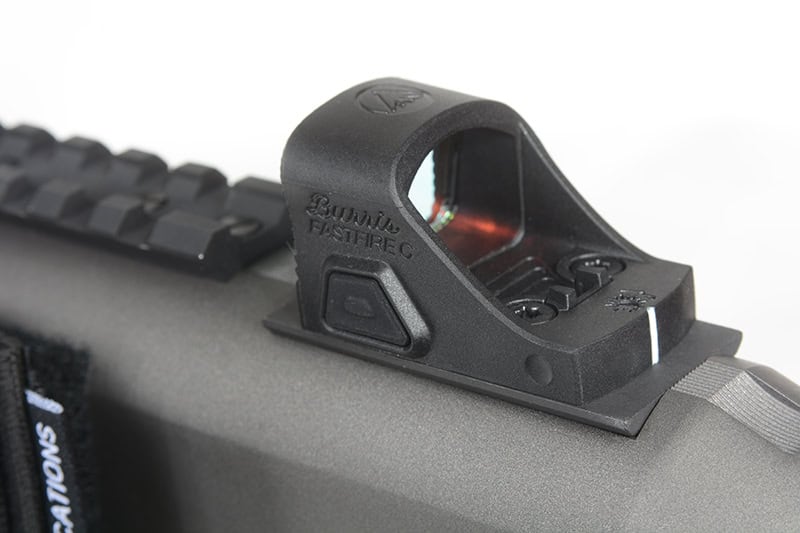
Jeremy used a Burris Fastfire C on the M3000. A micro dot designed for compact handguns,
the Fastfire C has a 6 MOA dot and mounts on Stoeger “C” plate.
The tungsten Cerakote receiver has a nicely scooped out magwell, and the rear of the forend is sloped to allow twin/quad loading. Controls are a cross bolt safety at the rear of the triggerguard and a prominent bolt release, but with the addition of a cartridge cutoff device that’s also appeared on some Benellis. Called a “cartridges drop lever” in the manual, the tab of the cutoff only protrudes if the hammer is in the cocked position (you can also check by looking in the cocking handle slot). Similar to how you must push the bolt release on a cocked pump shotgun to cycle the pump, even with an empty chamber, the bolt will not automatically lock open if the hammer is cocked. It will if the hammer is in the fired/down position, or if you pivot the cutoff lever upwards back into the receiver. The real benefit is that you can clear the chamber without another round feeding onto the carrier, for example, in Gunsite’s “Select Slug” drill, where you need to quickly swap the round in the chamber to another type.
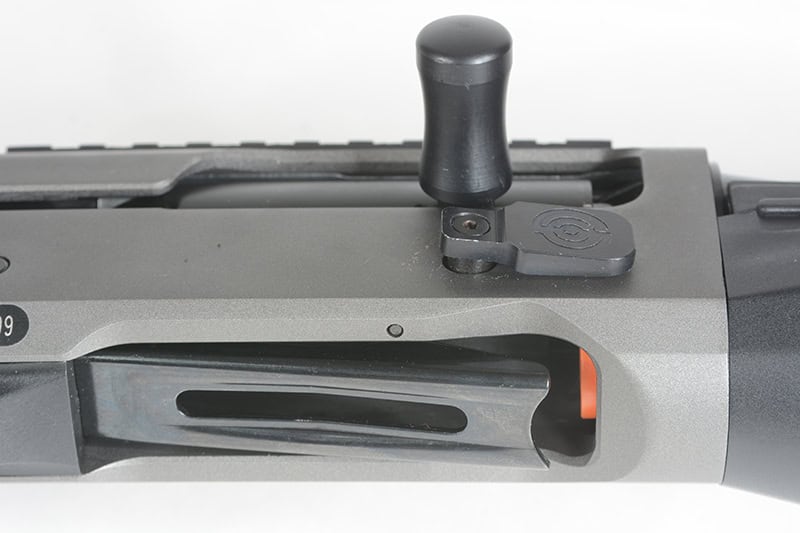
The tungsten Cerakote receiver has a nicely-scooped out magwell and the rear of the forend is sloped
to allow twin/quad loading. Controls are a cross bolt safety at the rear of the triggerguard and a prominent
bolt release and a cartridge cutoff device that appears on some Benellis.
Gone are the days of you’ll-take-it-and-like-it stock design. While the composite buttstock looks like it has more drop than usual, it comes with a comprehensive set of shims to adjust for cast and rise, and the comb features a comfortable rubber cheekpiece insert. The forend has a traditional sling stud on the magazine tube endcap and nine M-Lok slots (three each at 3, 6 and 9 o’clock). The buttstock has six and a pair of QD cup receptacles (you’ll need to add your own cups).
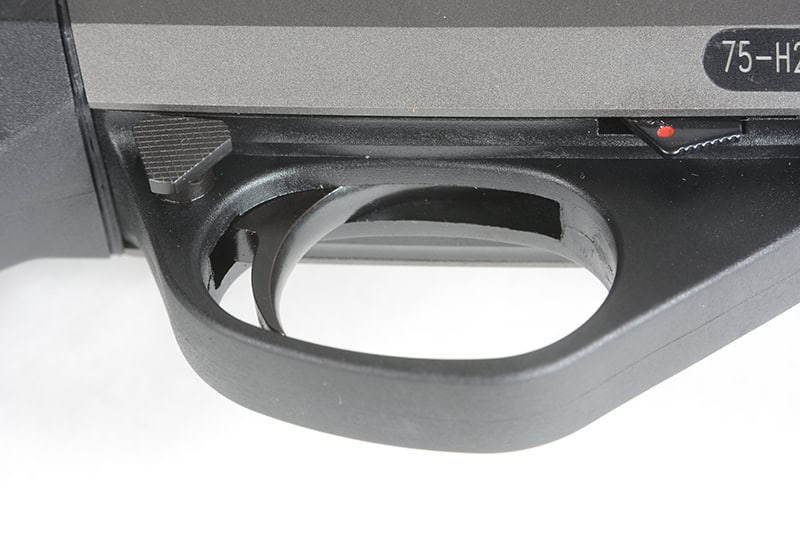
Called a “cartridges drop lever” in the manual, the tab of the magazine cutoff makes it possible
to lock the bolt back with a loaded magazine, enabling quick substitution
of the cartridge in the chamber, important for things like Gunsite’s “select slug” drill.
Sighting options are equally flexible. The M3000 comes with ghost ring sights installed, the rear an adjustable composite unit and the front with a prominent, wide blade begging to be replaced with a tritium insert. Both have protective ears. Prior to the acceptance of red dots, the ghost ring has been the gold standard for shotgun sights for decades. For those who haven’t used one, it’s an aperture sight with a thin ring that virtually disappears, causing you to focus on the front sight. There’s also a 10-slot length of Pic rail installed, an optic cut and a pair of plates for RMR and Burris sights.
For this test, I installed a Fastfire C red dot from Burris. With a 6 MOA dot, the micro sight is intended primarily for compact carry pistols, and its size makes it an unobtrusive addition to the M3000. It uses a “C” plate, which was not among those that came with the M3000, but which I had on hand.
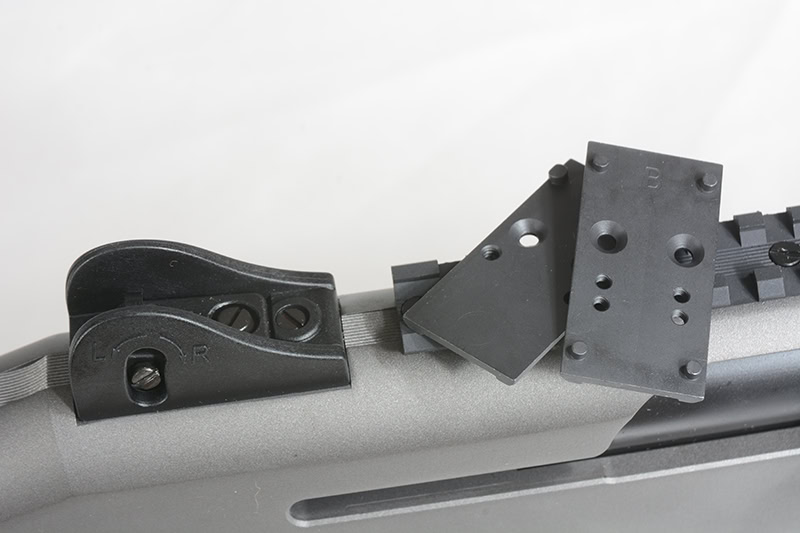
The M3000 Tactical comes with a Pic rail, ghost ring rear sight and a plate for those who wish to add
a compact optic. With a preference for small dots on shotguns, Jeremy used Burris Fastfire C micro dot.
Now for the elephant beside the room: Stoeger and Benelli are both owned by Beretta. Herein lies confusion. Despite the rumors, a Stoeger is not a Benelli by any other name. While the M3000 does feature the inertia action popularized on the M1 Super 90, this is the result of the patent expiring, rather than Benelli simply marketing their guns under another name. Benelli and Stoeger are not made in the same factory: they are not made by the same people. They are, in fact, not even made in the same country as one another.
About that inertia action. Most modern semiautos are gas-operated like your AR. There’s a gas port or two in the barrel near the muzzle, and it vents combustion gases down into a chamber formed by a piston encircling the magazine tube. Gas pressure forces the piston back, driving the action operating rods to unlock the bolt, allowing it to move backwards and cycle. In the systems I’ve been inside, it’s very similar to a pump, only the gas does the pumping.
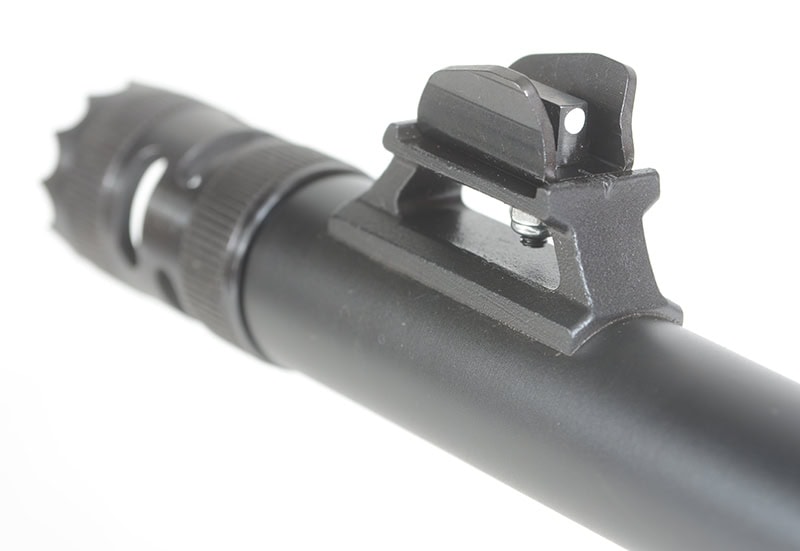
The front sight is a broad, well-protected blade that matches the rear ghost ring.
Also notice the aggressive breacher-style muzzle device, which tells you this gun is not for shooting clay pigeons.
You can replace it with a different Stoeger choke if you like.
When John Moses Browning created the first semiauto shotgun, he made it recoil operated instead of gas, which he arguably had also invented. Backwards as this may seem, whenever you second-guess Browning, start with the assumption you’re wrong. He knew a large amount of the ammo still floating around was loaded with black powder (remember, this was in 1899), which would quickly foul a gas system. Thus, the barrel of the Browning A5/Remington Model 11 recoils along with the bolt.
Inertia operation combines some elements of both gas and recoil operation. The M3000 carrier has a rotating bolt head at the front. Spring-loaded, as the carrier moves forward into battery, the bolt turns counterclockwise (viewed from the rear), and its lug locks into place in the barrel extension. So far, very AR-like: the difference is that while gas shoves the AR bolt carrier back to unlock it, inertia operation uses a powerful internal spring.
As recoil begins, the weight — “inertia,” if you will — of the bolt keeps it in place relative to the rest of the gun, which is pushing backwards and compressing that spring against the bolt carrier. At a certain point, the spring has all it can stand and extends again, punching the carrier backwards. Viola: The bolt rotates, the gun opens. There’s a very helpful animation online, and that’s what it took for me to understand it.
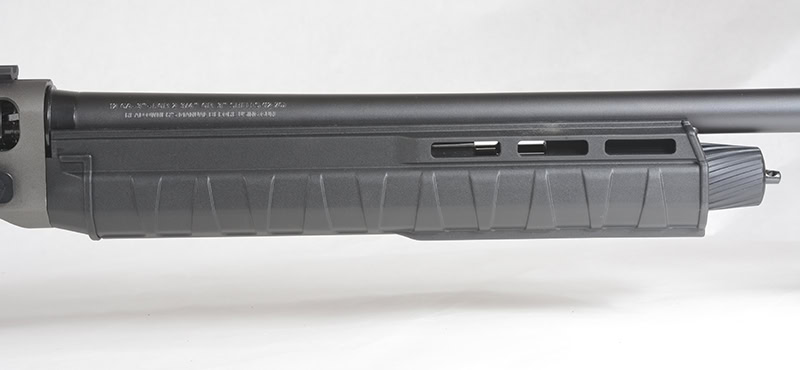
Most of us have specific ideas about how to accessorize our guns, so the forend has nine M-Lok slots
(three each at 3, 6 and 9 o’clock) for mounting slings, lights or other items,
and traditional sling stud on the magazine tube endcap.
With no gas blowing through it, it’s a cleaner system, and there’s little resistance to cycling the bolt, which is also helped by a prominent, hourglass-shaped cocking handle. The gun does, however, have to move a bit. It’s possible to weight the gun down enough to make it sluggish in recoil and affect its operation, but I did not encounter this, even adding a SureFire Scout light, shotshell cards from Ibex Applications, and the optic.
Inertia guns also have a reputation for benefitting from a break-in period, and for liking it hot. I spent some time with an earlier version of the M3000 at a Stoeger-sponsored shooting event in Texas, and really liked it. We shot Federal 9-pellet 00 BallistiClean buckshot, #7 1/2 Top Gun birdshot and slugs. I do not remember seeing a malfunction of any kind, anywhere on the line, even when shooting against the clock.
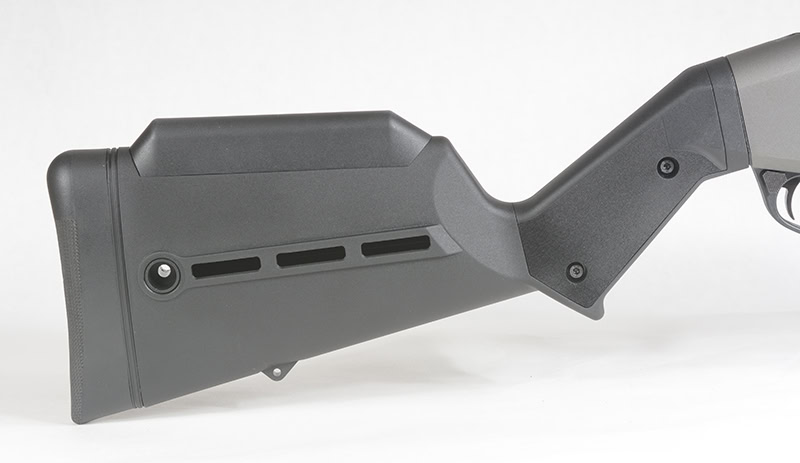
Gone are the days of you’ll-take-it-and-like-it stock design. While the composite buttstock looks
like it has more drop than usual, it comes with a comprehensive set of shims
to adjust for cast and rise, and the comb has a comfortable rubber cheekpiece insert.
Federal and Fiocchi provided ammo for this test, to which I added an eclectic mix of 12-gauge I had on hand. All together, I fired over 388 rounds of buckshot in #1 and 00 sizes, 325 grain slugs, and #8 birdshot.
And here’s where we get to a lesson. My usual practice is to take a gun out of the box and shoot it without cleaning or oiling. When I did that with the M300, it ran fine with full-power defensive ammo but struggled with birdshot. This didn’t bother me in the slightest — it ain’t for widgeon — but when I mentioned it in passing to Stoeger, I was reminded that anything with the correct dram equivalent should work. It was also politely pointed out to me that I might consider seeing if the gun had any lubrication.
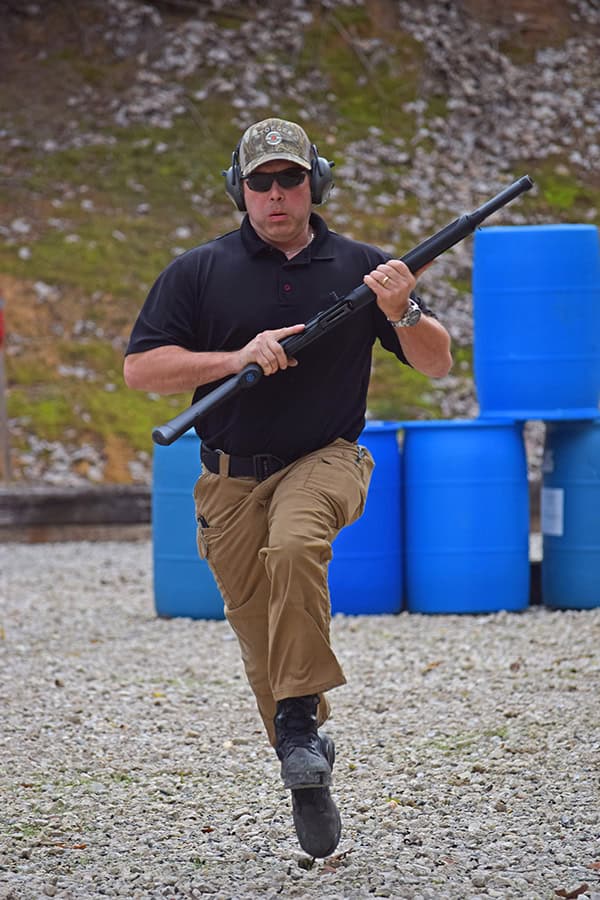
Jeremy running and gunning with an earlier version of the M3000 at a Stoeger event in Texas.
He never saw one malfunction there. Photo courtesy Stoeger/Media Direct.
After oiling it, suddenly birdshot was fine, and I proceeded to work through a couple hundred round boxes of Winchester #8’s and Federal #7 1/2’s without a hiccup (both loads had 1 1/8 ounces of shot and were 3 dram equivalent). The only round that wouldn’t cycle was Fiocchi’s 9-pellet buckshot load, which I had naturally assumed was loaded with 00 pellets. Imagine my surprise upon cutting one open to find they were #1 instead, a charge weight reduction of something like 40%. That makes it an excellent choice for a pump gun and the recoil-sensitive, but not a good match for the M3000. It particularly liked 00 buck at 1,300 fps, and a 15-round box of Winchester 3” 15-pellet 00 buck ran flawlessly. I can tell you the gun liked it a lot more than my shoulder did.
Ten-yard patterns averaged a little over five inches (tighter than the last couple defensive shotguns I’ve tested), handily putting the lie to the old expectation of 1” spread per yard. Standing, at 25 yards, I put 4/5 slugs into a big hole less than 2 1/2”, with a different sight picture sending one round a few inches away. Our range has a steel ram at 100 yards with a body that measures 10” high by 16” long, and with the Burris FastFire C, I managed a satisfying three hits in a row from standing. Believe me, you know when you hit it.
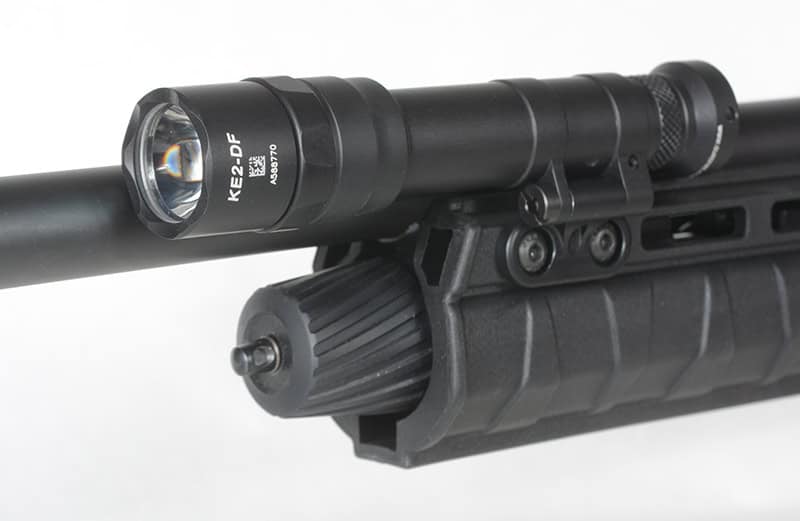
Jeremy added SureFire’s Scout Light Pro Dual Fuel, mounted with the M-Lok adaptor.
Boasting 1,500 lumens, it’s powered by either two 123 batteries or the included rechargeable battery.
I ran the gun with shot cards from Ibex Applications. Made with a flexible backing instead of the usual stiff one (it gives more support to the shotshell that way), they come in six and four-round capacities. I used four, since that’s what the mag tube holds. They worked well, and the much-relieved mag well of the M3000 was easy to reload quickly, including twin loads. Any fumbles, which I’ll blame on the 37-degree weather, were mine.
Out of curiosity, I ghost-loaded the gun. A bit fumbly to set up, it’s a competition technique where you have a full magazine and insert one additional round on the carrier and another in the chamber, raising the gun’s capacity by one — to six, in this case. I’d be leery about relying on it out in the real world, but in the case of the Stoeger, it worked with the rounds that were powerful enough to cycle the action.
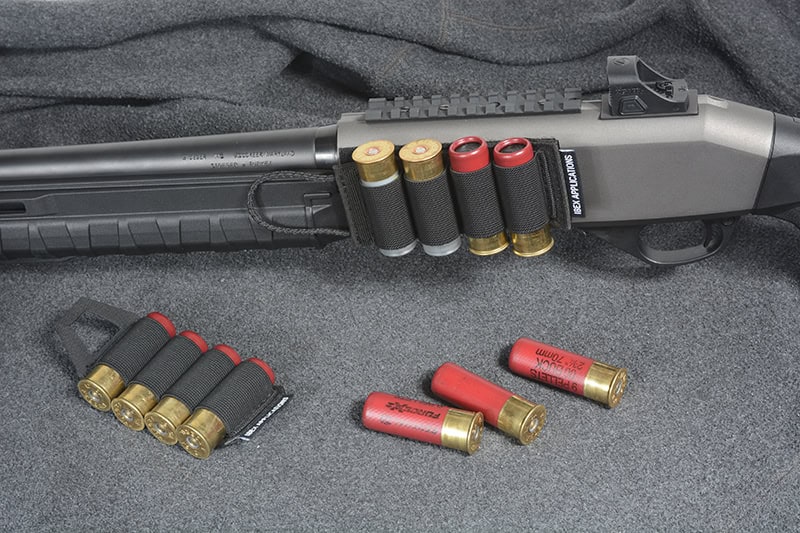
Jeremy ran the gun with shot cards from Ibex Applications, which are made with a flexible backing instead of
the usual stiff one. They come in six and four round capacities: he used fours since that’s what the mag tube holds.
Perhaps as a result of the short mag tube, the M300 has a light, lively feel, yet surprisingly lacks unpleasant recoil. Doing double-taps against the clock, I got split times down to .18 seconds (with a high of .21), using 00 buck. Like I said, five shots fast, and it ain’t for birdshot. I’d sleep well with it propped up by the nightstand.
Contact:
BURRIS OPTICS
burrisoptics.com
(888) 440-0244
FEDERAL AMMUNITION
federalpremium.com
(800) 831-8100
FIOCCHI USA
fiocchiusa.com
(417) 725-4118
IBEX APPLICATIONS
ibexapplications.com
STOEGER FIREARMS
stoegerindustries.com
SUREFIRE
surefire.com
(800) 828-8809
Want more online exclusives from GUNS delivered straight to your inbox? Sign up for our FREE weekly email newsletters.