The Mysterious 21-Gun Salute
Seven cans of Raid and the surprising history of
America's most misunderstood military salute
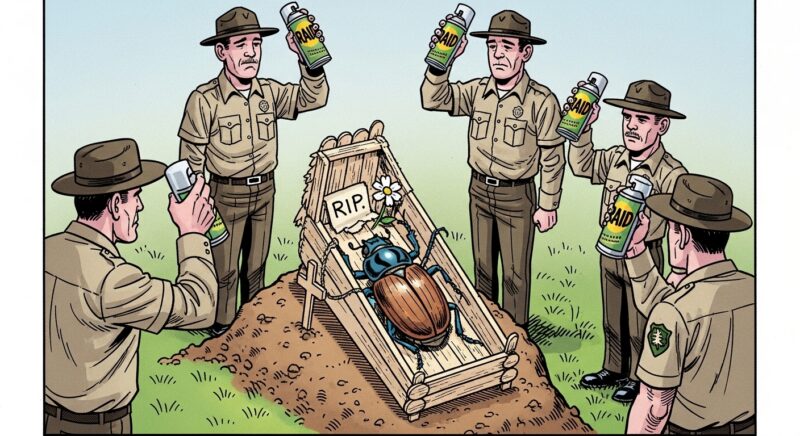
One of the most memorable funerals I’ve ever attended was for a bug.
His name, according to the official investigation, was Leroy D. Bug.
Our police academy was run like boot camp, complete with drill instructors, room inspections, formations and an unwavering attention to detail. Inspections were very serious business. You might not end up getting court-martialed like in the military, but getting kicked out meant losing your career, so nobody was play-acting.
During one morning room inspection, the drill instructor discovered the tiny carcass of an insect in the overhead light fixture of the room that another cadet and I shared. Since we’d thoroughly cleaned the light inside and out beforehand, I’ve always suspected Leroy’s untimely appearance was the work of a certain instructor who enjoyed giving “special attention” to recruits from my agency.
Murder in D Squad
Later that day, Lieutenant Davis called my roommate and me to attention in front of more than 100 recruits during afternoon formation and solemnly announced evidence of a homicide had been discovered on academy grounds. We were presented with a tiny plastic case containing the mortal remains of the victim — a small black beetle we later determined was likely a picnic beetle, Glischronchilus spp. — and were ordered to conduct a complete investigation and then submit our findings to the instructional staff. The instructor also mentioned we should handle the remains in a dignified fashion.
My roommate, a fellow smartass, embraced the assignment with enthusiasm. He produced a comprehensive professional investigative report complete with photographs, diagrams, witness statements and an autopsy. I then took charge of the final arrangements.
My father had been a funeral director, so I had spent enough time around funeral homes to know how these things were supposed to work. Our dorm room became the site of Leroy’s visitation. Organ music played from a cassette recorder, and a bouquet of flowers surrounded a tiny velvet-lined casket fashioned from Popsicle sticks. Cadets stopped by to pay their respects, some struggling heroically to maintain their (faux) composure.
Word Spreads
An hour later, our entire academy class formed up in the driveway outside the building. By then, word had spread, and many members of the concurrent State Police Academy class fell in with us. The assembled group then marched in solemn formation to a small patch of ground beside the academy where one of our classmates — a legitimate ordained minister — conducted a proper graveside service for Mr. Bug.
As the ceremony concluded, seven cadets stepped forward, each carrying a can of Raid insect spray. At my command, they rendered three perfectly timed volleys over Leroy’s final resting place.
By then, the on-duty overnight drill instructor — who just happened to be Lt. Davis — had summoned several off-duty staff instructors from their nearby homes. They arrived just in time to witness one of the most unusual military-style funeral ceremonies ever conducted.
When it was over, I closed the service with words I’d heard my father say countless times at the end of real funerals.
“This concludes the services for Leroy D. Bug. Feel free to linger as you wish.”
Silence. All eyes were on Lt. Davis. He stood there for a moment, nearly speechless. I was sure he’d find the humor in our little program, but I was also mentally prepared to start selling paint at Walmart if he didn’t.
Finally, Davis laughingly said he’d never forget what he’d just witnessed. Whew! Someone had captured the entire ceremony on videotape, and for years afterward, it was shown to incoming academy classes. Whether intended as an example of initiative, teamwork or simply what happens when bored police recruits are given too much creative freedom, I’ll never know.
As ridiculous as it all sounds, our improvised ceremony borrowed from a tradition stretching back centuries. What we performed wasn’t technically a 21-gun salute, as many people (and I) would have called it. It was something different — a three-volley salute — and the distinction is one many Americans don’t realize. Let’s take a look.
Why Gunfire?
To modern ears, it may seem unusual that explosions and gunfire are associated with respect rather than conflict.
Yet throughout history, loud reports have served as public expressions of honor. Cannons announced the arrival of dignitaries. Muskets marked military victories. Rifle volleys honored the fallen. Even today, the boom of artillery on Independence Day reminds us that freedom was not won quietly.
Colonial Americans celebrated the Fourth of July with bells, bonfires, fireworks, speeches — and gunfire. Militia companies fired muskets into the air. Artillery pieces thundered from town squares and forts. The sound itself became part of the celebration, linking remembrance of the nation’s birth with the sacrifices required to secure it.
The tradition continues today every time an honor guard presents arms at a veteran’s funeral or a ceremonial battery fires in recognition of a national occasion.
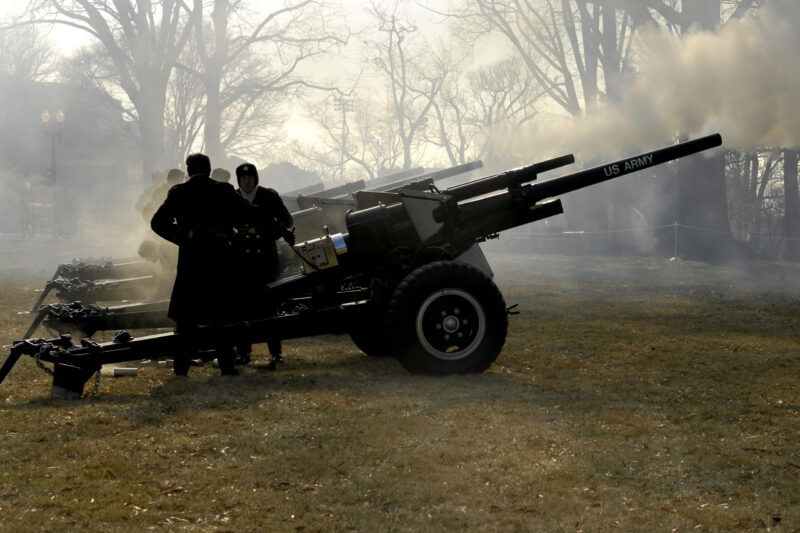
An actual "21-gun" salute is rendered with a battery of field artillery pieces or cannon,
not shoulder weapons carried by riflemen. Here, members of the Presidential Salute Battery,
an element of the 3rd United States Infantry Regiment, perform a 21-gun salute.
Photo by Senior Airman Kathrine McDowell, USAF (Public domain)
Three Volleys
Attend a military funeral today, and you’ll almost certainly hear someone remark, “They’re giving him a 21-gun salute.”
Usually, they aren’t.
The ceremony most Americans witness is a three-volley salute, traditionally performed by a rifle detail of seven service members. Each fires three rounds on command, producing 21 shots in total. It’s easy to understand how the misconception developed, but the number of shots doesn’t make it a 21-gun salute.
The origins of the three-volley salute reach back hundreds of years. According to one legend, during battles in Europe, opposing armies often agreed to temporary cease-fires so each side could recover and identify its dead. Once the fallen had been removed from the battlefield and burial details completed their work, three volleys of musket fire signaled that the army was prepared to resume fighting.
Another version of the origin story says it came from the Roman custom of throwing dirt on a body three times, saying the deceased’s name three times and finishing by saying “Vale” (farewell) three times before burial.
It should also be noted the numbers in the birth year of the United States — 1776 — also add up to 21. Perhaps it’s only an interesting coincidence?
Regardless of how it started, the three volleys of rifle fire have evolved into a solemn expression of honor and remembrance. Today, it remains one of the most recognizable military and law enforcement funeral traditions in the United States.
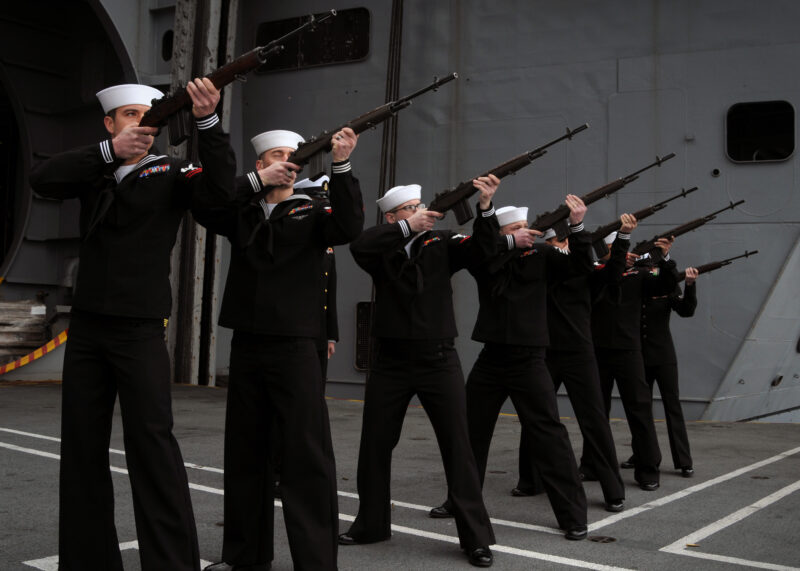
What most people think is a “21-gun salute" is actually a “three-volley salute" performed by rifles.
Here, sailors on the USS Abraham Lincoln armed with M14s perform a three-volley salute during a burial at sea.
U.S. Navy photo by Mass Communication Specialist Seaman Apprentice Aaron Hubner (Public domain)
21-Gun Salute
The true 21-gun salute has an entirely different history — and it doesn’t involve rifles at all.
Its roots allegedly lie in the Age of Sail. According to common tradition, warships entering a friendly harbor fired their cannons to demonstrate peaceful intentions. Once the guns had been fired, they were temporarily incapable of returning fire, reassuring those ashore that the vessel approached without hostile intent.
Early naval vessels commonly fired seven guns, largely because shipboard powder supplies were limited. Shore batteries, with far greater ammunition reserves, answered with three shots for every one fired by the ship, resulting in 21 guns from land.
As naval technology improved and powder became more plentiful, the practice evolved until 21 guns became the accepted international standard. By the late 19th century, many nations had adopted the tradition, and it remains the highest ceremonial military honor rendered by artillery.
Today, a true 21-gun salute in the U.S. is reserved for occasions of national significance, including the inauguration of a president, the funeral of a president or former president, the arrival of foreign heads of state and other ceremonies designated by military protocol.
Other Military Salutes
While the 21-gun salute receives most of the attention, it isn’t the only ceremonial gun salute recognized by the U.S. Armed Forces. Military regulations prescribe different numbers of artillery rounds depending on the office or rank of the individual being honored.
The 21-gun salute remains the nation’s highest military honor, reserved for the President of the United States, former presidents, visiting heads of state and a handful of occasions of national significance.
Military regulations also prescribe artillery salutes ranging from 11 to 21 guns, depending on the office or rank of the individual being honored. The 21-gun salute remains the highest ceremonial honor, while 19-, 17-, 15-, 13- and 11-gun salutes recognize other senior civilian officials and military leaders according to established protocol. Notice something? These are all gun salutes, meaning artillery — not riflemen.
Lucky Thirteen?
Long before the United States grew to 50 states, the number 13 carried enormous significance. The original 13 colonies became the original 13 states, and the number appeared repeatedly in early American symbolism — from the stars and stripes on the first national flag to the arrows and olive leaves clutched by the eagle on the Great Seal.
For many years, ceremonial salutes of 13 guns marked important national observances, reflecting the nation’s origins. While the 21-gun salute eventually became the internationally recognized highest military honor, 13 remains woven throughout American military tradition.
Fifty Guns
Presidential funerals actually involve two different military salutes, which often causes confusion. The president receives the traditional 21-gun salute — the nation’s highest ceremonial military honor — fired by an artillery battery as part of the funeral service. But on the day of the burial, military installations across the country also fire a separate 50-gun salute at the lowering of the flag, one round for each state in the Union. While the 21-gun salute honors the individual, the 50-gun salute represents the nation itself paying tribute to its fallen commander in chief.
Fortunately, the 50-gun salute is heard far more often under happier circumstances. At noon each Independence Day, military installations fire the same 50 rounds as the traditional “Salute to the Union.” Whether celebrating the nation’s birth or mourning the loss of a president, those fifty rounds symbolize the 50 states standing together as one nation.
More Than Noise
This Independence Day, you’ll probably hear fireworks from every direction. If you’re fortunate, you may also hear something else — a crisp three-volley salute or the measured boom of ceremonial artillery marking the nation’s birthday.
These reports are far more than noise. They are echoes of centuries-old customs honoring sacrifice, celebrating liberty and reminding us that some traditions are worth preserving.
As for Leroy D. Bug, I’m sure he’s long since returned to the dust on the grounds of the Indiana Law Enforcement Academy and his popsicle-stick casket has become humus. I have no idea what became of that old VHS tape. Yet, every July Fourth, when I hear ceremonial artillery or gunfire, I can’t help but smile.
After all, not everyone receives full funeral honors — and very few have gotten their three volleys from cans of Raid.
Get More Guncranks Every Week!
By submitting this form, you are consenting to receive marketing emails from: . You can revoke your consent to receive emails at any time by using the SafeUnsubscribe® link, found at the bottom of every email. Emails are serviced by Constant Contact