Is Your Goose Truly Cooked?
Hard Decisions After a Big Fire
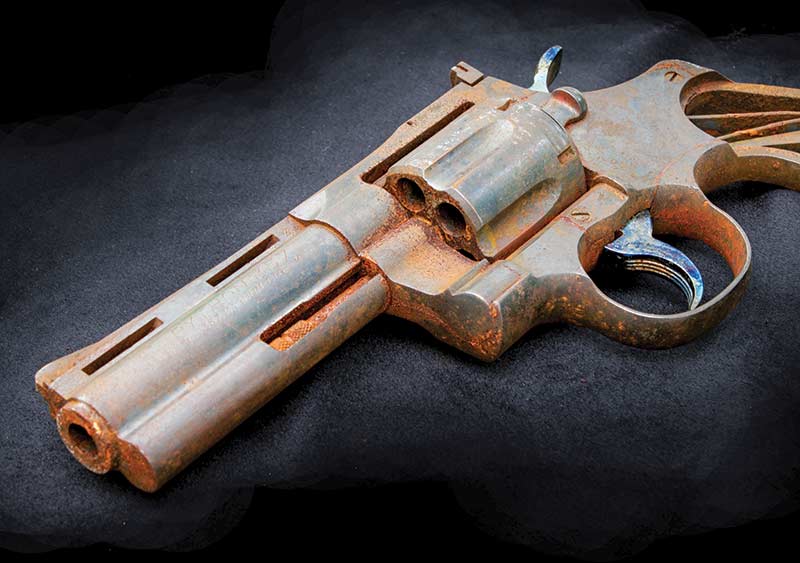
Can this gun be saved, or is it destined for the scrap bin? Unfortunately,
there’s never a hard and fast answer but there are general guidelines and,
more importantly, experts like Turnbull Restoration who can help you decide.
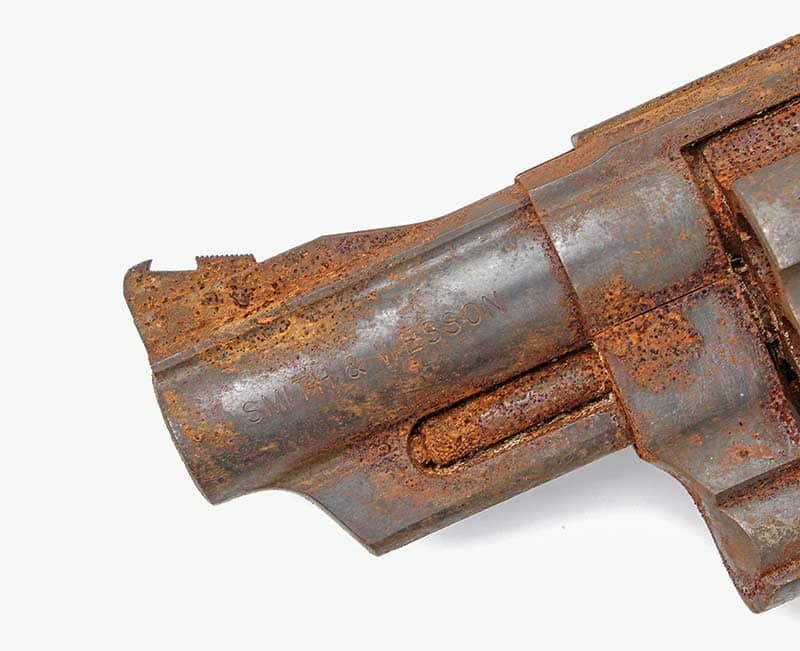
Fire hot enough to completely burn off plastic and wood indicates a no-go for repair or restoration (below). Note the missing front sight insert.
As readers may remember from my story in the August issue of GUNS, I awoke on the morning of January 8th 2025 — along with thousands of my Los Angeles neighbors — to some truly horrific news: My house had burnt to the ground, along with decades of personal effects, creature comforts, and yes, most of a firearms collection.
I heard a psychologist remark recently that our possessions are one way of linking our souls to the environment around us. If you lined up all of my vintage Winchesters, Smith & Wesson revolvers and military surplus handguns, they would have told a story of who I was, how I spent my time, and what I valued. When it was safe for me to return to my home — what was left of it, anyway — I was apprehensive to see what had become of my collection. I hoped for the best but expected the worst.
As my buddy’s angle grinder fell silent and the contents of my safe were dumped into a bed of ash, it became clear the fire was merciless to the items I cherished most. I’d run through a lot of emotions in the days prior, but it was only then I realized I’d joined a strange fraternity of people whose lives were now marked by tragedy.
Secondarily, I found myself staring at a pile of extremely damaged firearms and wondering what, if anything, could be saved. This question brought me into the orbit of Turnbull Restoration and the company’s General Manager, Steve Lester. With Steve’s help, I got a better idea of the conditions under which a gun can be saved from the effects of fire or flood and at which point they are likely done for.
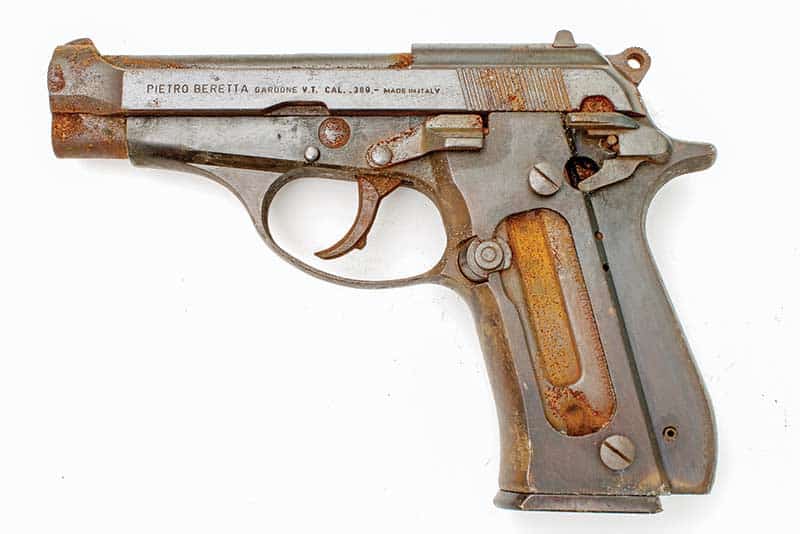
Clayton’s beloved Beretta 84 post-fire (above). Though it still resembles “a gun,” it’s utterly toast. Through-hardened, seized, and with no original finish left (below), it’s beyond the possibility of repair.
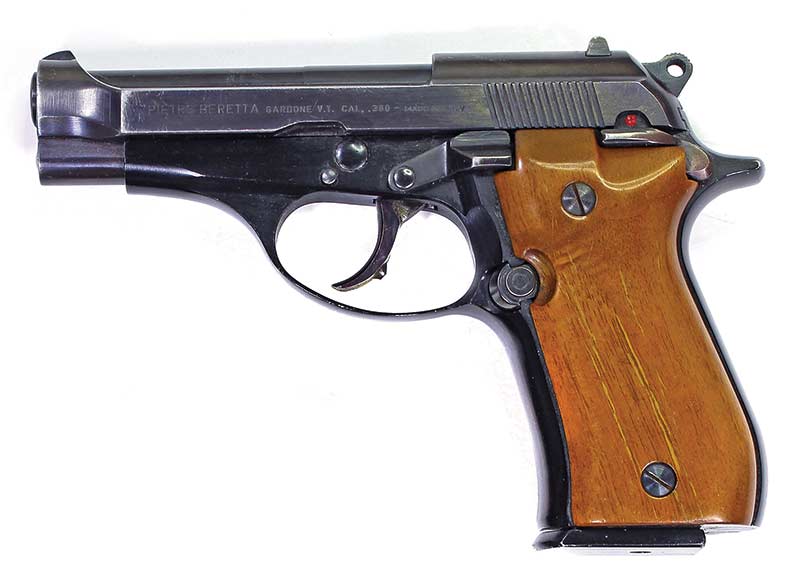
Through-hardened, seized, and with no original
finish left, it’s beyond the possibility of repair.
All Wet
Steve says he’d much rather deal with water damage than fire damage, so it makes sense to begin here. When a gun is dunked underwater or left in a room doused by a fire hose, one of the most obvious signs of damage comes in the form of oxidation. We know it by its more familiar term: Rust.
While firearms can certainly rust when exposed to nothing but the air around them, water accelerates the chemical process. Not only is water more oxygen-rich than the air we breathe, but it can also contain a number of electrolytes — a reason why salt water will cause a metal to rust more rapidly than freshwater. Under these conditions, the iron molecules at the surface of a firearm will more rapidly lose electrons to ambient oxygen molecules.
Given enough time, rust will continue to eat into the surface of the firearm. When removed or dissolved, rust can leave behind cavities and indentations we call “pitting.” Additionally, when rust forms in the tight spaces between two machined parts, it can fuse metal together and result in seized, inoperable firearms.
As for the wooden components of a firearm like the stock, grips and fore end, extended water exposure may cause warping or swelling. As the wood deforms, it can bind or drag against other parts or cause a shotgun or rifle action to become misaligned with the stock. However, it may be possible to dry, reshape, and refinish the wood, assuming the parts can’t simply be replaced altogether.
Some good news: Steve says that in many cases, guns are salvageable from flood damage even if they’ve been completely submerged for several days. Even pitting can be addressed by welding up the affected cavities to replace lost material, sanding the surface flat, and refinishing the part. However, if a gun has been exposed to months or years of intense moisture, it may simply be too corroded to work with.
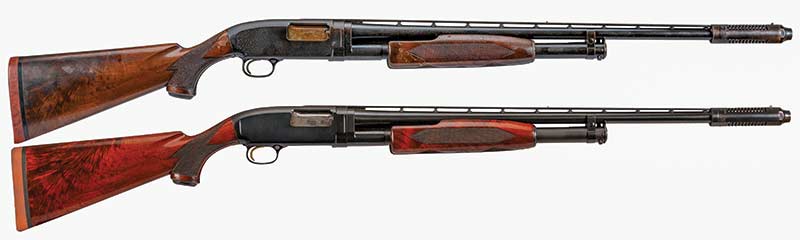
Before — This Winchester Model 12 came into Turnbull with fire damage.
Photo: Turnbull Restorations
Going Through Changes
It’s certainly possible for a gun to survive a house fire. Affected firearms might be limited in their direct exposure to flame, stored in a safe that offers some level of fire protection, or perhaps their location might have been expeditiously doused by the local FD. All of those contingencies raise a gun’s chances of returning from the dead, though in such cases it’s not unusual for the item to be water- or smoke-damaged.
Steve says most gun owners aren’t fully aware of how nasty smoke can be to a firearm. The kind of ash a house fire produces is extremely caustic. In fact, the first thing Steve recommends to anyone who recovers their guns from a fire is to soak them in a bath consisting of about five gallons of warm water, half a cup of Tide detergent and at least 3 lbs. of baking soda. That should stop any of the acids from the soot from damaging the metal further.
Unfortunately, if the firearm is exposed to prolonged and extreme heat as an entire house burns down around it, the chances of survival begin to plummet.
Understanding why involves a consideration of metallurgy. Fact is, a gun’s ability to safely contain a small explosion is only because of its manufacturer’s thorough knowledge of the way various alloys change with temperature. As a metal is heated, its crystalline structure begins to change. When controlled, heat treatment can improve a metal’s wear resistance, strength and toughness. By the same token, however, extreme temperatures can change a metal’s crystalline structure in undesirable ways, making it unacceptably weak or brittle.
Here, Steve mentioned case hardening as an example. In the early days of the gun industry, the purpose of case hardening was functional, not aesthetic — it was a means of adding strength to various firearm parts without affecting the “through hardening” of the steel. But even in the late 19th century, the case hardening process was controlled, applied consistently to steel of a known and uniform composition, and only affected a few thousandths of an inch deep.
A house fire, on the other hand, will burn somewhere between 1,000 and 2,000 degrees Fahrenheit, heating any metal unevenly, unpredictably and often long enough to completely change its physical properties.
As one example, when I was removing my torched Remington 870 from my destroyed property, an exposed stock screw was preventing it from settling nicely into a plastic storage box. I was able to bend that screw by hand into a U-shape like a cheap spoon. A firearm whose metallurgy has changed so dramatically is absolutely not safe to fire, even if it still mostly looks like a gun.
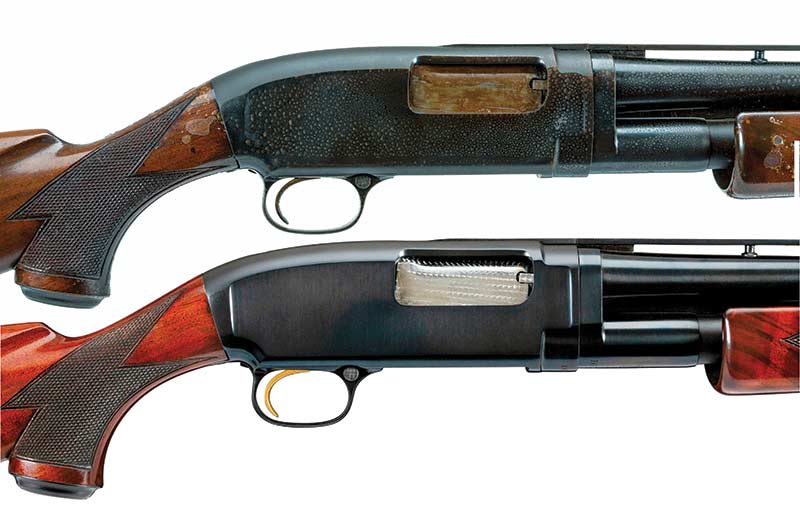
Before — A closeup of the action of the Winchester Model 12 as it came into the Turnbull shop. Note the blistered finish and water spots. Surprisingly, this damage indicates the gun can be saved. Photo: Turnbull Restorations
Key Diagnostics
I asked Steve if there were any “magic numbers” to start a damage estimate, but he noted it’s difficult to impossible to quantify damage based on duration or temperature alone. Fortunately, there are quite a few simple indicators Turnbull uses to determine if a gun can be restored. Often, they can assess a project’s feasibility through just a photograph or two.
The first set of diagnostics concerns the status of any wooden or plastic parts. “If the finish used on the wood has bubbled, that’s usually okay,” Steve said. “It’s not typically hot enough to affect the metal’s structure.” However, if the stocks or fore ends have the alligator charring typical of burnt firewood, it’s probably toast. It’s definitely toast if the wood or any plastic material has completely disintegrated.
By the same token, metal surfaces can speak volumes. With blued firearms, Steve says to look for any signs of pitting or scaliness in the finish. If that disfigurement is present, restoration is likely a no-go. And, supposing a fire was hot enough to completely remove the finish of a firearm, leaving all of the metal “in the white,” the gun is almost assuredly done for.
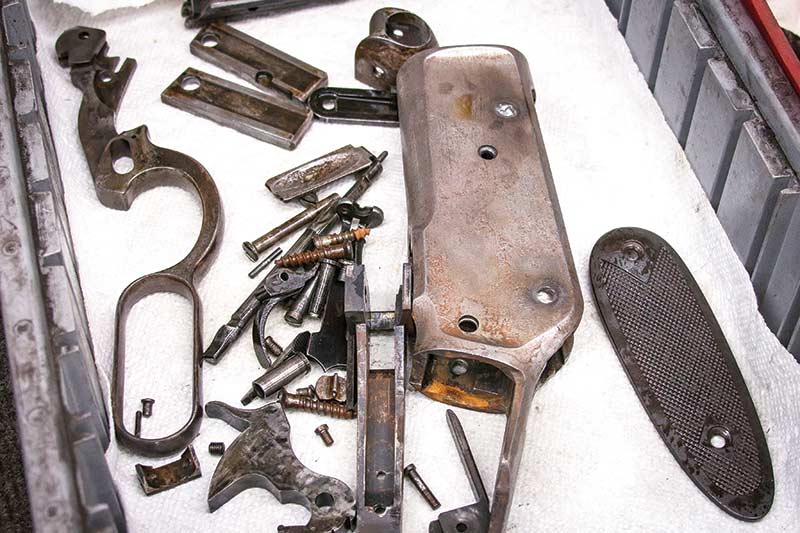
People often underestimate the amount of work it takes to truly restore
a gun from neglect or major damage. This Winchester 1886 needed extensive
metal prep, woodworking, engraving and refinishing by Turnbull experts.
Photo: Turnbull Restorations
The Price of Sentimentality
If a piece is safe to work on, the question moves from one of “can” to “should.” Here, Steve offers the following: Most people who inquire about a restoration vastly underrate the time and cost involved. Many shooters hope a gun can be brought back from the dead for a couple hundred bucks; in reality, one can expect a project to run several thousand dollars when skilled labor is involved.
Steve shared with me the before-and-after pictures of a Colt Single Action Army utterly destroyed by a house fire — it wasn’t a project they would normally take on given the extent of the damage, but Turnbull wanted to give themselves a professional challenge. The results very nearly beggar belief — the transformed revolver is a work of magic. However, by Steve’s estimate, it required 60 to 80 hours of labor to perform this particular feat of necromancy.
Steve tells me about 70% of all firearm restorations are too far from economical. Instead, he says he and the Turnbull staff are most excited to give the royal treatment to firearms central to a family’s history. “For us, it’s about giving a beloved gun another hundred years and two more generations.”
I asked Steve what recent project was most gratifying to him. He responded without hesitation: Turnbull had painstakingly restored a humble Marlin .22. When the project was finished, multiple generations of shooters made the trek out to the company’s headquarters to receive and admire the firearm, each of them sharing their own memories and tales of what the gun meant to them.
New Chapters
My conversation with Steve — and his distillation of Turnbull Restoration’s decades of expertise — confirmed what I had suspected: Anything I didn’t carry out from my home in Altadena, Calif., was gone, gone, gone. A restoration of any particular flame-scorched piece was precluded by considerations of time, expense and safety. Even for those rare and unusual items I’d pulled from the ash, I realized it would be easier and less expensive to repurchase similar examples. I suspect most shooters dealing with the aftermath of a house fire will reach the same conclusion.
But as the saying goes, where one door closes, another opens. One silver lining to navigating this year’s wildfires has been really getting to know Turnbull Restoration, whose work I’ve admired for decades. Thanks to Steve, I learned just how much care, concern and craftsmanship goes into each project Turnbull takes on.
True, I won’t be sending any of my burnt husks to Steve and crew. However, I look forward to someday sending one of the guns I did carry out to the gifted artisans at Turnbull. I can think of no better way to commemorate my own story of survival and transformation, and it would give me great pleasure to one day pass down such a treasure to the ones I love.