The .38 Smith & Wesson
Big Medicine For A Pocket Revolver

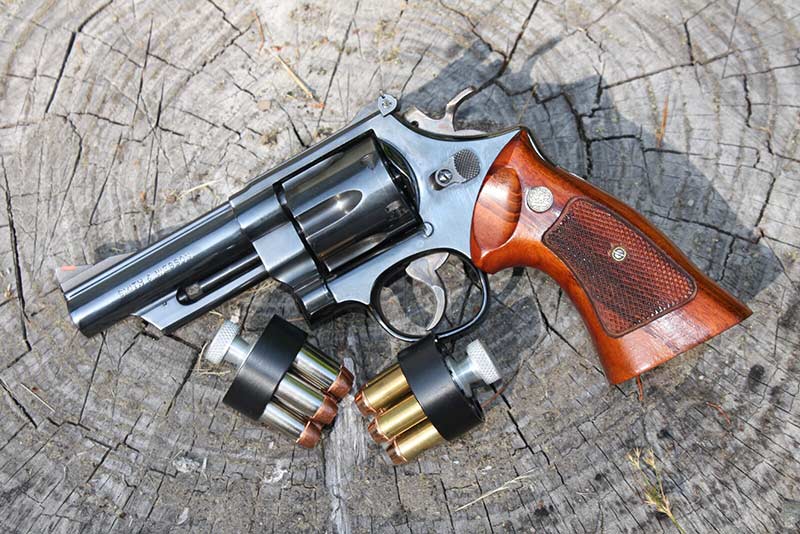
This is Alan’s near-pristine “Lemon Squeezer” S&W New Discovery in
.38 Smith & Wesson. The .38 S&W was commonly chambered in
pocket pistols until the 1940s.
Some consider the Smith & Wesson .38 obsolete. Admittedly, most shooters expect better performance from a cartridge. But at one time, it was considered a powerhouse and was trialed as a U.S. Army cartridge.
Before we go further, I want to be clear — the .38 S&W is not to be confused with the .38 S&W Special. The .38 S&W we are discussing was introduced as a black powder cartridge in 1876. Compared to other cartridges, the .38 S&W was big medicine. Colt used the same cartridge but called it the .38 New Police. It is also called the 38 S&W Short and the .38/200.
Lemon Shake-Up
In 1887, Smith & Wesson took innovation in a different direction with a revolver dubbed the New Departure. It was double-action only, with a hidden hammer and palm safety. It was the perfect pocket revolver, and Smith & Wesson played up how safe it was, calling it the “Safety Hammerless.” But the design inspired the moniker “Lemon Squeezer,” which persists 138 years later.
The New Departure came out right when the U.S. Army contemplated reducing its cartridge size in rifles and revolvers. The new thought was the .45 Colt was excessive for the job of killing a man, a decision they would regret later.
Some thought the new Colt revolvers with the swing-out cylinder chambered in .38 Colt would be a good fit, while others felt the Smith & Wesson New Departure in .38 S&W would be the best choice for a cavalry trooper. They decided to have field trials with both and ordered 100 of each. The S&W New Departure was ordered with 6″ barrels to match the Colt.
Initially, the Smith & Wesson gun proved more accurate, but the Colt cartridge had more power. The Smith & Wesson proved to be slightly faster in loading and firing. The testing went back and forth as the testers devised outrageous ways to cause mechanical failures.
The trials treated both revolvers shamefully, dragging them through torture test after torture test, including repeated baths immersed in a solution of sal-ammoniac, which rusted the gun actions to the point mallets were required to persuade them to function. Ultimately, the Colt was chosen because it could be fired single or double action, had a better trigger, better balance, and most importantly, fewer parts. However, the Smith & Wesson showed well.
The failure to become the new military standard sidearm did nothing to stop the public from buying them by the hundreds of thousands. By the time the New Departure was removed from production, Smith & Wesson had produced a quarter-million as they transitioned through the various improved models. Production ended in 1940. Since the New Departure was so popular, copies were made. Iver Johnson and Harrington & Richardson are two of the most common.
It is common to find them in a heavily rusted state. But, every so often, one is found in great shape, similar to the one I own.
Side matches are a part of Cowboy Action Shooting, specifically SASS. Many of the side matches are speed-oriented, including pocket pistol matches. The object is to empty a period-correct pocket revolver as fast as possible at a steel target. Smith & Wesson lemon squeezers are a popular choice.
You will find many warnings not to fire these old break-top revolvers because they have weak frames. It’s good advice.
But my revolver is well taken care of and is in the same shape as when it was boxed up at Smith & Wesson. In addition, I will not use man-stopper loads as I only want to punch holes in paper and make a steel target ring.
Since the .38 S&W is such an old and largely obsolete cartridge, it’s rare to find it on the shelf or in modern reloading manuals. The Lyman Cast Bullet Manual still has the .38 S&W listed, but it warns only to use the loads listed in solid-frame guns. Should I be concerned? Maybe.
I decided to see what was written when break-top revolvers in .38 S&W were common, so I went to the loading manuals of the 1930s.
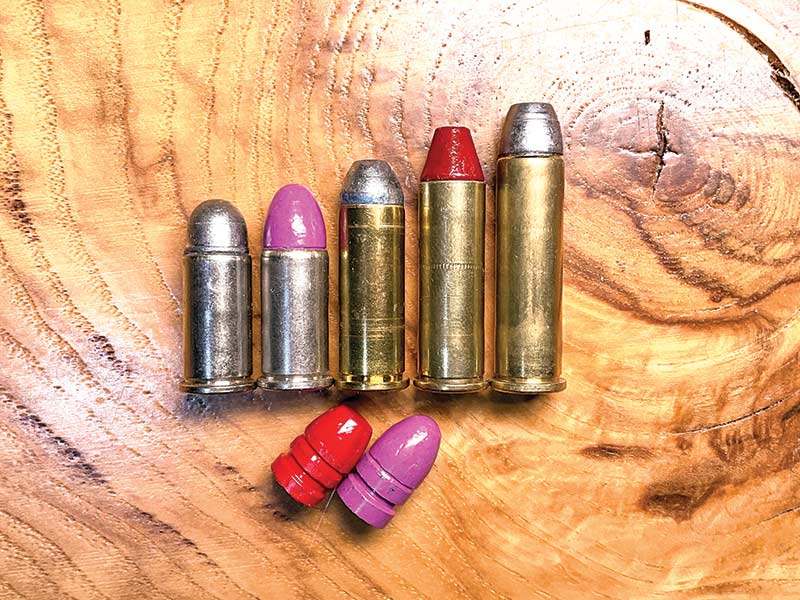
Left to right: Once considered a powerhouse, the two .38 S&W
handloads on the left are dwarfed by the .38 Colt, the .38 S&W
Special and the .357 Magnum
Recipes
For decades, the standard pistol powders were Unique and Bullseye. In 1936, Ideal listed the starting weight for a 147-grain bullet as 2.0 grains of Bullseye, with no restrictions on the type of gun used.
I had no plans to punish the revolver. In my quest for a low-power match load, I focused on a 125-grain bullet but also tried a 160-grain bullet to compare. The original loading used during the U.S. Army testing gave 635 fps with a 146-grain bullet, which is anemic by today’s standards but great for plinking and competition.
For the experiment I tried a variety of powders — Bullseye, Unique, a favorite; Red Dot, one of the bulkiest currently available; Titegroup; and American Pioneer Powder (APP) FFFg black powder substitute. I have seen bad reviews of APP in muzzleloaders, but cowboy action shooters swear by it. During the powder shortages, it has always been available.
All the loads used were surprisingly accurate. Remember, the revolver is double-action only with rudimentary sights and a short barrel. Once again, Titegroup had the most consistent velocities.
The Smith & Wesson New Departure with a 3.25″ barrel was used to test all loads. Velocities were chronographed with a LabRadar LX chronograph and averaged from 607 to 1044 fps. Starline cases and Federal Small Pistol primers were used throughout.
The mildest and most accurate load was with the 125-grain bullet over 2.0 grains of Titegroup. Velocity averaged 598 fps for 10 shots with a minuscule deviation of 7 fps. Unsurprisingly, the hottest was the same bullet over 4.5 grains of Unique. It pushed the velocity to 1,044 fps on average, while the deviation was a very reasonable 11 fps.
In almost all cases, my loads had higher velocities than what was listed in the manuals, sometimes significantly higher. I recommend starting at the minimum loads and checking your results before going higher.
Overall, I was impressed with the accuracy and low recoil of the .38 Smith & Wesson. Many target shooters have previously recommended it, and now I see why.