.41 Magnum – The ‘Do-It-All’ Caliber
Too Versatile to Vanish
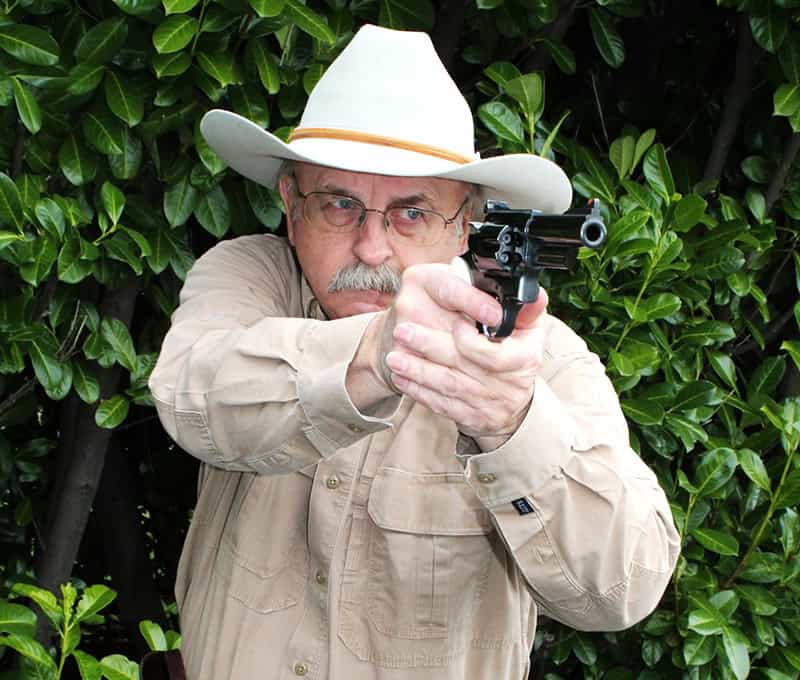
Dave likes revolvers, and his favorite caliber is the .41 Magnum.
He’s used sixguns in this caliber for hunting, competition and personal protection.
When Smith & Wesson introduced the .41 Magnum back in 1964, it was initially aimed at the law enforcement market, as evident by the writings of the late Elmer Keith and Bill Jordan, but nowadays, some 62 years later, I’m pretty certain they didn’t fully anticipate what the cartridge—and the revolvers for which it is chambered—have become.
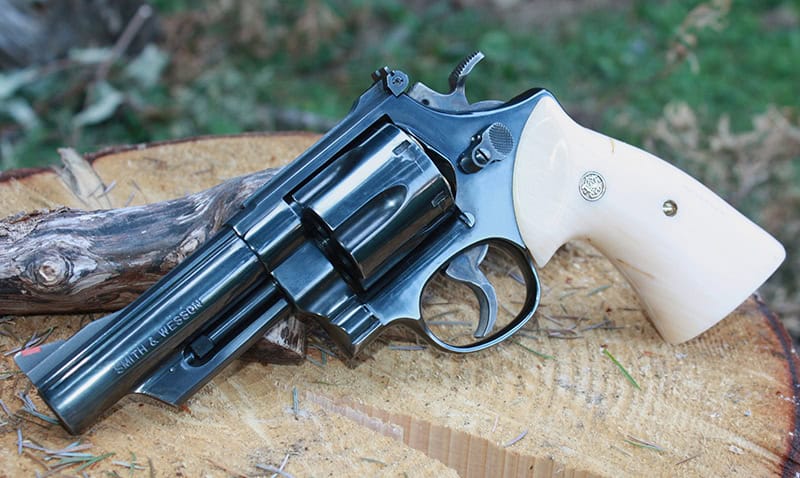
Revolvers chambered for the .41 Magnum can be pretty snazzy.
By the time all six rounds have been fired, you’ve gotten plenty of attention.
Cult Classic
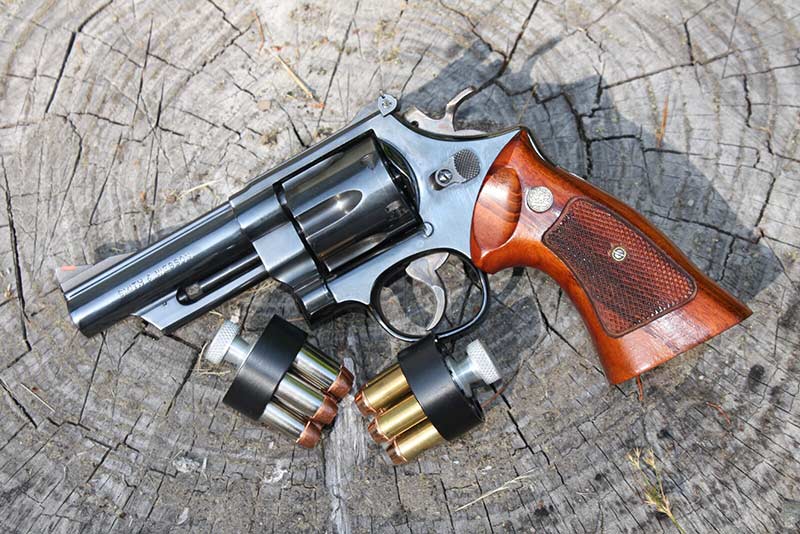
The .41 Magnum has gained the status of a cult classic, and count me guilty, I’ve got more than one wheelgun chambered in this caliber, both single- and double-action, and for sheer eye candy, the Model 57 S&W with a 4- or 6-inch barrel wins the blue ribbon. The M57 pre-dates the internal lock, and both of my guns have the firing pin on the hammer.
When Smith & Wesson introduced its .41 Magnum, it was built on the same frame as the .44 Magnum, which came along about nine years earlier. Only the bore size and chamber dimensions were different.
No Longer Disappearing
In a world dominated by semi-autos, more than a few people have wondered why older guys such as me continue to gravitate toward big bore revolvers. The answer is fairly straightforward. First, revolvers are relatively simple to operate. We don’t have to struggle with slides, heavy recoil springs and magazines which might decide to malfunction. Second, shooting revolvers both consciously and subconsciously teaches us to count our shots carefully, and in the process we learn trigger discipline and the need for taking accurate shots; i.e. we don’t “spray and pray.” We’ve learned to make each shot count.
And there’s something else in the wind. Last year I interviewed three very reputable holster makers and all agreed customer requests for holsters to fit revolvers have been trending upward. Whether those new revolver owners gravitate toward the .41 Magnum or some other caliber, the “middle magnum” is in no danger of disappearing.
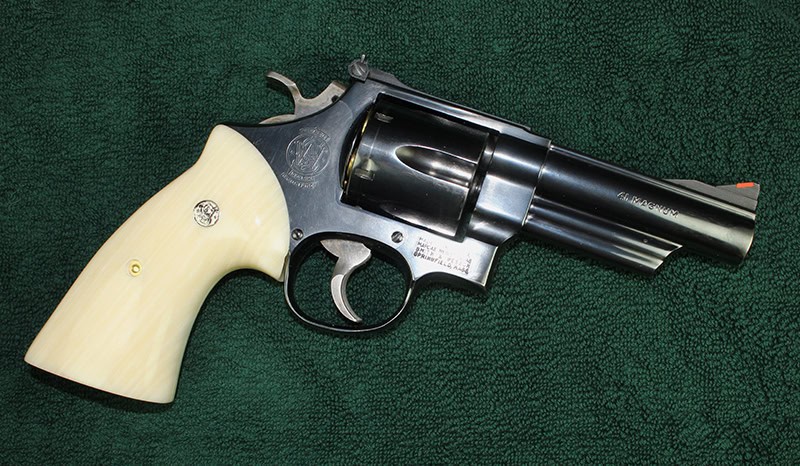
Beauty shot of a Model 57 wearing a set of Kirinite grips from Eagle Grips.
Less Recoil Is Better With Age
It’s been my good fortune to have purchased two double-action 1980s-era Model 57s with smooth double actions and crisp singe action trigger letoff. I’ve never felt the necessity to adjust either one. The only changes have been the addition of after-market grips from Eagle Grips (www.eaglegrips.com) on the company’s Heritage pattern. They fit my hand perfectly.
While the caliber, and the revolvers designed to handle it, didn’t gain the desired acceptance in the police world, long-range silhouette shooters and a gradually increasing fraternity of handgun hunters quickly found much to like. They discovered early on that with comparable loads, the .41 Magnum demonstrated it could do pretty much everything the .44 Magnum was already doing, but with a flatter trajectory and – by some accounts, anyway – about 20 percent less felt recoil.
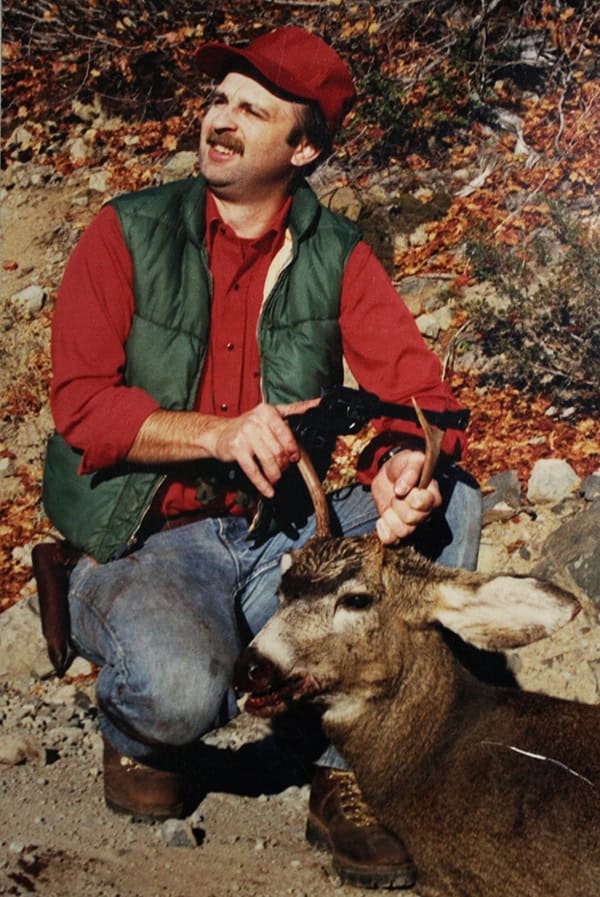
Years ago, Dave anchored this high country mule deer buck
with two shots from his Ruger Blackhawk.
Big Game? Not A Problem
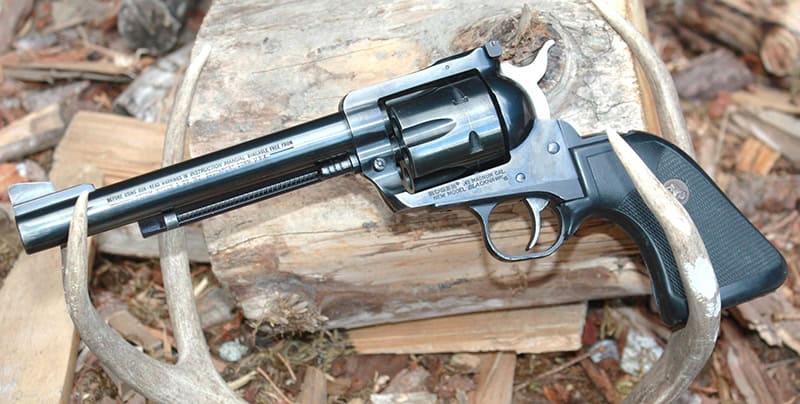
When I helped push for big game handgun hunting in Washington state back in the early 1980s, most of my associates rushed to purchase Ruger Super Blackhawks and Model 29 Smith & Wessons, or other handguns in .44 Magnum. I opted for a Ruger Blackhawk with a 6.5-inch barrel in .41 and never looked back. I’ve used that sixgun to take both coastal blacktail and mule deer, and a few years ago, I anchored another muley buck using a 4-inch Model 57 Smith stoked with handloads. Keith shot caribou in northwest Alaska with his S&W .41 Magnums, and the cartridge has also accounted for black bears, whitetail deer, wild boars and other game.
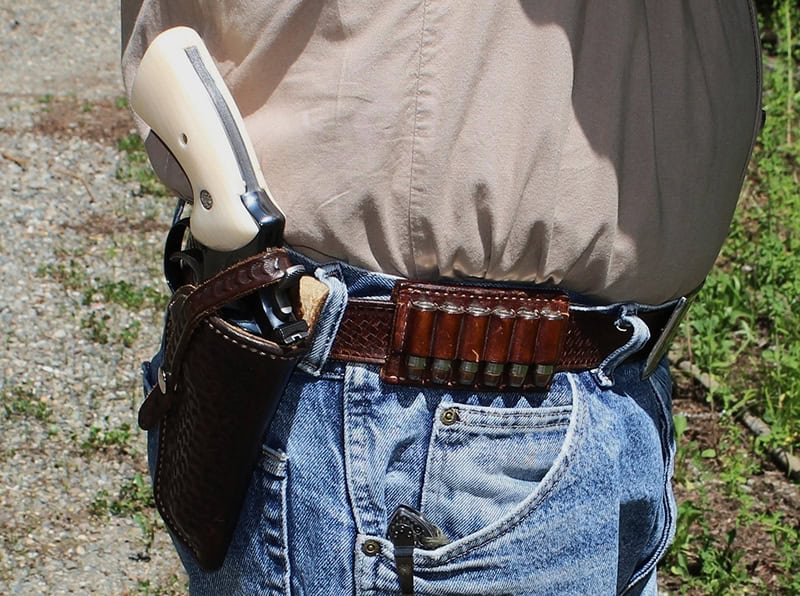
Although a Model 57 S&W is not a small gun, it carries well in a belt holster,
with extra cartridges on a belt slide carrier.
Versatile Carry Gun
Over the years, I’ve carried a .41 Magnum for hunting, back country hiking, firewood cutting and during the winter, even for personal protection. Under a winter parka, that big cannon vanishes when carried in a vintage Safariland shoulder holster. I’ve competed with the 6-inch Model 57, and some of my shooting buddies have done likewise in long-range events.
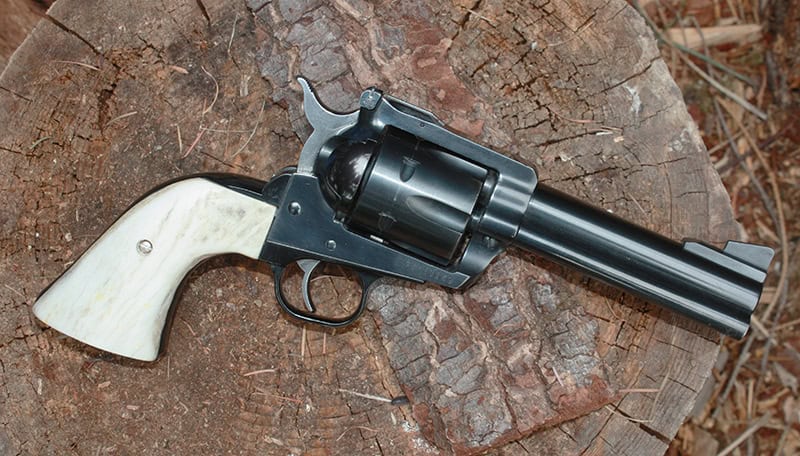
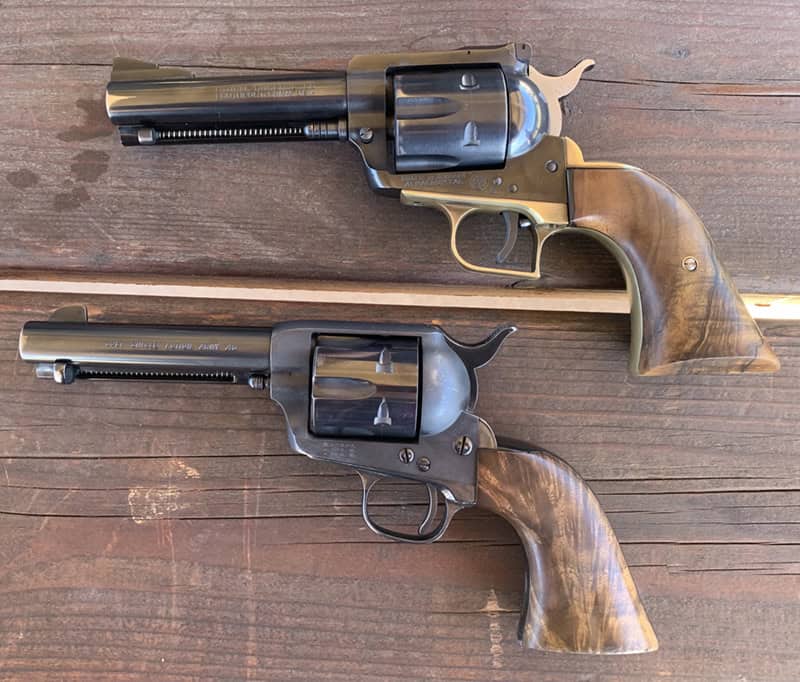
A few years ago, Dave handcrafted a set of elk antler grips for his Blackhawk, with a 4 5/8-inch barrel.
Handloading Delight
The .41 Magnum cartridge features a case length of 1.290 inches, with a 0.492-inch base. The maximum overall cartridge length is 1.590-inches, according to SAAMI specs. It takes a heavy roll crimp for the best performance. When I reload, I’ll check each case and the Speer reloading manual suggests a trim length of 1.280-inch.
Thanks to advances in bullet and propellant development, the .41 Magnum has become a handloader’s delight. One of my fellow .41 fans, Guy Maakad, who shoots a Model 51 S&W with an 8 3/8-inch barrel, has turned his shooting and handloading into something of a science.
“The .41 Magnum,” he observes, “as a long range caliber enjoys advantages over larger bored handguns, namely in less recoil with a flatter trajectory for the same bullet weight. The .41 sports a better ballistic coefficient and sectional density over the .44 in the same frame firearm with the same size cylinder. The .41 has a thicker cylinder wall, especially in the cylinder stop notch area.”
To underscore his observation, Guy loads a healthy dose of 2400 behind a 220-grain Speer half-jacket bullet—which is no longer made, but being a bright fellow, Guy stocked up some years ago—and ignites it with a standard large pistol primer. He seats the bullet with a heavy crimp, and I can say from experience, it bucks! Guy uses the same powder behind a 212-grain Keith-style cast lead semi-wadcutter, and I have witnessed him hitting targets placed well beyond a hundred yards.
Keith, whom many rightly credit as being the “father” of long-range handgunning, wrote about how he and Jordan strolled around the National Rifle Association convention in 1963, lobbying for development of the cartridge. Jordan, in his own account, likewise recalled that event. I once treated Jordan to a cold lemonade in Dallas, but if he and Keith were around today, I’d buy them something a bit more stout!
Depending upon the propellant, a .41-caliber 210-grain JHP can warp out of the muzzle at better than 1,500 fps, and a couple of loads using H110 or W296 are capable of surpassing 1,600 fps. I can say from personal experience the .41 Magnum is a game stopper. No doubt it would also stop a two-legged predator in his tracks as well.
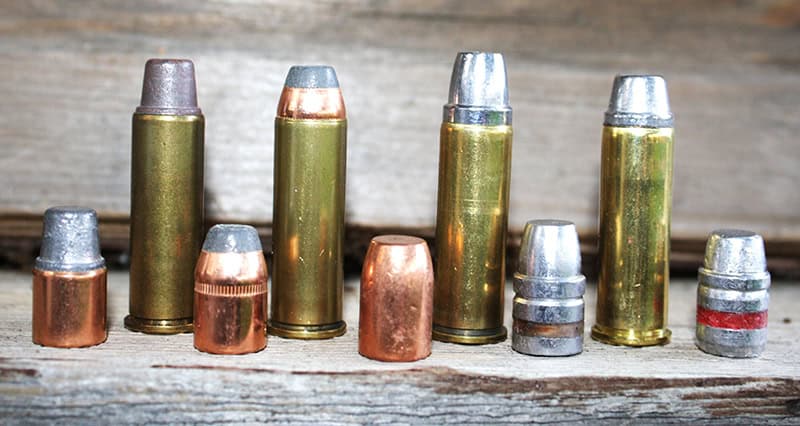
There is a wide choice of jacketed, plated and hard cast lead bullets for the .41 Magnum.
Dave has tried all of them and they all work.
Favorite Loads
My personal favorite loads have included 16.5 grains of 2400 behind the now-discontinued 200-grain Speer half-jacketed hollowpoint (I still have about a half-full box of these), or 20 grains of H110, launching a 210-grain Nosler JHP. Lately, I’ve also been shooting 170-grain Sierra JHPs over 24 grains of H110 (and that’s not the hottest load suggested!), or a 215-grain cast lead SWC from Rim Rock bullets, over 16.0 grains of Accurate #9, which is delivering decent results.
Another .41 Magnum afficionado is my pal, Ed Ditunno of Idaho. He uses Lyman’s 410449 cast bullet over 18.0 grains of H110, sparked by a CCI350 large pistol magnum primer. He’s put thousands of rounds downrange, and he told me recently his own 6-inch Model 57 has never needed any repairs or a reset of cylinder timing. His wife, Debbie, uses that gun in the annual Elmer Keith/John Taffin memorial handgun shoot, and she’s devastatingly accurate with it.
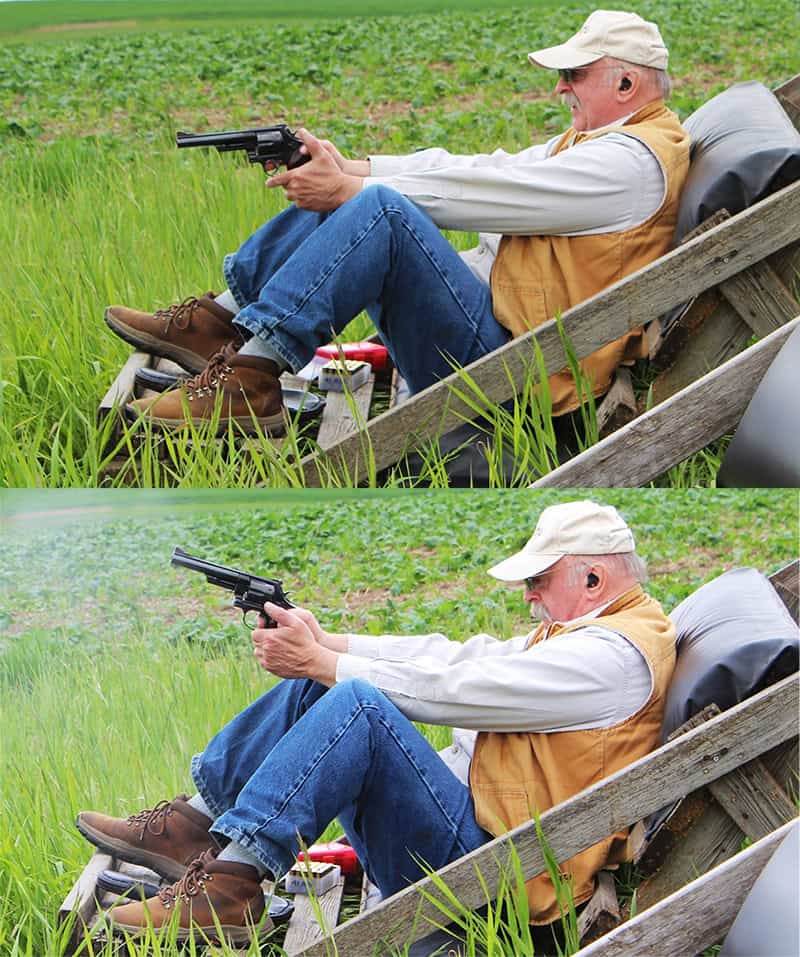
For long-range handgunning, author Workman says the .41 Magnum with the right loads will hold its own.
Every few years somebody comes up with the notion that the .41 Magnum is headed for the trash heap. The first time I heard that nonsense was when the .357 Maximum was announced some 40 years ago. It didn’t happen then, nor did it fade into the shadows when the 10mm Auto came along. Seems like every time someone wants to read a sermon over its grave, the .41 Magnum comes roaring back to life with gusto.
Charter Arms once offered a snub gun in .41 Magnum. I got one to test, and it was definitely a handful! It was the Mag Pug, with a 2 ½-inch barrel, rubber grips and a very healthy recoil.
Dan Wesson’s .41 Magnum revolver became a favorite of many silhouette shooters. The 8-inch barrel got the most out of each cartridge.
I’ll stick with my S&W and Ruger sixguns, which have never let me down. In the revolver arena, the .41 Magnum holds its own, emerging from the shadows of its .357 and .44 magnum siblings as a winner.