The Other Shoe Drops
Mossberg 990 AfterShock 12-Gauge Semi-Auto
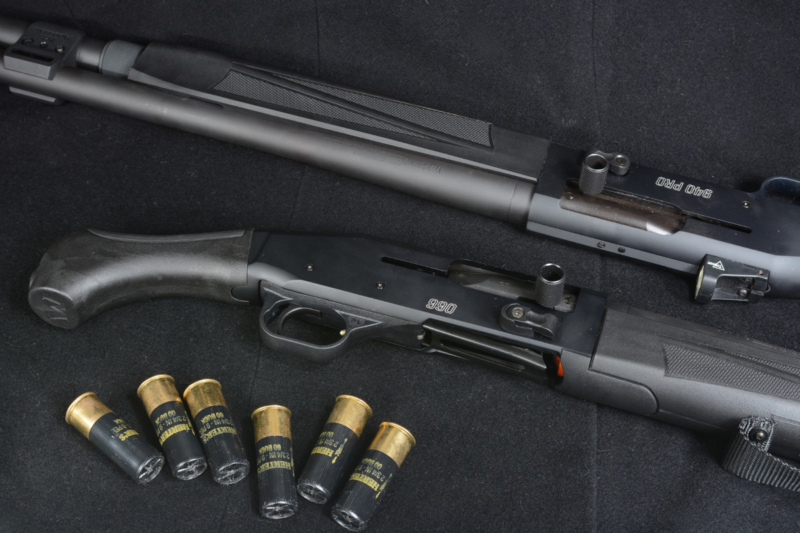
Mossberg’s AfterShock builds on the success of both the Shockwave pump and the 930/940 family by combining the size
of the short, powerful Shockwave with the more compact 990 semi-auto action.
Mossberg’s 2017 introduction of a 14” barreled 12-gauge took advantage of a then-little-known technical gap in the guidelines of what constituted a shotgun. Shotguns are required to have an 18” or longer barrel or be registered under the NFA with a tax stamp, the same way as a machinegun or silencer. They’re also defined as being designed to be fired from the shoulder. By assembling a 590-style pump action with only a pistol grip, the barrel length requirement was eliminated and in its place a minimum overall length of 26” became the determinative factor of whether or not it has to have a tax stamp. Sometimes called “pistol grip only” or “pistol grip firearm,” (the language used on the 4473, which your dealer will need to know when signing one out to you), Mossberg’s new model, named the Shockwave, does not. And a shockwave is exactly what it sent through the industry, becoming the bestselling pump shotgun in 2020. Note: Remington responded with the 870-based TAC-14.
Appropriately named the AfterShock, the latest iteration not only upgrades the action from pump to semi-auto, but also improves upon Mossberg’s prior semiauto operating system. No stranger to autoloading shotguns, Mossberg’s 930 series achieved significant success in three-gun competition, where it showed both its advantages and a few shortcomings. These were addressed first by the aftermarket, then by Mossberg in the 940 series, which incorporates better venting of spent gases as well as modifications, making it easier to reload quickly. I have defensive versions of both guns, and while the 930 was good, the 940 is far better, and the AfterShock’s 990 action improves still further.

Those familiar with the 930/940 gas-operated action will recognize the gas piston arrangement of the new, more compact 990 action.
The most obvious difference is that the action spring is now contained beneath the handguard instead of in a tube running through the buttstock.
For those unfamiliar with gas-operated shotguns, there are two ports in the barrel near the ring that goes around the magazine tube. As the shot package passes these ports, high-pressure gas jets down into a chamber formed inside the ring, which encircles the magazine tube. Closed at the front, there’s a piston to the rear that rides on the outside of the magazine tube and seals to the chamber with rings like those of a car’s piston or an AR bolt. Under pressure, it moves backwards, operating the action through a pair of action rods much the same as a pump-action shotgun.
On the 930/940, the bolt return spring was contained in a tube that ran through the buttstock, and which was forced backwards by a pivoting strut — think FN FAL or 1911 hammer strut — connected to the rear of the bolt. Perhaps the largest difference in the new 990 action is that the bolt return spring is now contained beneath the handguard, eliminating the technical need for a buttstock and making it possible to shorten the gun significantly, and creating an interesting opportunity for anyone interested in applying for Form 1.

The controls will be familiar to those who’ve shot the 940: it shares the large, knurled bolt handle and generous bolt stop of the competition
and tactical models, as well as a flat-ended elevator, relieved loading port and high-visibility orange anodized magazine follower.

The 990 AfterShock maintains the intuitive safety location of most Mossbergs, enhanced by a larger safety thumb piece
with a concave, checkered contact pad. Also note the QD sling cup and the cap that covers the mounting bolt.
The longish grip has to stay on the gun in order for it to stay legal.
Holding a total of six shotshells (not counting a ghost load, which I haven’t spent enough time with it yet to recommend), the AfterShock is, indeed, a seriously compact package. It has as much firepower onboard as many of the classic military shotguns, such as Winchester’s ’97 trench gun, Model 12 and Remington Model 11 semi-auto.
The controls will be familiar to those who’ve shot the 940: it shares the large, knurled bolt handle and generous bolt stop found on competition and tactical models, as well as the relieved loading port and orange anodized aluminum magazine follower. It also has a squared-ended elevator, which eliminates the pinch risk of earlier elevators with a notch on the magazine end.
The top-mounted safety is a Mossberg distinctive; while it had appeared on other break-action guns, Mossberg was the first to use it on a pump gun. I’ve always liked that safety location because it doesn’t leave you scrabbling blindly around the trigger guard to turn the gun on. It’s harder to reach on a gun with a pistol grip (part of why the new 590R has an AR-style thumb safety), but with a traditional stock or the extended grip of the AfterShock, you can find it easily with either hand. The 990 has improved on it with a new, larger safety with a concave, checkered contact pad. The front of the gun has three M-Lok slots (one on either side, plus one on the bottom) for a sling, as well as a hand strap and fiber optic sight to keep things lined up in the right direction.

The front of the gun has three M-Lok slots (one on either side, plus one on the bottom) for a sling, as well as a hand strap
and fiber optic sight to keep things lined up in the right direction. You’ll want to use the strap.
You may wonder how to shoot such a beast, and that’s a fair question. When the AfterShock was in development in 2022, I was part of a group invited to Gunsite Academy to shoot it in prototype form, provide input, and receive training on how to use it best. The technique we learned under the skilled tutelage of Rangemaster Lew Gosnell and instructor John Hall was the reverse of the Weaver-based push/pull technique. Instead of pushing the firing hand forward and pulling backwards with the support hand, pulling back on the AfterShock’s pistol grip while pushing forward against the hand strap provides isometric tension to help stabilize the gun and to manage recoil, which is otherwise quite ferocious with 00 buckshot. Holding it loosely at eye level will probably earn you a black eye or worse, but held in tension where you can use the front fiber optic bead, it’s both controllable and usably accurate. I say “accurate” because, like most good defensive shotguns, the patterns are tighter than you might think, and it still needs direction in order to hit the target. The pattern may open up faster than longer barrels (I’ll have to test more to find out), but at typical self-defense ranges, the prototype patterned well.

Jeremy shooting a prototype of the 990 AfterShock at Gunsite Academy in October 2022 when the gun was still being developed.
Note the push-pull technique: pull the pistol grip back, and push forward against the strap to stabilize the gun and control recoil.
Photo/Gunsite Academy

Test target from the prototype version showing patterns at 5, 10 and 15 yards.
All are within the expected range for a traditional combat shotgun.
The AfterShock will take both 2 3/4” and 3” shotshells, though I have little interest in running it with 3” Magnums. As five of the shorter cartridges are a bit of a tight fit in the mag tube, I expect you’d lose a round loading it with 3”. Even with “just” 2 3/4” shells, for close quarters such as home or vehicle defense, it’s hard to imagine a smaller package with a heavier defensive payload than the AfterShock offers.
I was impressed with the original version I shot at Gunsite, and though I’ve only had time to put a box or so of buckshot through the test gun, so far it’s performing like the game changer I expected it to be. Look for a longer test article in GUNS Magazine in the coming months.
MSRP: $1,120 – $1,302