Resurrecting the Star PD
The Alchemy of Iron and Elbow Grease
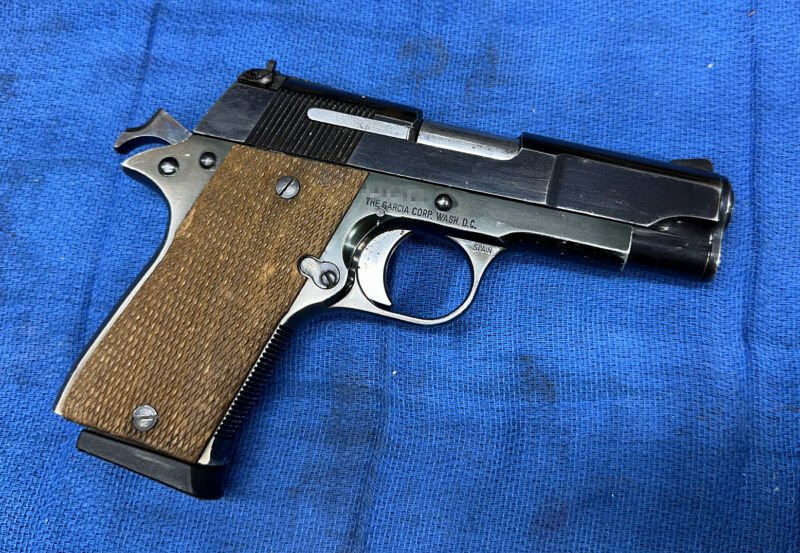
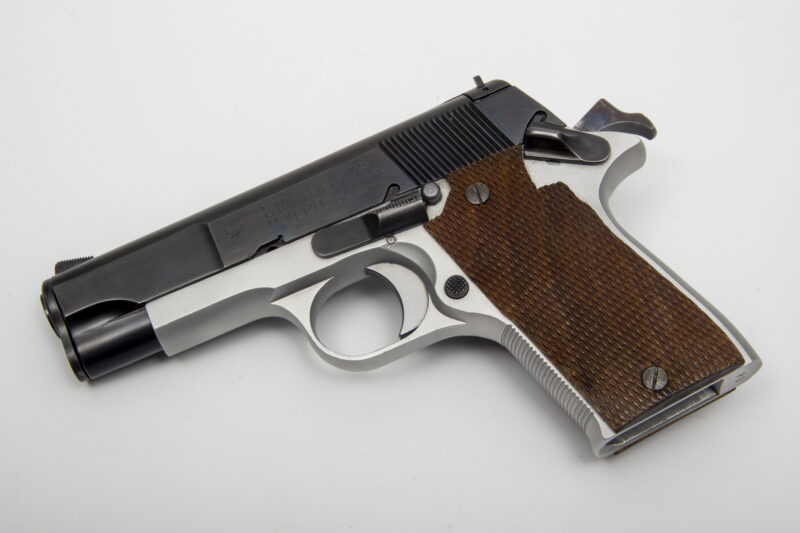
The patient resting quietly on the operating table before “surgery.”
The Star PD was a trendsetter that is largely forgotten by today’s shooters,
but it offers compact size and light weight in a major-caliber pistol.
Long before every firearms manufacturer under the sun offered a subcompact, polymer-framed or lightweight aluminum 1911-style pistol, there was a lone pioneer hailing from the Basque region of Spain.
Established in the gunmaking hub of Eibar, Star Bonifacio Echeverria, S.A. — known to most simply as Star — had a centuries-old regional heritage of ironworking and firearms. By the mid-20th century, Star had built a global reputation for producing robust, reliable and uniquely engineered semi-automatic pistols. While they drew clear ergonomic inspiration from John Browning’s legendary 1911 pistol, Star’s designs carved out their own distinct mechanical path, omitting the grip safety and simplifying the internal lockwork.
In 1975, Star caught lightning in a bottle with the introduction of the Model PD.
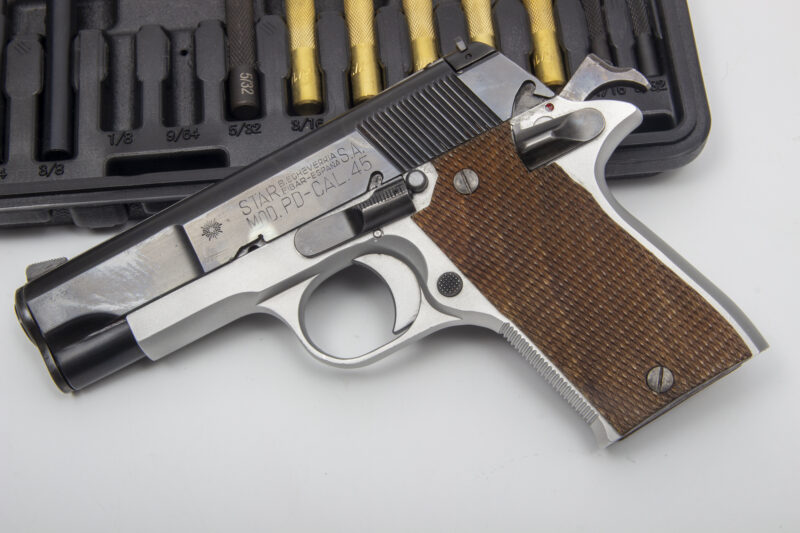
The final result of Brent and Roy’s efforts: from ugly duckling to modern two-tone belle of the ball!
Something New
Brainchild of firearms writer, designer and distributor Pete Dickey (hence the “PD” moniker, contrary to the popular rumor that it stood for “Police Department”), the gun was a minor miracle of mid-seventies engineering. By mating a shortened steel slide with a slim, featherweight aluminum alloy frame, Star created a six-plus-one-capacity .45 ACP that tips the scales at a mere 25 ounces. In an era when a defensive .45 meant packing a full-sized, all-steel Government Model or a slightly truncated Commander, the Star PD was a revelation. It single-handedly kicked off the modern trend toward micro-.45 carry guns.
However, light weight extracts a toll in physics. The great Colonel Jeff Cooper famously summed up the compact Spaniard with a classic piece of Cooper-esque prose, labeling the Star PD a gun to be “carried much, shot little.”
The Colonel wasn’t wrong. While very comfortable on the hip, shooting the lightweight PD can be downright painful even with modest target loads. To keep the slide from battering the alloy frame to pieces, Star incorporated an internal plastic recoil buffer, which required replacing every thousand rounds or so. Cooper also suggested defensive-minded folks buy two: one to carry, and one to subject to the abuse of the practice range.
My Turn
Which brings us to my personal Star PD. It didn’t look like a classic piece of firearms history — it looked like a survivor of a pawn shop riot.
It was a beater, not exactly hopeless but not something to set the gun enthusiasts’ hearts aflutter. The slide was marred by rust pitting where it rested against decades of sweaty bodies, and it was witness to the generalized neglect that breaks a gun guy’s heart. Yet, underneath the shortcomings, the mechanical bones were solid. I decided it was time to transition this tired old Spaniard from a semi-neglected relic into a refined, reliable piece of working art.
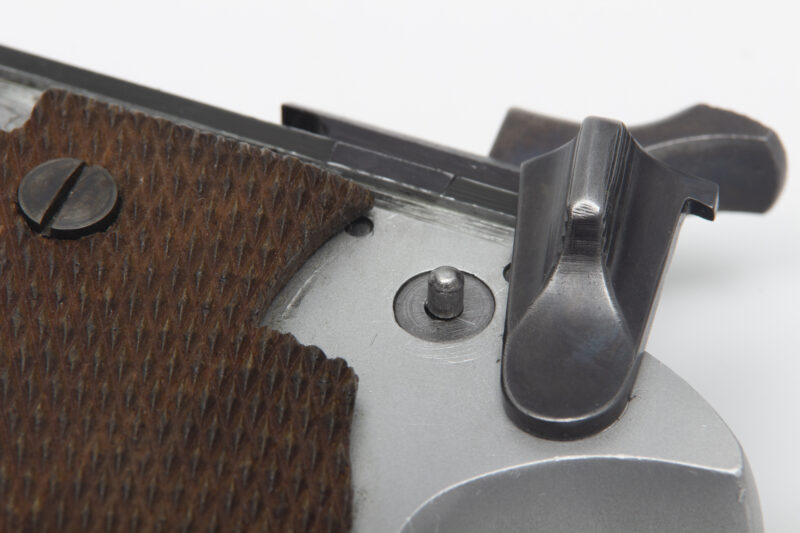
The dreaded plunger, under which is a spring that is quite capable of launching it into low Earth orbit.
Brent has a strong suspicion that the spring wasn’t OEM as it was strong enough to be used as the primary recoil spring!
Naturally, the project began with a lesson in humility. While first detail-stripping the slide to find the cause of a sticky thumb safety, I bypassed a fundamental rule of gunsmithing: when removing a thumb safety, keep your finger firmly over the plunger hole until the tension is safely captured. If you don’t, the spring and plunger can immediately launch themselves into low Earth orbit, leaving you staring blankly at an empty workbench. Depending on the availability of spare parts, you might also question your life choices.
Once the rogue spring and plunger were successfully replaced by an order to Numrich Gun Parts — an inch-by-inch search of my office proved entirely fruitless — I packed up the pitted frame, the slide and the remaining shreds of my dignity for a visit to Roy Huntington’s shop. It was time to see if a little teamwork, some elbow grease and workshop alchemy could turn this neglected piece of Spanish iron into a bona fide prize.
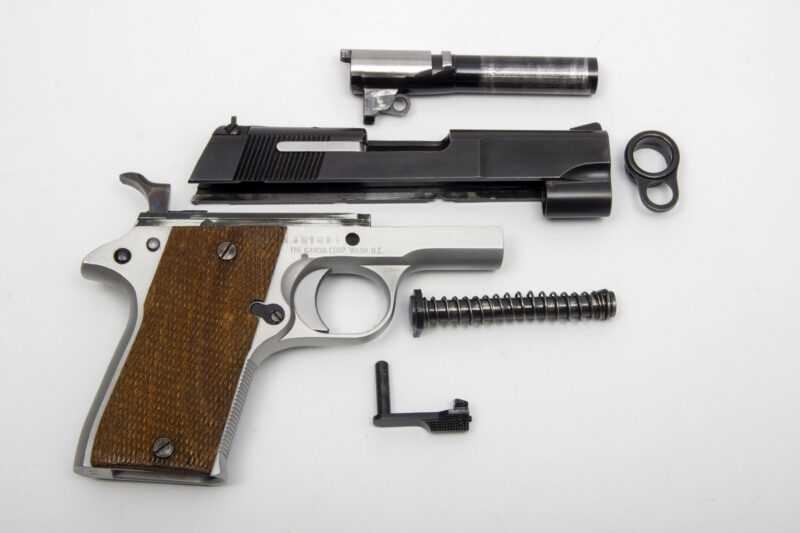
The Star PD is a John Browning-pattern design but omits the grip safety.
This made the gun lighter and (likely) less expensive to manufacture.
Beater to Basque Beauty
Once inside Roy’s shop, the very first order of business was defensive positioning. Having already contributed one plunger to the local ecosystem, Roy field-stripped the gun with extreme prejudice, immediately capturing every single component inside a secure plastic box. No rogue parts were escaping into the rafters this time.
With the Star down to its bare bones, we split the labor. Roy focused his efforts on slicking up the internal action, while I went to work on the exterior cosmetic triage. Armed with a few strips of emery cloth and copious oil, I began tackling the rust spots. The pistol suffered from some fairly deep pitting on the slide, but we made a conscious decision not to try to completely eradicate every single crater. Taking the metal down far enough to erase the pits would have compromised the slide’s dimensions. Fortunately, a good finish has a way of masking minor character flaws.
Next, I fired up the bead blaster. I used it to strip the remaining factory anodizing cleanly off the aluminum frame, while simultaneously blowing away the old, dead bluing from the steel slide and small controls like the slide stop, magazine release and thumb safety.
The blue anodizing on the pistol frame melted away under bead blasting.
The bare aluminum looks nice and also allows for easier inspection for frame cracking,
something Star PDs were noted for in earlier runs.
The high-speed beads worked surprisingly well on the frame. Aluminum anodizing can be anything from relatively soft to tougher than diamond, but the Star version came away cleanly and quickly. We decided to leave the raw aluminum frame entirely “in the white.” This gave the pistol a striking, modern two-tone effect that beautifully contrasted with what we had planned for the top end.
For the steel components — the slide, slide stop, magazine release, rear sight, barrel bushing, grip screws and safety — we turned to a bottle of Brownells Oxpho-Blue Creme formula. To call this stuff magical is an understatement. If you didn’t know any better, you’d swear the deep, rich blue-black finish came out of a professional hot-dip bluing tank. After four hand-rubbed coats and an oil wipe, the gun literally looked close to “factory.”
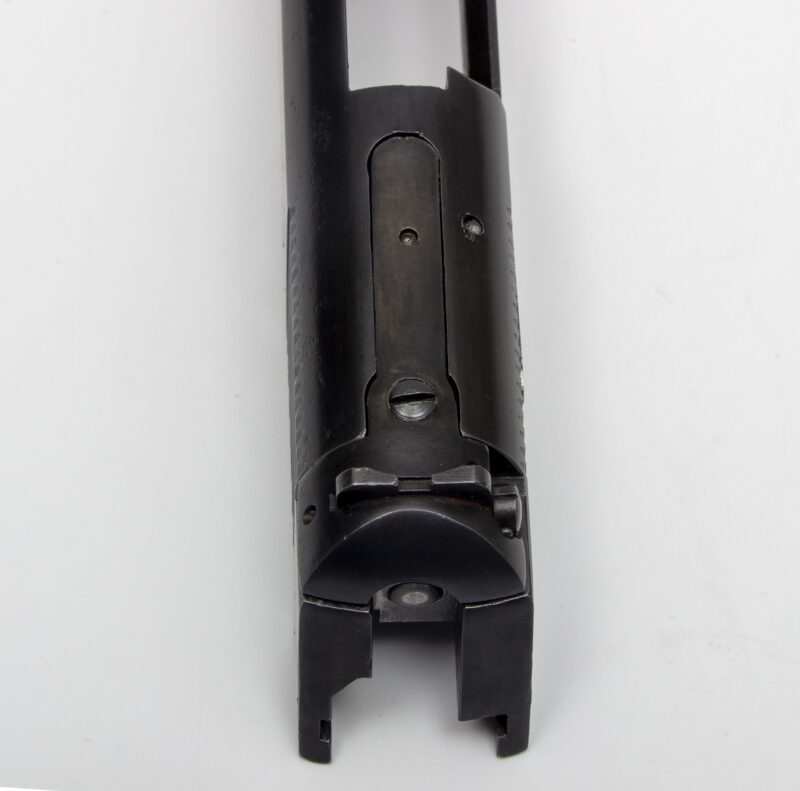
The Brownell’s Oxpho-Blue Creme formula looked great on the steel parts, especially the rear sight.
The sight was the worst-looking part of the gun and looked like it had been painted rather than blued.
After the Oxpho-Blue, it now matches the slide and other steel parts.
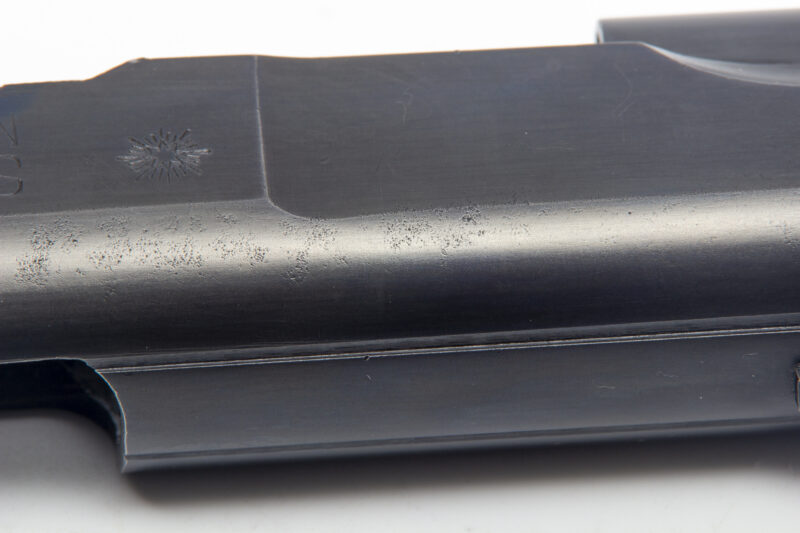
The deep blue-black finish of the Oxpho-Blue Creme helped hide the deeper rust pits that emery cloth couldn’t remove.
The photo makes it look worse than it appears in person. For a "beater" project gun, the result was nothing short of miraculous!
Roy noted that after trying everything on the market, the durability of the Oxpho-Blue Creme is nearly on par with that of a traditional hot bath. For a project gun like this, it serves admirably without the hassle of shipping parts away. Let’s be honest: sending a heavily pitted Star PD out for a professional, high-end hot bluing job would be like giving a 1990 Honda Accord a hand-rubbed, twenty-coat custom paint job. You could do it, but is it really necessary? I think not.
There is, however, one minor humorous side effect to this chemical wizardry. When I later pulled the finished gun out of its sealed polymer carrying case, the aroma was unmistakable. It smelled much like a $6.99 drugstore “box perm.” Beauty always has a strong scent …
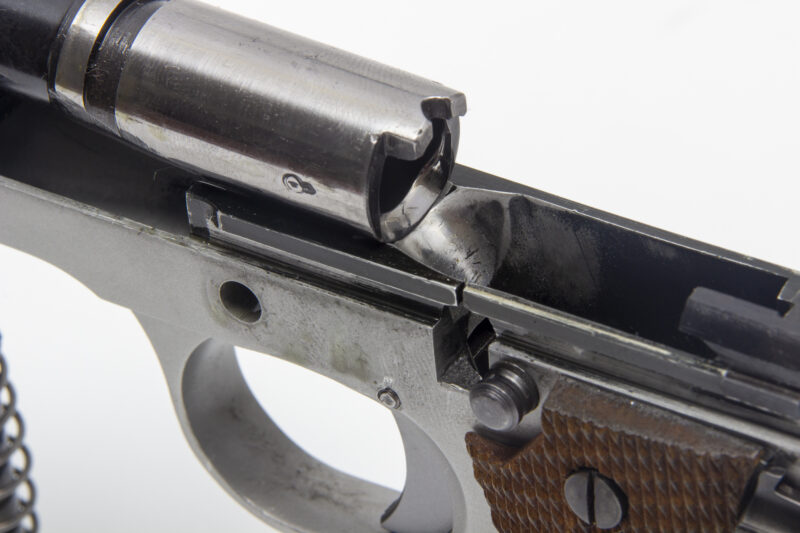
Someone had previously tried to smooth the feed ramp but took too much off the frame,
leaving a lip between the frame and barrel that could cause nose-dive malfunctions.
Roy smoothed it up “good enough” to work with all but the most-hollow of hollowpoints.
While I was finishing the finish, Roy addressed a mechanical issue on the feed ramp. A previous owner had clearly “worked on” the gun, smoothing the frame portion of the ramp so aggressively that they accidentally created a small lip right where the frame meets the barrel ramp. This lip is a prime culprit for causing catastrophic nose-dive jams, though I couldn’t remember having too many malfunctions of any kind the last time I spent a day with the Star on the range. Roy carefully went to work with his files and stones, smoothing out the transition to ensure flawless, modern functionality.
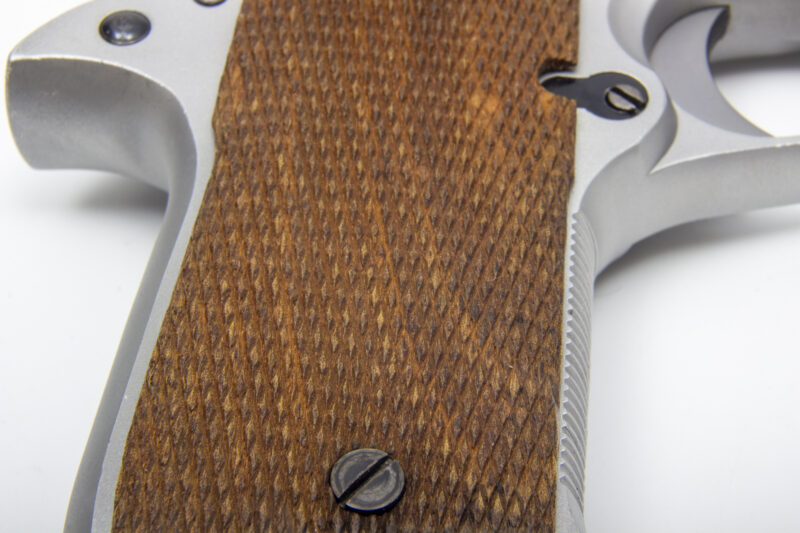
The original grip panels were unfinished walnut. A quick application of Birchwood Casey Tru-Oil
sealed them against grease and oil and made them look a bit dressier.
To round out the project, we took the original, somewhat drab unfinished walnut slab grip panels and gave them a fresh hit of Birchwood Casey Tru-Oil. The Tru-Oil seals the raw wood, making it highly resistant to hand sweat, gun solvents, and everyday stains — plus it instantly brings out a gorgeous, rich grain that completely changes the gun’s personality.
A Classy Commuter
When we finally reassembled the Star, we stepped back to admire our handiwork.
Before we started, this was just another mundane, beat-up, 1911-pattern pistol —the exact kind of forgotten hardware you’d gloss over at a weekend gun show unless the price tag was absurdly cheap. But with a little collaborative elbow grease, we (Roy, mostly) transformed it into a remarkably classy, eye-catching and easy-to-carry piece. Frankly, I was surprised by how easily the entire project came together, taking only one afternoon in Huntington’s shop. Asked for a comment for this story, Roy noted, “With a few simple tools and supplies (and the loan of a blasting cabinet), even Brent can do this!”
Indeed.
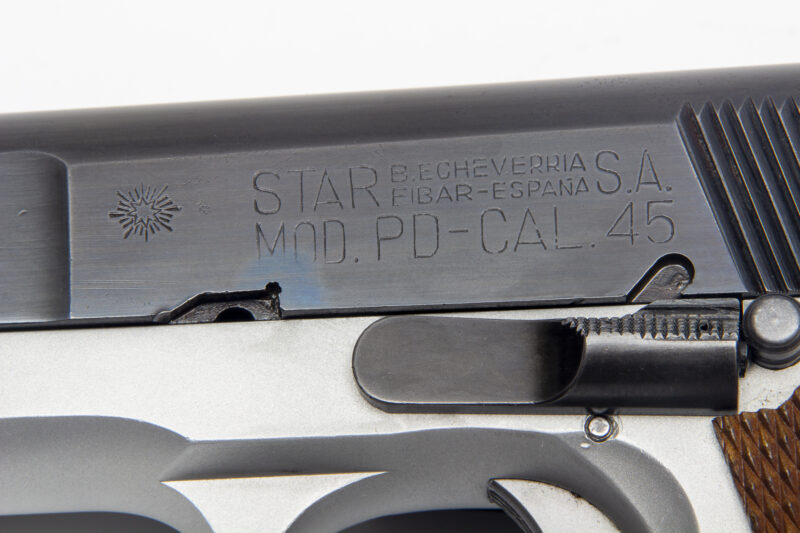
Close-up, you can see a couple of notable things: first, the differential hardening around the slide stop cut,
and second, the rough machining thereabout. The Star PD, like many older import guns, showed a remarkable
range of machine work quality.
Granted, our cosmetic alchemy didn’t alter the laws of physics; the PD is still just as punishing to shoot as ever. But as a packing gun? It would be tough to beat.
So, if you happen to stumble across an unloved Star PD for around $400, don’t walk away. Grab it, because it’s an interesting piece of CCW history and makes an absolute premier blank canvas for a fun, low-budget custom project. When you’re done, you’ll possess a decent, lightweight, hard-hitting carry pistol with a lot more soul than today’s standard plastic fantastic options.
Just keep your thumb over that darn plunger spring!
Want more online exclusives from GUNS delivered straight to your inbox? Sign up for our FREE weekly email newsletters.