Stocking Up
Gun Wood Review

One of the hallmarks of a special firearm is using the proper wood for the intended purpose of the gun. Some wood
is highly ornamental but doesn’t hold up to fieldwork, while a working gun needs tough and — hopefully — attractive wood.
I’ve been looking around for a custom gunstock for a dream project and considered the usual suspects — walnut, maple, laminate and several others. In doing research, I discovered there are far more choices than I realized.
After a deep dive into the interwebs, I came up with a fairly comprehensive list of gunstock blank materials and some background info on each. Keep in mind that many popular woods aren’t listed because, while you can undoubtedly find examples of each, such as old-growth pine on old American flintlock rifles, just because somebody makes a gun from a species of wood doesn’t mean it’s a good idea.
Here’s a rundown of material choices for gunstocks:
1. Birch
Birch is affordable and easy to machine, with a uniform grain that finishes well. It’s often used in budget or military-style stocks, though it lacks the elegance and strength of premium woods.
• Positives: Affordable; decent strength; uniform grain.
• Negatives: Less attractive; not as durable or stable as walnut or laminate.

The birch stock on Brent’s well-worn Marlin Model 60 .22 LR squirrel rifle. Birch possesses a good combination
of characteristics for making gun stocks, and it’s relatively inexpensive, though it won’t win any beauty contests!)
2. Black Walnut
Black walnut is a traditional American favorite, valued for its workability, moderate weight, and attractive grain. It’s a solid all-around choice, though slightly softer than English walnut.
• Positives: Good strength-to-weight ratio; attractive grain; easy to shape and finish.
• Negatives: Slightly softer than English walnut; grain can be inconsistent.
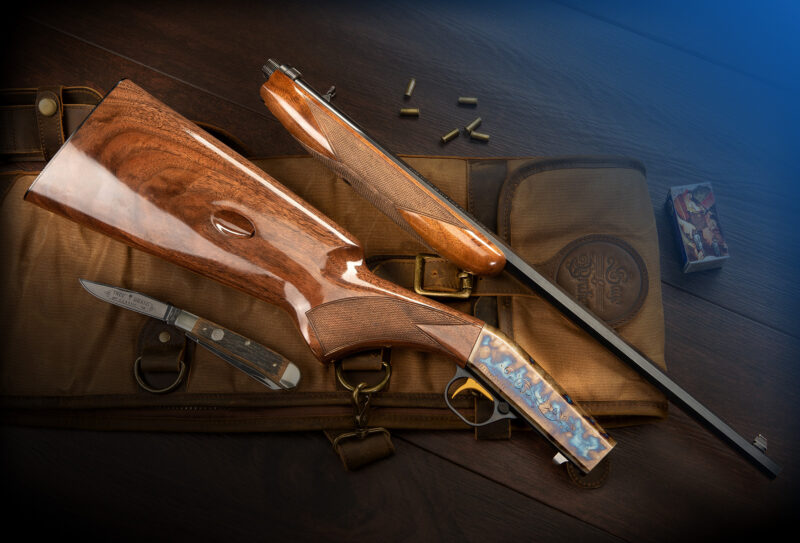
Black walnut can achieve a highly polished, almost glasslike finish at the hands of a professional stock refinisher.
Here the stock of a Turnbull-restored Browning SA-22 owned by Roy Huntington is a great example of what can be achieved.
3. Bubinga
Bubinga is a dense, exotic hardwood known for its striking grain and excellent strength, making it a durable choice for gunstocks. However, its weight and difficulty in machining can be drawbacks, especially for field use.
• Positives: Very hard and dense; excellent strength; beautiful grain patterns; exotic appearance.
• Negatives: Heavy; difficult to work with; can be expensive; may dull tools quickly.
4. Cherry
Cherry is seldom used in firearm stocks but offers beauty and moderate weight, along with stability and good workability. It is most often seen on presentation firearms.
• Pros: Aesthetic appeal — beautiful grain and color, takes finish well; easy to work with and holds detail well for checking or engraving; dimensionally stable.
• Drawbacks: Softer than maple or walnut, prone to dents and dings; can’t handle heavy recoil or hard use; grain is more uniform and less visually interesting; color can change over time.
5. Claro Walnut
Claro Walnut is prized for its beautiful figure and moderate weight, offering a good balance of aesthetics and performance. It’s a popular choice for custom rifles, though it can be pricey and less consistent in grain than English walnut.
• Positives: Attractive figure and color; good balance of strength and weight; easy to work with.
• Negatives: Can be expensive; availability may be limited; not as strong as English walnut.

Claro walnut is often considered the “go-to” material for fine-quality firearms stocks, such as this highly-figured
Cosmi shotgun featured on the cover of the January 2023 issue of GUNS Magazine.
6. Ebony
Ebony offers unmatched hardness and a sleek, dark finish, ideal for custom or luxury builds. Its brittleness and high cost, though, make it impractical for most functional firearm stocks.
• Positives: Extremely hard and durable; elegant dark appearance; smooth finish.
• Negatives: Very heavy; expensive; brittle and prone to cracking; hard to machine.
7. English Walnut
English walnut is the gold standard for gunstocks, especially fine rifles and shotguns. It combines strength, stability and beauty. Its fine grain and excellent balance make it ideal, though expensive and increasingly rare.
• Positives: Traditional choice for gunstocks; excellent balance of weight, strength, and beauty; stable.
• Negatives: Expensive; limited availability; may require careful selection for grain quality.
8. Hickory
Hickory is extremely tough and shock-resistant, making it suitable for heavy-duty applications. However, its coarse grain and weight make it less desirable for refined or lightweight stock designs.
• Positives: Very tough and shock-resistant; strong and durable.
• Negatives: Heavy; difficult to work with; grain can be coarse and unattractive.
9. Laminated Wood
Laminate wood is engineered for strength and stability, resisting warping and moisture better than natural woods. While it lacks the organic beauty of solid wood, it’s a practical choice for rugged, high-performance firearms.
• Positives: Extremely strong and stable; resistant to warping and moisture; available in many colors.
• Negatives: Heavier than solid wood; lacks natural beauty; may feel less “traditional.”

Boyd’s gunstocks are known for their drop-in-ready composite stocks. Available in a palette of colors,
the augmented wood material is tough, strong, lightweight and attractive.
10. Maple
Maple, especially figured varieties like curly or birdseye, is visually stunning and reasonably strong. It’s used in some custom builds, though it can be heavy and expensive for certain grades.
• Positives: Hard and strong; beautiful figure (especially curly or bird’s-eye maple); good workability.
• Negatives: Can be heavy; may be prone to denting; less traditional than walnut.
11. Oak
Oak is strong and widely available, but its open grain and heaviness limit its use in gunstocks. It’s more common in furniture than in firearms due to finishing challenges.
• Positives: Readily available; strong and durable; classic look.
• Negatives: Heavy; open grain can be hard to finish smoothly; not traditionally used for gunstocks.
12. Pear or apple Wood
Pear wood has a fine, smooth grain and takes finish beautifully, making it suitable for decorative or presentation-grade stocks. However, it’s not strong enough for regular use and is rarely seen in firearms intended for field use.
• Positives: Fine grain; smooth finish; good workability; elegant appearance.
• Negatives: Not very strong; rare and expensive; not commonly used for gunstocks.
13. Sycamore
Sycamore is light and easy to work with, but lacks the strength and stability needed for reliable gunstocks. It’s rarely used and generally considered a poor choice for this application.
• Positives: Light to medium weight; decent workability; unique grain.
• Negatives: Not very strong; prone to warping; rarely used in gunstocks.
The Oddballs
There are other woods available through dealers that are not commonly seen on firearms but occasionally mentioned or used by do-it-yourselfers. Many of these are used in handgun stocks, especially semi-auto slab grips, where strength takes a backseat to visual appeal.
1. Bocote
• Pros: Beautiful swirling grain; good workability; moderately hard.
• Drawbacks: Can be oily; not as strong as walnut; availability may be limited.
2. Cocobolo
• Pros: Dense, oily wood with stunning reddish-brown hues and dramatic grain patterns. Very durable and resistant to moisture.
• Drawbacks: Extremely oily — can interfere with gluing and finishing. Heavy and hard on tools. Dust can cause allergic reactions.
3. Ironwood (e.g., Desert Ironwood)
• Pros: Extremely hard and dense; stunning figure; highly durable.
• Drawbacks: Very heavy; difficult to machine; expensive and rare.
4. Padauk
• Pros: Vibrant orange-red color; good strength and stability; relatively affordable for an exotic.
• Drawbacks: Color fades over time to brown; can be brittle; dust may cause irritation.
5. Purpleheart
• Pros: Unique purple hue; very hard and durable; good resistance to wear.
• Drawbacks: Extremely dense and heavy; difficult to machine; color darkens with age and exposure.
6. Rosewood
• Pros: Rich color and fine grain; very hard and stable. Often used in high-end custom stocks.
• Drawbacks: Expensive and increasingly restricted due to conservation laws. Heavy and difficult to work with.
7. Teak
• Pros: Excellent moisture resistance; stable and durable; smooth grain.
• Drawbacks: Oily nature makes finishing and gluing tricky; expensive; not traditionally used for gunstocks.
8. Wenge
• Pros: Very dark, dramatic grain; extremely hard and durable.
• Drawbacks: Brittle and splintery; difficult to work with; heavy; dust can be toxic.
9. Zebrawood
• Pros: Striking striped appearance; moderately hard and stable.
• Drawbacks: A coarse grain can be difficult to finish smoothly. Not as strong or shock-resistant as traditional stock woods.
Want more online exclusives from GUNS Magazine delivered straight to your inbox? Sign up for our FREE weekly email newsletters.