Three Rifles You Need
Building the most basic gun collection

Semi-auto .223 rifles are workhorses around a farm or ranch.
This older Ruger Mini-14 (bottom) has a 1-10 twist while the
current Ranch rifle (top) has a 1-9 twist.
Back in 1905, two brothers claimed homesteads on adjacent quarter sections in western Canada. They built houses, raised families, shared labor and assets. Among the shared items were firearms. Each had a .22 rifle. One brother acquired a Winchester 1892 .25-20 WCF, the other, a Remington-Lee sporter in .30-40 Krag. The .25-20 was mainly for protecting the chicken coop from predators such as coyotes, fox, badgers, skunks. I suspect it was also used on hawks and owls, legal at the time, and on the occasional whitetail deer.
The .30-40 was the “big game” rifle, which at the time meant mainly deer plus the occasional moose or elk wandering far from its usual stomping grounds. Game populations were not nearly as high as they were to become later but wild game often made for meat on the table, so a pig or steer could be sold rather than eaten.
Time Marches On
Fifty+ years later, the brothers were retired and living in Arizona as -40º winters are something you can learn to tolerate but never get used to. A new group of young men had taken over the farms and the jobs. One fellow had two Savage centerfire rifles, a Model 40 in .250 Savage and a Model 99 .300 Savage. Another, who always had to have the newest and latest, had two Winchester 88 rifles, a .243 and a .308. One fellow, a known oddball, had two bolt-action rifles — a Winchester 70 .270 and a Remington 722 in .222 Rem. It goes without saying they each had a .22 rifle.
Seventy years later some things have changed. There are far more rifle models, far more cartridges from which to choose. Frankly I don’t know how youngsters manage. When I was a pre-teen hunting enthusiast in the 1950s it already seemed complicated enough. If you wanted a big game rifle, it would be in .270, .30-’06, .300 Savage or .308. A varmint cartridge would be .22 Hornet, .222 Rem., or for the power-mad a .220 Swift. “Dual-purpose” cartridges like the .243 Win. or .244 Rem. were gaining a lot of interest. Surely they had to be superior to the old .250 Savage — they were newer, after all.
Some things have changed, others are much the same. In North America the game we hunt and the pests after our livestock and gardens haven’t changed much. There may be more elk and fewer mule deer, more coyotes and fewer groundhogs, but generally speaking, it is the same type of shooting challenges
Basic Building Blocks
Believe it or not there are people who want or need to own rifles but want only the essentials, the irreducible minimum. For a rifle enthusiast such as me, this is just nuts. I’m always looking for a reason to add another rifle. I try to understand those who disagree. I know people who love hunting and love the outdoors but consider rifles just tools. They’d just as soon hunt with a muzzleloader, shotgun, compound bow or crossbow.
They seem puzzled why I need 10 or a dozen rifles just for deer hunting. Rifles are expensive, they explain. They need to be cleaned, stored, scoped, provided with ammunition. Why go to so much trouble just to avoid the minor inconvenience of still hunting and stand hunting with the same rifle?
I remember buying a rifle shortly after getting married. My bride said, “I don’t see why you can’t hunt deer with your duck rifle. I really think you could if you wanted to.”
Good Advice
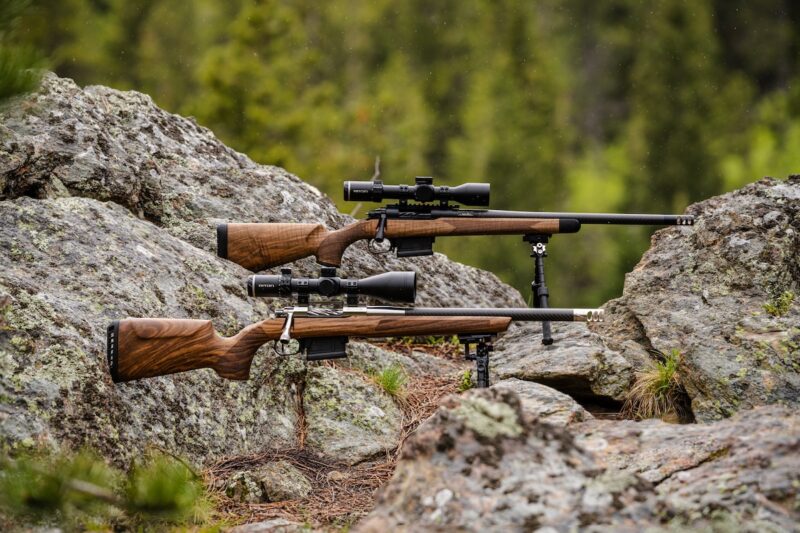
So, for those afflicted with a practical nature, my recommendation for a minimum is pretty much the same as half a century or a century ago — a rimfire, a vermin/pest/small game rifle and a big game rifle. To be specific, a .22LR, a .223 Rem. and a .308 Win. There’s nothing particularly magic about the .223 and .308 but they are perfectly adequate and available in a wide range of models and price ranges. Ammunition and reloading components are widely distributed.
Ammunition resupply is a bigger issue than perhaps we old timers realize. Young shooters are neither dumb nor blind. They see empty and picked-over ammo shelves and don’t like the thought of searching around to find ammo. Believe it or not, many have no interest in reloading. Cartridge availability has far more appeal than minor improvements in ballistics.
These practical types can teach us old timers a thing or two. At present and for the foreseeable future, the .223 and .308 cartridges will remain widely distributed and moderate in price — or at least no more expensive than other cartridges. They are sound practical choices for the new shooter. In fact any rifle enthusiast will find it prudent to have something on the rack capable of firing these cartridges. The day may come when we are glad to have any ammunition at all, without being too fussy!