The Tactical Truth About Thompsons
Obsolete Yet Iconic!

The M1921 Thompson, with optional drum magazine, was the classic gangster model.
“Icon” — noun. A person or thing regarded as a representative symbol or as worthy of veneration.”
“Icon” is a theological term with Greek origins. The foundational word literally translates to “image” or “resemblance.” In modern parlance, an icon is something so distinctive as to be emblematic of a larger era or idea. Iconic is the adjective form. Among gun nerds serious about their craft, the Thompson submachine gun is an indisputably iconic firearm.

The M1928 (top) and M1A1 Thompsons were both GI-issue weapons.
The M1A1 was simplified for ease of production.
Origin Story
The Thompson submachine gun really should have perished in obscurity. The first operational prototypes missed combat in WWI by literally days. Two decades later, this big, heavy beast of a weapon was lyrically obsolete. However, like all such things, the Second World War was a come-as-you-are affair. Allied forces consumed Thompsons in the early days of the fight like kindergartners inhaling M&Ms.
Thompson guns came in three broad flavors. The original M1921 featured such frivolities as the finned barrel, removable buttstock, Cutts compensator and top-mounted actuator. All M1921s spawned from a single 15,000-gun run produced under contract by Colt in, you guessed it, 1921. These early examples weighed nearly 11 lbs. empty and cycled at a hyperactive 900 rpm.
The subsequent M1928 was the same gun with a heavier bolt actuator. Many M1928s were converted from that original 1921 lot and had their model designations overstamped from 1921 to 1928. Collectors understandably call these guns “Overstamps” today. They looked, felt, and operated the same as the M1921s. However, the heavier actuator slowed the cyclic rate of fire down to a more manageable 700 rpm.
These guns were cut from massive chunks of forged steel and resembled sewing machines on the inside. Additionally, Colt built the things like heirloom collectibles replete with impeccable workmanship and a gorgeous deep blue finish. As a result, they were insanely expensive, like $4,700 apiece in today’s money.
Once WWII kicked off, things got real, and fast. Uncle Sam binned luxuries like the finned barrel, compensator and bespoke bluing. M1 and M1A1 GI Tommies moved the actuator to the right side and featured a utilitarian Parkerized finish. The M1 and the M1A1 differed solely in the specifics of the bolt design. These guns were not cut to accept the distinctive drum magazines defining the previous weapons and the buttstocks were fixed. The rate of fire on the M1A1 bounced back up to around 800 rpm, but these streamlined versions were indeed both cheaper and faster to make.
And so things languished all the way until the end of the conflict. Around 1.5 million copies rolled off the lines. Despite being just boat anchor heavy, young GIs brought up on James Cagney gangster serials just couldn’t get enough of them. The Thompson was nominally supplanted by the M3 Grease Gun in the last year of the war. However, Thompsons still saw active service all the way into Vietnam. Caches of vintage Tommy guns have been uncovered as part of the ongoing war in Ukraine.
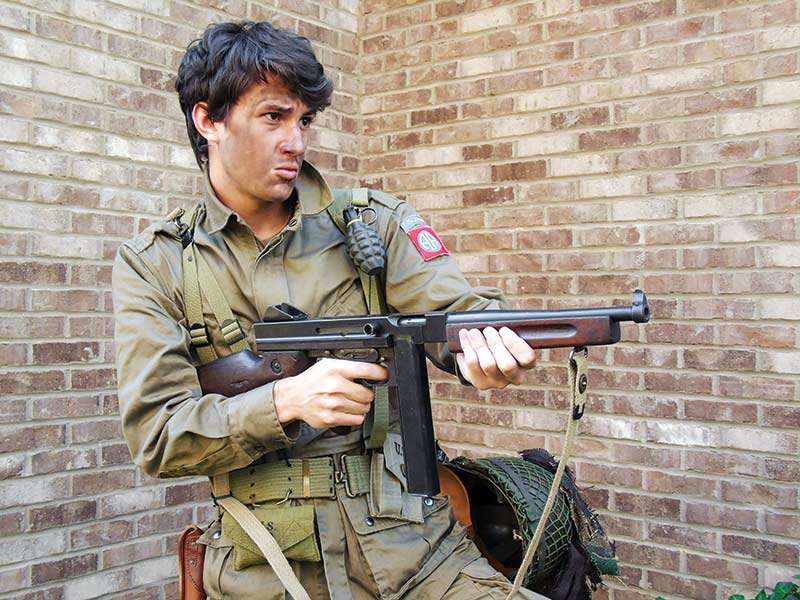
The Thompson was a popular though heavy and fairly inefficient
nfantry arm during World War II. Thanks to WorldWarSupply.com
for the vintage gear used to outfit our reenactor.
Practical Tactical
We get most of our ideas about Thompsons from the movies. Machineguns are innately sexy, so cinema directors tend to front load their actors with buzz guns rather than the more pedestrian rifles. The timeless comedy classic war movie Kelly’s Heroes saw almost all of the titular characters packing Thompsons. That never happened in the real world.
My wife’s grandfather fought in North Africa, Sicily and Italy all the way up to the armistice. He told me he never touched a Thompson in combat. However, a buddy I met in my medical clinic had some fascinating first-person anecdotes.
His name was Bill. Like most all of those old heroes, he’s gone now. Bill landed in Normandy a couple of weeks after D-Day and fought until the very end at the River Elbe. By New Year’s Day 1945, he was considered a seasoned veteran despite still being a teenager. Bill’s issue weapon was the comparably iconic M1 Garand.
One evening, Bill got tagged to go on a night patrol. His infantry unit included a section of 37mm anti-tank guns. These small-caliber cannons were literally worthless in the face of the German Tigers, Panthers and StuGs they were facing, but the gun crews were issued Thompsons. Before he left on his night excursion into Indian country, Bill swapped out his rifle for one of the AT gunner’s Tommy guns. As he related the story, he then grinned and said he just never got around to giving it back.
Bill got the M1A1 Thompson and five 20-round magazines but no web gear. He just packed the stubby little stick magazines in the pockets of his field jacket. He told me he also filled his pockets with loose .45ACP rounds. He said any time there was a lull in the action, he would drop down behind a convenient tree to top off his mags. He did specifically mention it was really handy to carry both a long gun and an M1911 pistol that fed the same ammo.
Bill carried that weapon until the end of the war. He related stories about firing it effectively from the back of an armored halftrack on the move. He also used his Tommy gun to kill a Wehrmacht soldier at contact range who had just ventilated his best friend with an MP40. He said Thompsons throwing those big, fat .45ACP rounds at close range would bowl a man over like none other. His tales were at once both horrible and mesmerizing.
Ruminations
There is a mystical connection between a soldier and his personal weapon. In Bill’s case, he respected the Thompson’s close-range firepower enough to hump the massive thing all the way across Europe. Despite there being numerous lighter, cheaper, more efficient options, those who packed the Tommy gun in combat revered it. The Thompson submachine gun was 11 lbs. of classic combat chaos.