Let 'Er Rip!
The Light Machine Gun Fully Evolved Into A Much-Feared
"Infantry Equalizer" During World War II
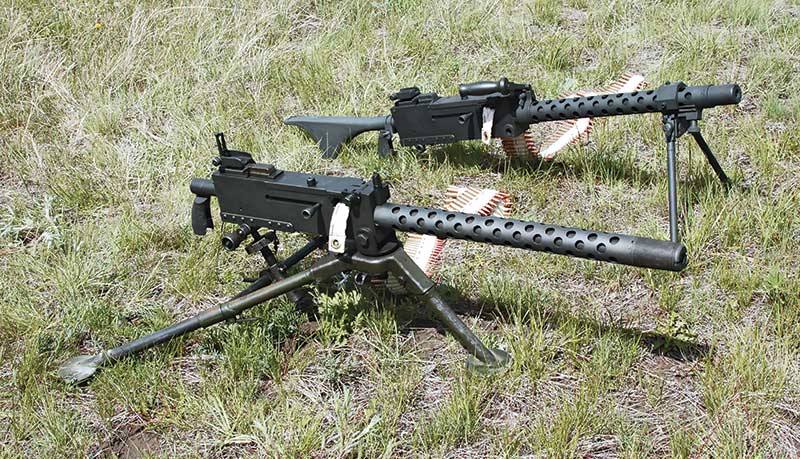
The LMG in the rear is the US Model 1919A6 with buttstock, weighing 32 pounds.
In the foreground is US Model 1919A4, which was sometimes termed an LMG and
sometimes a “medium” machine gun.
In regards to infantry combat, World War II belonged to the light machine gun (LMG). They were used by all combatant nations. If a country didn’t have the manufacturing capability to produce their own (i.e. Finland) they captured them from any adversary who did (i.e. the Soviet Union).
LMG’s, however, did not make their debut in WWII. The British adopted the American-designed Lewis Gun and issued them by the thousands in World War I. Then the French had their Chauchat, which retains a notorious reputation for unreliable functioning even now, a full century later. Ironically, for WWI combat, the US Army declined to adopt the superior Lewis Gun and instead saddled troops with the French invention.
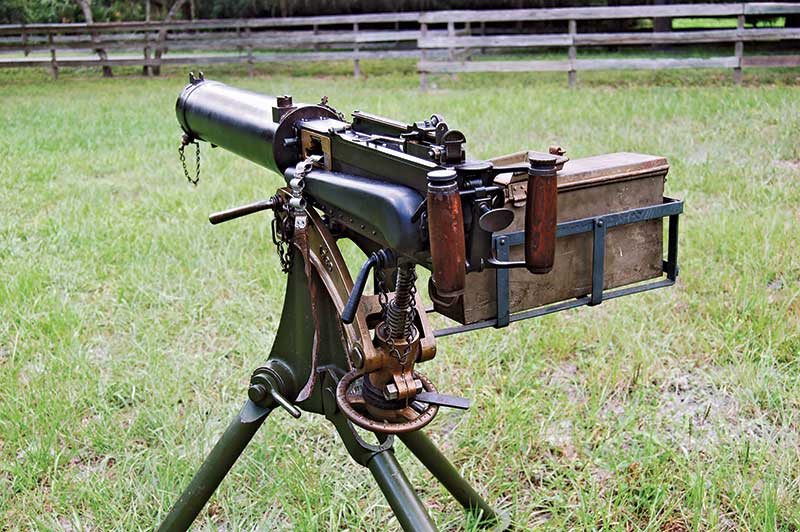
Heavy machine guns of WWII were mostly water cooled and much heavier than LMG’s.
A Weighty Question
Essentially, there were two types of machine guns used in WWII. They were heavy or light. The HMG was mostly relegated to defensive roles, such as dug-in emplacements, anti-aircraft positions, or solidly constructed bunkers. Usually, they were fired from tripods, with the legs (preferably) sandbagged in. LMG’s were designed to flow with the troops up hill and dale.
Mostly they had bipods and were intended for prone firing, although when hung over the gunners’ shoulders by heavy-duty slings, they could be used for “marching fire.”
One factor should be stressed. When talking about WWII LMG’s, the term “light” is relative. In this day and age, when light carbines and “mountain rifles” are all the rage, no one would ever consider a WWII LMG as being easy to carry—most of them weighed at least 20 pounds. The Lewis Gun—still in common use during WWII by many nations—weighed about 28 pounds. To the best of my knowledge, the American Model 1919A6 was the heaviest of LMG used in the early 1940’s. It weighed 32 pounds.
Speaking of the Lewis Gun, I’d like to add this note. After WWI ended, the Brits were uncharacteristically intelligent about their war weapons. They put many thousands of .303 Lewis Guns in storage when they adopted the soon-to-be-famous BREN Gun in 1938. But after the Wehrmacht ran the British Army off the European continent in 1940, most of the BREN Guns stayed behind. Therefore, having a backup in the same caliber was most fortuitous for the British.
If one factor can be pinpointed as being common to all WWII LMG’s, it’s that they were air-cooled. HMG’s, such as the US Browning Model 1917 or British Vickers, were generally water cooled, meaning when on the move, a crewmember also had to carry water to fill the jacket surrounding the barrel.
The manner of feeding ammunition into the various LMG’s is by no means uniform. For instance, the Lewis Gun and Soviet Degtyarev used round drums or “pans” atop the action. Interestingly, both guns’ drums were of 47-round capacity. The British BREN and Japanese Nambu LMG used top-feeding 30-round magazines. Because they must be inserted directly atop the action, sights are then offset to the left. The American Browning M1919A6 used either cloth belts or metal links. Both the German MG34 and MG42 could fire belted ammunition, but the former could also be fed from 75-round drums.

Japan’s Type 99 LMG 7.7 is easily discerned from the very similar
Type 96 6.5 because it has a flared flash hider. Note the bayonet!
The carbine is a Type 44 in 6.5.
Mostly Odd
Japanese designed firearms tend to seem odd to American eyes, and in many ways they truly are. For instance, instead of a belt or magazine feed system, their 6.5mm Type 11 had a hopper into which regular 5-round stripper clips were dumped.
Furthermore, the cartridges were oiled as they were fed into the chamber. The oiling feature was carried over into their Type 96 6.5, but dropped with the 7.7 Type 99.
World War II LMG’s were meant to be shoulder fired—usually but not always. The gunner lay behind the gun and put the buttstock to his shoulder. His job was to shoot. His assistant gunner fed magazines or belts to the weapon. Some accessories meant for LMG’s sound odd nowadays. Germany and Japan issued telescopic sights for their later model MG42 and Type 99. Another odd facet of Japanese LMG’s is the Type 99 had a bayonet lug and bayonet. However, it would seem very difficult for a soldier to do any bayonet fighting with the blade fitted to the end of a 20-pound LMG!

Duke’s other WWII LMG is also of Japanese origin. It’s a
Type 92 7.7x56R, which was only issued to the Japanese Navy.
Need For Speed
Comparing cyclic rates of fire of LMG’s is fascinating. Germans like them fast. Their MG34 was rated at 800 to 900 rounds per minute, and they increased matters with the MG42 to hit 1,200 rpm. So far, I have never fired an MG34, but I’ve fired the MG42 from both bipod and quad-pod. It is an awesome experience. Muzzle blasts from individual rounds can’t be discerned. The sound is just a continuous roar. Of course, such a cyclic rate heats up barrels quickly, so the MG42’s barrel can be switched out in seconds.
On the other end of the spectrum is the US Model 1919A6 with a rate of 500 rpm. Its muzzle report is just a rhythmic chug-chug-chug.
Japan’s Type 96 6.5 and Type 99 7.7 are almost visually identical, except the latter has a flared flash hider and the former does not. Still, somewhere in the three years between each weapon’s development (1936-1939), the Japanese military decided to up the cyclic rate. The Type 96 is rated at 550 rpm but the Type 99 is 850 rpm.
As is the case with the German MG42, Japan’s Type 99 barrels can be switched out in seconds. The very obvious handle on the barrel is actually more for facilitating the switch than for actual field carry. The BREN Gun and Soviet Degtyarev, incidentally, are both rated at about 500 rpm.
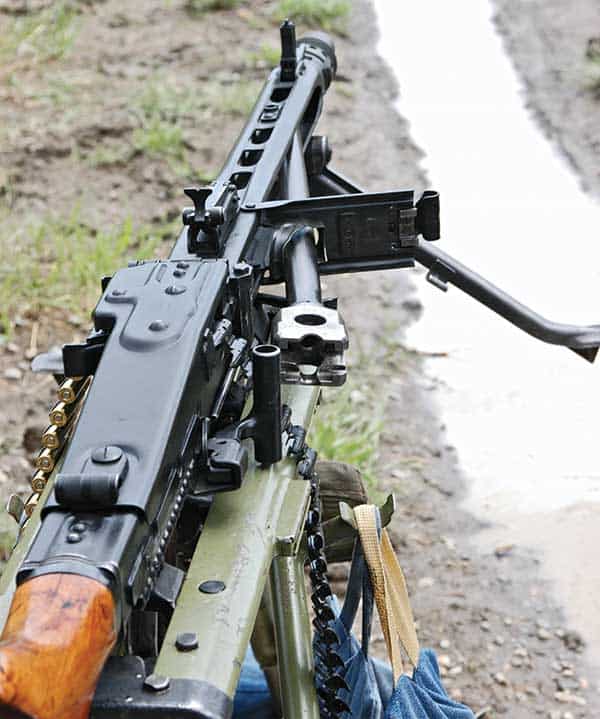
Germany’s MG42 barrels could be switched out in seconds. Considering the gun’s blistering cyclic rate, that particular feature was pretty much mandatory!
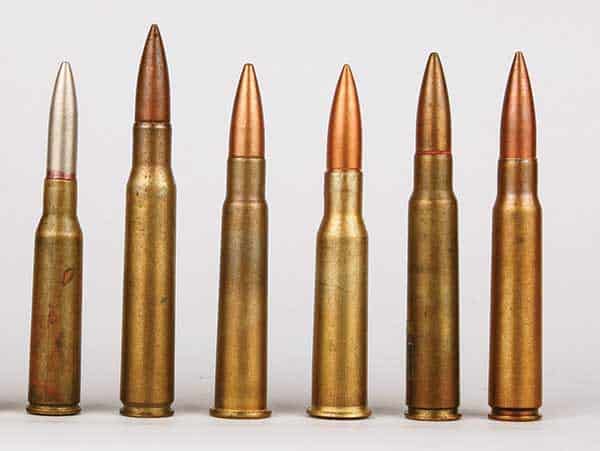
Most WWII LMG’s were chambered for (from left) 6.5 Japanese, .30-06,
.303 British (aka 7.7x56R Japanese), 7.62x54R Russian, 7.7x58 Japanese
and Germany’s famed 7.92x57.
Calibers & Cases
Let’s look at LMG cartridges for a moment. Of course, the United States’ Browning Model 1919A6 fired .30-06. Britain used their long-serving .303. Japan had three LMG rounds: 6.5×52, 7.7x56R and 7.7×58. Germany was stuck on the 7.92×57 (8mm Mauser in American terms). And the Soviets used 7.62x54R.
All were full-size rifle cartridges, with the Japanese 6.5 being the least potent with (approximately) a 140-grain spitzer at 2,500 fps. Germany’s was the most powerful, with a 198-grain bullet at over 2,500 fps. Germany fielded many loads for their 7.92×57, but the 198-grain is most often mentioned in reference books. Some of their ammunition boxes were stamped with a red “MG” meaning they were intended for machine guns, only to be fired from rifles in a pinch.
What’s surprising is the shape and case-head designs of these LMG cartridges. The 6.5 Japanese is semi-rimmed. British .303, Japanese 7.7x56R and Soviet 7.62x54R are fully rimmed. Our .30-06, Japan’s 7.7×58 and Germany’s 7.92×57 all use the same rimless case head. Here is one last conundrum. The British .303 and Japanese 7.7×56 are exactly the same cartridge—just with different names.

Because the British lost so many BREN guns during the Dunkirk evacuation in May 1940, they returned to the Lewis LMG for use in the Pacific/Asia Theater (left) and North Africa (below).
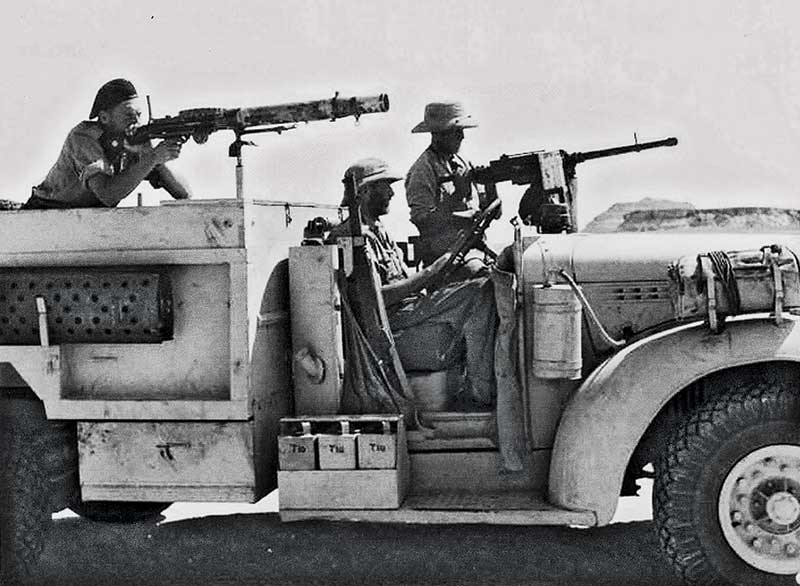
Theater (left) and North Africa (below).
Having A Blast
Now for some personal opinions—they’re only opinions because I am certainly no machine gun expert.
First off, the German MG42 was indeed a frightful weapon with its awesome sound and rate of fire. I’ve shot a friend’s from both bipod and quad-pod. From a bipod, it was very difficult to shoot with accuracy. Let’s consider, say, a single 10- or 12-round burst (which is about the least you’ll get with a press of the trigger). From the bipod, they would string about 20 feet laterally, so it is easy to believe American GI’s who claimed to have been caught in an MG42 burst that holed their clothes but didn’t wound them. Conversely, when that thing is sandbagged in, the same burst would land right where aimed to deadly effect.
Think of it this way: On my 100-yard range, the burst from a Browning M1919A4 would hit my 50-pound steel target with a thunk-thunk-thunk, but the target stood there and took it. A burst from the MG42 turned it over every time.
The Japanese Type 99 is just a little less scary but far more controllable from a bipod. Just last week, I let 12-year-old Wes Spratling fire it on a silhouette range. With a little familiarization, he was hitting 300-meter pig silhouettes with short bursts. For those who wonder, my PACT Model IV timer counted the MG42 as having a 1,142-rpm rate using military surplus Yugoslavian 7.92×57 ammo. The Japanese Type 99 7.7 came in a 794 rpm with Norma 7.7 Japanese factory loads.
A few years back, I had never fired a WWII-vintage LMG. Now I own two (both Japanese)—the Type 99 and a Type 92 Lewis Gun, which was actually only adopted by the Imperial Japanese Navy. LMG’s are now referred to as Squad Automatic Weapons (SAW) in American parlance.
It may be a different name, but the purpose remains the same.