I’m Really Into Leather…
Fortunately, So Are Three Examples of Today’s Craftsmen

Anybody can build a holster, but a select few can create a masterpiece.
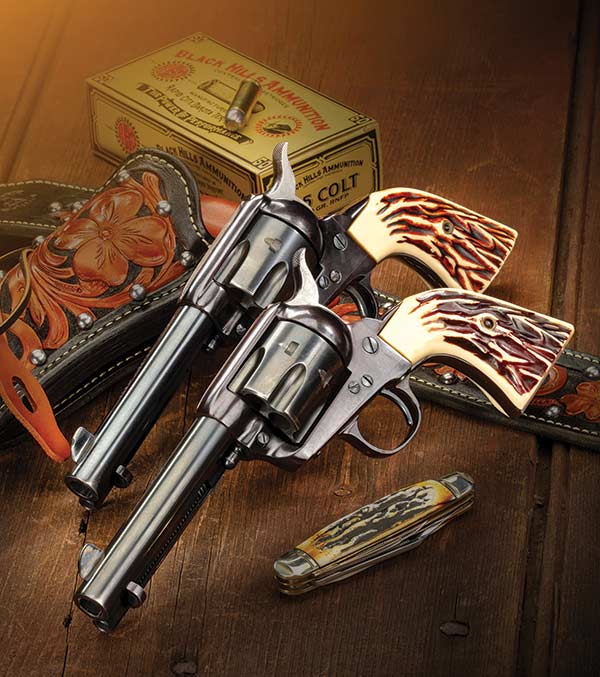
Among the best is Mike “Doc” Barranti, whose handiwork is staring at you.
Photo: Barranti Leath
If Insider readers haven’t figured it out by now, your humble correspondent is a leather freak…in a good way.
Cartridge belts, rifle slings, rifle scabbards and — especially holsters. I spent more than 20 years doing essentially one-at-a-time orders for a small but faithful clientele. However, having hung up my leather tools, I can now simply drool over the genuine artwork one finds from today’s true craftsmen. And for this Insider installment, I had the good fortune — nay, call it a “distinct honor” — to recently interview three guys who, in my humble opinion, best represent what is a true art form from a relatively small fraternity of leather craftsmen.
If you want to write about art, you’ve got to talk to the artists, and they are few and far between. Nobody finds a John Bianchi on every street corner. Milt Sparks and Bruce Nelson are gone. Lucky for us, there are still some folks who are devoted to the same things they were: quality, functionality and longevity of their products. And most important of all, they genuinely love what they do. Trust me on this, I know the feeling.
What motivates these masters of the magnificent? Let’s find out.
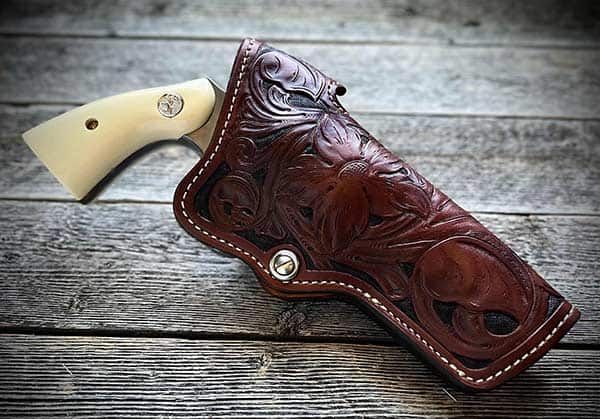
Instead of slapping Doc Barranti’s leather, you just might want to
gently caress it. While good leatherwork is pure eye candy, it’s also
fully functional and designed to last a lifetime. Photo: Barranti Leather
Mike “Doc” Barranti
My late dad used to say, “That guy does such good work, it scares me.” This observation could easily apply to Mike “Doc” Barranti, especially holsters bearing his floral leather tooling. It is superb.
Since I was a kid in junior high school shop class, where I first got the leather bug, tooled leather has fascinated me. On a planet with hundreds of millions of people, there are a relative handful who do this well, and Doc Barranti is definitely one of ‘em. His company, Barranti Leather, is widely known by word-of-mouth, which is no small accomplishment.
While his company has been around long enough for Barranti to have a good crew of talented employees, Doc confessed he does the floral tooling himself. Photos of his work on social media can prompt gasps. His favorite class in high school was art, and judging from the products he now creates, the art thing was a gift.
“The leather thing goes way back,” he said. “I was doing leather stuff for my toys when I was a little kid.”
As he grew older, he subsequently made holsters for his BB guns, and when he started acquiring black powder handguns, he recalls, “I needed a way to carry those around, too!”
On his website, Barranti relates these memories, noting how his childhood television heroes all had great guns and leather, and he dreamed of one day having his own. Some of his earliest rigs were built from “whatever material I could find,” which included the tops of old cowboy boots, a ’la Skeeter Skelton. Early on, he would buy leather from Tandy and build his first holsters on the kitchen table.
Barranti hails from Pennsylvania, and his shop in the beginning was a corner in the basement. He had two “little” benches, a stitcher and a total work space of about 200 square feet. When he relocated to Snyder, Texas — a small town “about 90 minutes south of Lubbock and west of Sweetwater” — Barranti built a full-sized shop. He and his five employees now work in a 1,200 square-foot building.
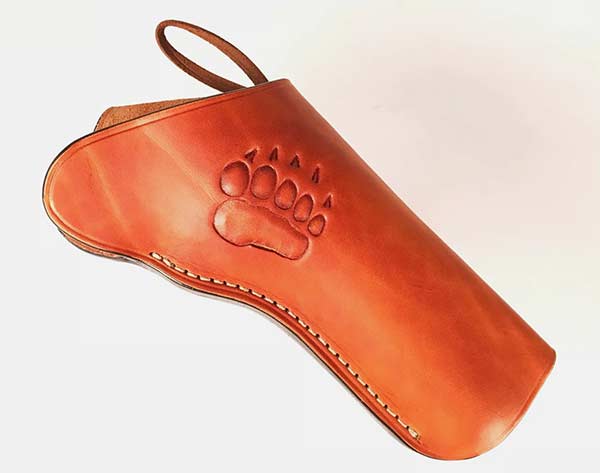
Even without fancy floral carving, a Barranti holster —
this one is a cross draw — is a handsome accessory
for any handgunner. Photo: Barranti Leather
Being from Pennsylvania, Doc knew Jeff “Tank” Hoover (ever notice how these guys all have nicknames?) whom he credited with “pestering” him to show off his work on Facebook and he’s gained a devoted following.
He discovered something after moving to Texas. He’s gotten more business from people in the East, including Pennsylvania, than when he was based there. Maybe some people think good leather only comes from west of the Mississippi.
Next year will mark the 40th anniversary of Barranti Leather and the 14th year he’s been doing it full time. In the beginning, his leather work was “just a side deal, making leather for myself and a few others.” I’ve heard the same from other holster builders, and it was my personal experience as well.
“I went full time in 2012,” he recalled, “and at the time I had about a two-year backlog of orders.”
In 2020, his wife Michelle joined him full time in the business. It has been something of a family affair for quite some time. His son and brother-in-law have also worked with him, and like any small business operation, his crew is like family.
Barranti says revolvers have always represented the majority of the guns for which he builds holsters. His models range from Threepersons-type belt holsters to rough-out “Summer Classic” models, including one for single-action sixguns. Finishes run from plain to elaborate floral. In between, you’ll see border stamping with or without a hammered background, and traditional basketweave or fish scale.
Tooling, he says, “adds a touch of class.” Indeed!
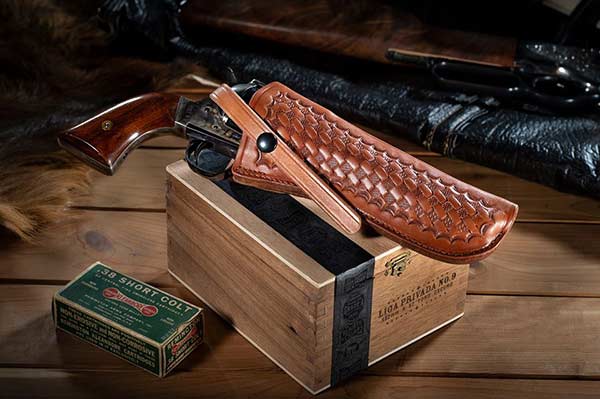
Rob Leahy’s Simply Rugged Holsters typify the kind of leather
discerning outdoorsmen and women warm up to.
Photo: Simply Rugged Holsters
Rob Leahy
The proprietor at Simply Rugged Holsters, Rob Leahy is a fellow with a marvelous future, not only as a holster maker but if his hair ever gets snowy white, he’ll make a great holiday Santa. It’s his physical build and the beard, and definitely his friendly voice.
Leahy’s sense of humor is enough to win friends. When I jokingly threatened to scrawl his cellphone number on the wall of a rest stop along I-90, he quickly fired back, “It’s already there!” How can you not immediately like this guy?
All kidding aside, Leahy is a craftsman’s craftsman, and he speaks highly of others in the trade. Life lesson: Competitors can also be pals.
He’s another guy who got turned onto leather work in his youth: 9th grade shop class at Chino Valley High School.
“On Fridays,” he recalled, “we could do leather work, woodwork, metal…I had a knife that came with no pouch. I noticed a lot of guys had pouches.” So, he built his own.
His shop teacher showed Rob how to dye and stitch leather, and the lessons stuck. He would work with leather while in the military, and he started building pocket holsters for instructors.
“I tried banking for a while,” he acknowledged about a wrong career choice, adding with a chuckle, “Rob Leahy and corporate America didn’t get along.”
So, he decided to start a business, and called it “Simply Rugged,” and his products live up to their brand. He recalled how his wife, Jan observed, “You have all this gun knowledge. Make it pay.” This was a bit of common sense from a lady who, Rob recalled, “got her first deer when she was six months’ pregnant.”
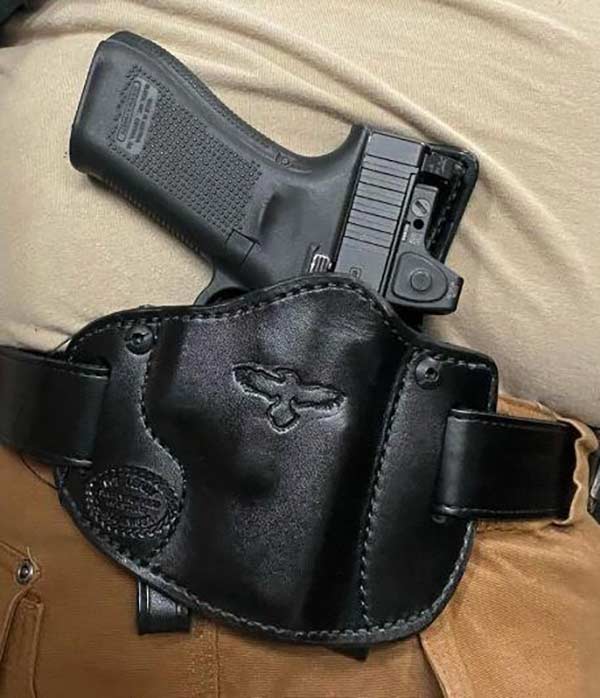
Rob and corporate America didn’t get along, but Leahy and leather
have formed a lasting relationship. Photo: Simply Rugged Holsters
For Rob Leahy, like Doc Barranti, holster building was a hobby that became a business, fueled by a passion which became a lifestyle. “I like that my wife has integrated into this lifestyle,” he proudly says.
Simply Rugged has become something of a family affair, with son Jake working with him since 2012, after having worked for another well-known holster builder in Alaska.
What Leahy and Simply Rugged are probably best known for is the continuation of the “Pancake” holster, a design created by the late Roy Baker. Leahy has turned this rig into an artform with models sized to fit all kinds of guns from small to big, round or flat.
The company launched in 2004 in Leahy’s kitchen and living room after the family moved to Alaska. As noted on the Simply Rugged website, “After a very successful season of making holsters in our small living space, the operation was moved into a 10′ X 12′ building in our very small Alaskan backyard, complete with moose traveling through. We soon outgrew that space and the business became housed in our two car garage.”
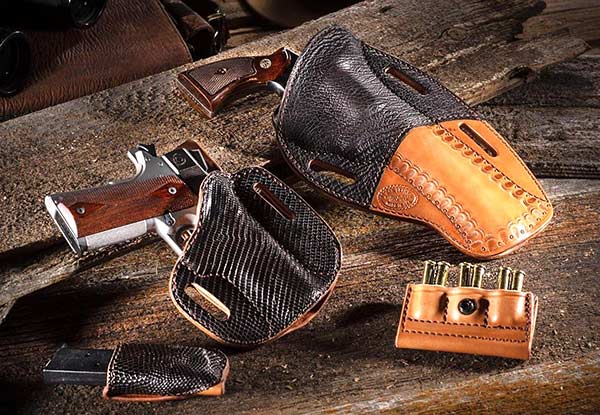
Simply Rugged is perhaps best known for continuing a classic
design based on the original Pancake Holster from the late Roy Baker.
Photo: Simply Rugged Holsters.
In 2009, the Leahy’s returned to the Lower 48, settling back in Yavapai County, Arizona. He says his place is located “halfway between the Ruger plant and Gunsite.” Yeah, we should all be centrally located like that, eh?
With a crew of nine, Rob’s ethic is to produce the very best leather holsters possible. While stamping is done in-house, Rob has the more elaborate floral carving done by Richard Gittlien in Alaska. The arrangement is working very well and he considers Gittlien a “true artisan.”
He has a principle: “I have always tried to tell my people if we make a mistake, own it and fix it.”
Nowadays, Simply Rugged is housed in a 1,600 square-foot building and Leahy acknowledged he may need even more space in the future. He estimated the company has produced somewhere in the neighborhood of 150,000 holsters and Leahy is proud of the fact that he has many repeat customers, including some who have become good personal friends.
As with Barranti, word-of-mouth has proven to be a major plus.
“I enjoy the customers and doing this for a living,” Rob says unabashedly. Pretty hard to argue with that!

Leather just looks good, and when one combines style with function,
you’ve got something that looks good and works better.
Photo: Mitch Rosen
Mitch Rosen
Mitch Rosen Extraordinary Gunleather epitomizes what we consider “high end” leather gear.
Based in New Hampshire, Mitch Rosen Extraordinary Gunleather produces truly top-line leather holsters. Mitch, who was recovering from a bit of surgery when we spoke, has a familiar history.
He started with his father, who made ladies’ handbags. They were “very well-made,” he recalled and they sold “all over the country.” Back in the late 1960s, when this started, the intention was to produce handbags to match the color of women’s shoes, which was smart marketing and the handbags were actually made from vinyl material.
But Mitch wanted to make high-end leather products, an idea with which dad didn’t agree.
“I left to become a stock broker,” he recalled. “I did that for ten years and then I got into shooting, which was odd in New York because it is hard to get a permit.” But he managed to get a permit, then a handgun, and then a holster. It was then he decided to start building his own line of holsters, “on the porch of an older home we were renting.”
He rented a stitching machine, with the notion of making “high end” rigs on the same principle as building handbags to match high-end shoes from a decade before: make the best products possible. He started building concealment holsters in September 1991.
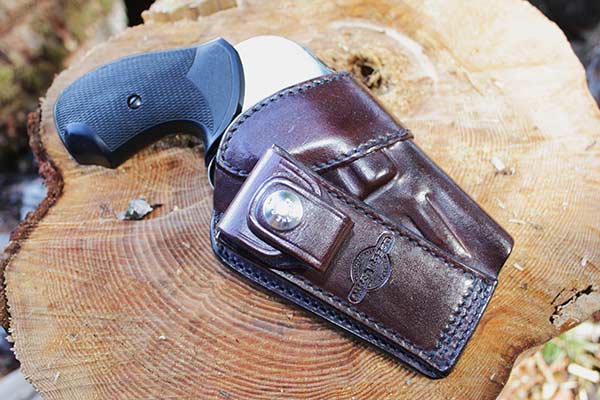
Rosen’s original “tuckable” holster is called ‘The Workman,’
based on an original design by author Dave Workman.
It has been copied by a lot of people.
“It was a big learning process for me,” he said. “I was not making the product just for the sake of selling something.”
Thus was born his company’s motto: “NO GIMMICKS: Simply extraordinary fit, finish and function.”
From Rosen’s website comes this look into his work ethic: “After purchasing several holsters and belts from what were considered the best manufacturers, I was left surprised and disappointed. With one or two exceptions, the products were clearly subpar. Having many years of manufacturing experience, I decided to craft a superior product line. We were copied immediately by both large holster mills and small shops alike and our customer base grew exponentially. This would certainly prove my mission to be successful.”
Rosen is a maestro. He says without hesitation, “Nothing goes out unless it’s right. We don’t have ‘seconds.’ If it isn’t right, it doesn’t go out.” You’ll find this a common sentiment among people who sell products bearing their names.
Over the years, Mitch has endeavored not only to produce good holsters, he also has tried to educate people about this special trade.
“An educated consumer is our best customer,” he explains. “You just don’t skip any steps, ever. If there’s an additional step that improves it, do it… It’s attention to detail. Do not skip any steps.”
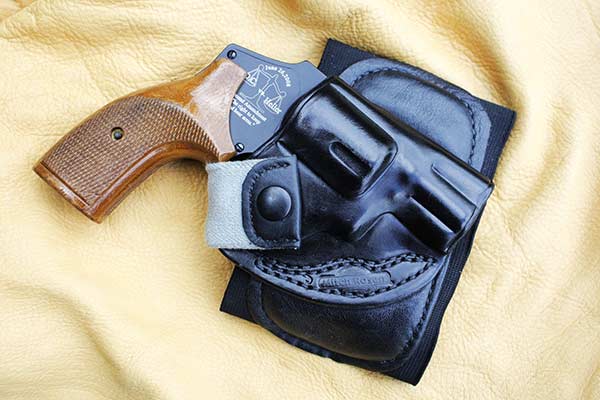
Gene Hackman’s “Popeye Doyle” made ankle holsters famous in
‘The French Connection.” Rosen’s rendition is called “Duncan’s Ankle.”
Dave photographed this particular specimen holding his J-frame
Model 442 Smith & Wesson.
If that sounds like the remark of a perfectionist, you just got educated about holsters, and the people who make them.
The past 36 years since Mitch Rosen started his holster company have seen many changes in the handgun scene, but the one constant has been the necessity of having a holster which fits the gun. This is not the arena for one-size-fits-all, he noted. Indeed, most serious handgunners of my acquaintance have more than one holster for their sidearms. This fact has helped Rosen and others, including Leahy and Barranti, build faithful customer bases.
Mitch has noticed a returning popularity of revolvers. Maybe it’s a cyclic phenomenon.
“I like revolvers, also,” he confessed. “I wear (it) or have it with me all the time.”
He subsequently sent an email pointing to advertising by Lipsey’s introducing two new versions of the Smith & Wesson Mountain Gun, in .22 LR and 10mm, which he suggested could be a component of the revolver resurrection.
“And that’s great,” he declared, “We’re in the process of introducing an IWB revolver rig. I’ve been wearing it for a few weeks…and it is excellent.”
What’s on the horizon for these guys and their craftsman colleagues? Recent years have seen the introduction of different holster materials and styles but it is not likely that quality leather gear — whoever makes it — will ever lose its luster or popularity. When people want the best, they will gravitate toward the brands which best represent their personal definition of “best.”
My guess is those rigs will be made from quality vegetable-tanned leather.